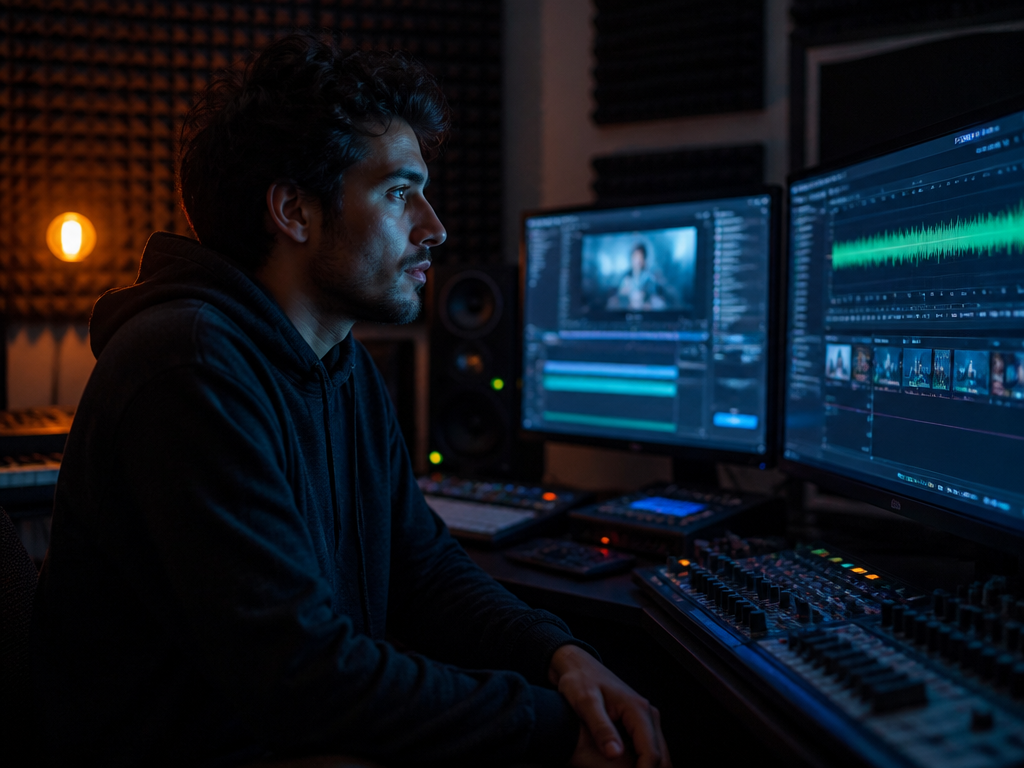
Last month a client asked for forty minutes of loopable underscore for a cyberpunk level, and I typed Detroit techno, 130 BPM, hypnotic, analog into a prompt box because that is what the brief sounded like in my head. The render came back clean. Kick on every quarter. Closed hat parked dead center on the eighths. A sawtooth stab with a filter that opened across sixteen bars and closed across sixteen more, sidechained to the kick with the pumping you get from a factory preset. Nothing was wrong with it. Nothing was in it either.
I bounced it, dropped it under the level, and it worked. Then I sat with the uncomfortable part, which is a question I suspect you have asked yourself in the same posture at the same hour: when I put the name of a city into a prompt, what am I actually asking for?
There are three questions stacked inside that one, and they have different answers. What am I legally taking. What am I sonically getting. What am I standing on when I type it. I'll take them in that order, because the first is what's blocking your ship date and the third is what will still be bothering you in a year.
Is it legal to generate music "in the style of" a genre?
Genre and style are not what copyright protects. Copyright attaches to a specific recording and a specific underlying composition — a melody, a lyric, a fixed arrangement. It does not attach to a tempo, a drum machine, a swing setting, or a regional idiom. That is why thousands of records have chased the Metroplex sound for four decades without a single style-infringement case reshaping the genre. Naming a scene in a prompt is not the same act as sampling a record from it, and the two carry different exposure. That's a description of how this has generally worked, not a promise about your project; if the budget is large enough that a takedown would hurt, pay a lawyer to look at it.
The risk that actually applies to you sits somewhere else: in the terms of the platform that made your file. That's where your right to ship lives, and those terms vary more than people assume. Before a render goes into anything commercial, know four things — whether commercial use is granted on the tier you're actually paying for, whether those rights survive cancelling the subscription, whether the platform indemnifies you if a claim arrives, and whether the same output could be generated for somebody else next week. The last one matters less for a game bed and a great deal for a podcast theme you plan to be known by.
Above all of that sits the unresolved question of what the models trained on and whether that training was licensed. As of writing, that is live litigation, it is not settled, and it will not be settled by you or by your deadline. The practical hedge is boring and effective: know which tool produced which file, keep the terms you agreed to at the time, and keep the render logs. If the ground shifts, you want to be the person who can answer questions about their own library.
What the words actually name
Here is the part the licensing answer skips.
Juan Atkins and Rick Davis put out "Alleys of Your Mind" as Cybotron in 1981 and "Clear" in 1983. Metroplex, Transmat, and KMS followed across the mid-eighties — Atkins, Derrick May, Kevin Saunderson running their own labels because the alternative was not running anything. A British compilation in 1988 attached the word "techno" to the export version of the sound and the name stuck to the city. Underground Resistance came together at the turn of the nineties with an explicitly anti-corporate posture, and the Submerge building on East Grand Boulevard became distribution, record shop, and eventually a small museum, which is a stack of functions no genre gets unless somebody decides to build them by hand. The festival at Hart Plaza has run since 2000.
None of that is decoration. It's the answer to why the records sound the way they do. The gear was cheap because it was used and unfashionable — 909s and 303s were secondhand failures before they were canon. The mixes are dry and hard because they were made in bedrooms and small rooms and cut for systems, not for streaming loudness targets. The mythology in Drexciya's catalog and the militancy in UR's sleeves exist because the people making these records were making something about where they lived, in a city that the rest of the country had written off in print.
So when you type the phrase, you are not naming a preset. You are naming a set of decisions people made under specific conditions, some of them still alive and touring, some of them gone. That's not a reason to stop typing it. It's a reason to know what you're pointing at.
Why your render came back flat
The technical diagnosis is more useful than the moral one, and it's where the two overlap.
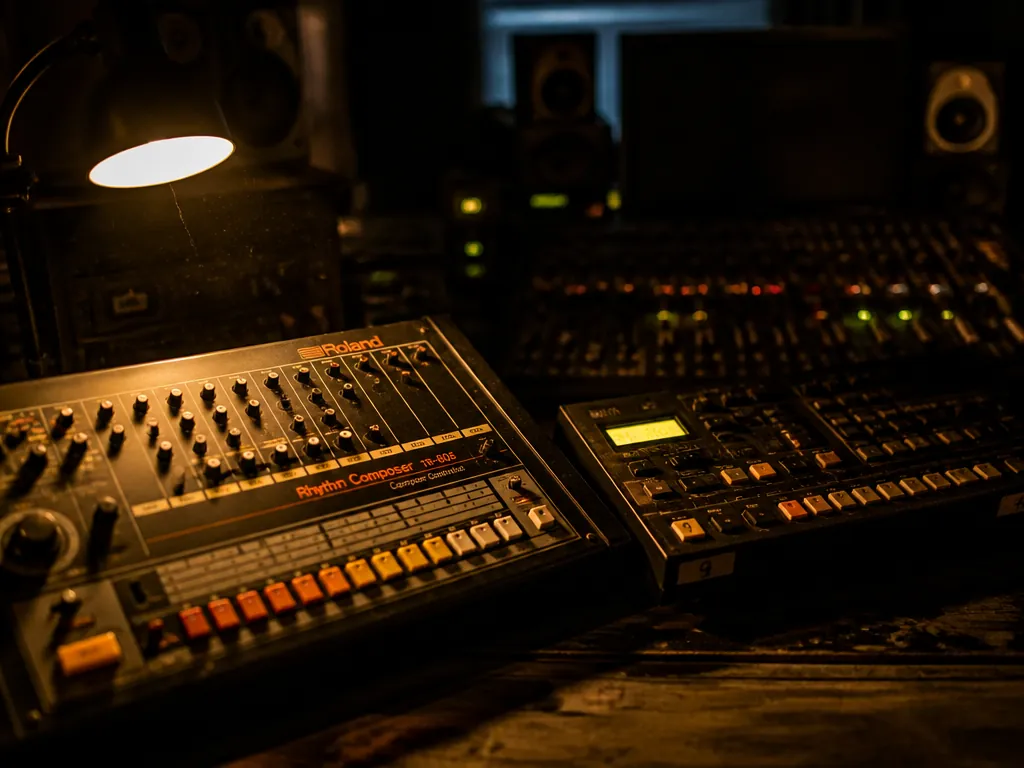
The models have heard a great deal of music filed under "techno," and most of that filing is recent, loud, and European. Ask for a genre and you get the centroid of everything wearing that label — which in practice means the modern festival version, mastered hot, with the low end doing the work. The originals sit off that centroid in ways that are specific enough to list:
- Shuffle. A lot of the Detroit catalog is not on the grid. The 909's shuffle setting, or a hand-pushed hat sitting a few milliseconds late, is a large part of why those records breathe. Generated output tends to quantize hard, because averaged training data averages out timing feel.
- Velocity on the hats. Sixteenth-note hats with a rolling accent pattern read as a performance. Flat sixteenths read as a metronome. You can hear the difference in three seconds and it is difficult to prompt for.
- Withholding. "Strings of Life" spends a long time refusing to give you a kick. Models are optimized to sound good immediately in a short preview, which is the opposite instinct.
- Empty midrange. Those mixes leave holes. Generated mixes fill everything, because dense output scores as "produced."
- One take. A filter move that a human tweaked live across eight bars has irregularity in it. A rendered sweep is a line.
Some renders beat this. I've had two or three come back with genuine weirdness in them and I could not tell you which clause in the prompt caused it. Prompt roulette is real, and anyone selling you a deterministic relationship between adjectives and output is selling. Budget for the roll: generate more than you need, keep the two that have something, delete the rest without sentiment.
What the models are good at on a Friday deadline
I want to be straight about this, because the piece is not an argument against the tools. I use them weekly.
Generative audio is genuinely good at beds — the four-bar and eight-bar loop that has to sit under dialogue, under a hallway walk, under a title card, and never pull focus. It is good at volume: forty variations of a mood at 128 BPM in an afternoon is not a thing you can do by hand. It's good at stems, where the platform gives them, because stems are what make a loop usable in a game engine — you can duck the lead layer when the player enters combat and keep the pulse running, which is the whole trick of adaptive audio and requires nothing more exotic than separate files. And it's good at the tempo-and-key housekeeping that used to eat an hour: ask for 128 BPM in F minor, get 128 BPM in F minor, drop it in without warping.
It is not good at the thing that is supposed to be yours. The eight bars where the track turns and the listener leans in — that's arrangement, that's a decision, and models do not have the taste to know which bar earns it. It is not good at vocals with intent behind them. And it is not good at being the sound people associate with you, because your competitor typed something similar last Tuesday.
Where the answer becomes "it depends"
Three scenarios I've actually been in, with three different honest answers.
You're scoring a level and the brief says "gritty, industrial, futuristic city." Generate it. Nobody's rights are implicated, the function is atmosphere, and the reference to Detroit in your head was shorthand for a feeling. Drop the city name from the prompt and describe the feeling instead — you will get a better result, for reasons in the next section. This is the easy case and it's most of the work.
You're cutting a documentary, a podcast episode, or a museum piece that is about Detroit, or about this music. Don't generate it. Not because a rule forbids it, but because it will be bad. A synthetic approximation under footage of the actual place is a statement about how much the subject was worth to you, and viewers who know the catalog will hear it immediately. The real records are licensable. The labels are still operating, the rights are mostly held by the people who made them or their estates, and sync fees for catalog like this are frequently within reach of a serious independent budget. Ask. The worst outcome is a number you can't afford, and then you commission a Detroit producer instead, which is a better film anyway.
You're learning the idiom. Here the answer splits. Using a generator as a sketchpad — block out a groove, hear the arrangement shape, decide if the idea holds — is a legitimate use and faster than programming a full arrangement to find out it's boring. Using it as a substitute for listening is where you stall out, because the model's version of this music is the flattened version, and if that's your reference you will produce a copy of a copy. Go buy four records. Program the hats by hand once. You'll hear what the prompt was missing, and after that your prompts get better.
Prompt the function, not the city
The practical upgrade is small: replace lineage words with sound words. A city name gives the model a fuzzy average. A description gives it constraints, and constraints are what produce something with edges.
| Instead of | Try |
|---|---|
| "Detroit techno" | "dry drum machine kick, shuffled hats, no reverb on the drums, 128 BPM" |
| "like Underground Resistance" | "militant, minor key, brass-like synth lead over a rolling bassline" |
| "classic techno strings" | "detuned string pad, slow attack, played in inversions, sits above the bass" |
| "hypnotic" | "one four-bar loop, single filter movement, no drop" |
Here's a prompt I actually use as a starting point for underscore work, with the reasoning attached:
126 BPM, F minor, dry analog drum machine with shuffled hi-hats,
detuned string pad in the upper register, single-note bassline,
no vocals, no risers, no drop, minimal reverb on the drums,
mix leaves space in the midrange, loops cleanly at 8 bars
126 and F minor because I need it to sit with the rest of the cue sheet. Shuffled because that one word is the difference between breathing and marching. No risers, no drop because generated arrangements default to EDM structure and I need underscore, not a build. Leaves space in the midrange because dialogue lives there. Loops cleanly at 8 bars because the engine will loop it whether the render agrees or not.
That prompt will not give you a Transmat record. It gives you something with a shape you chose, which is the realistic goal.
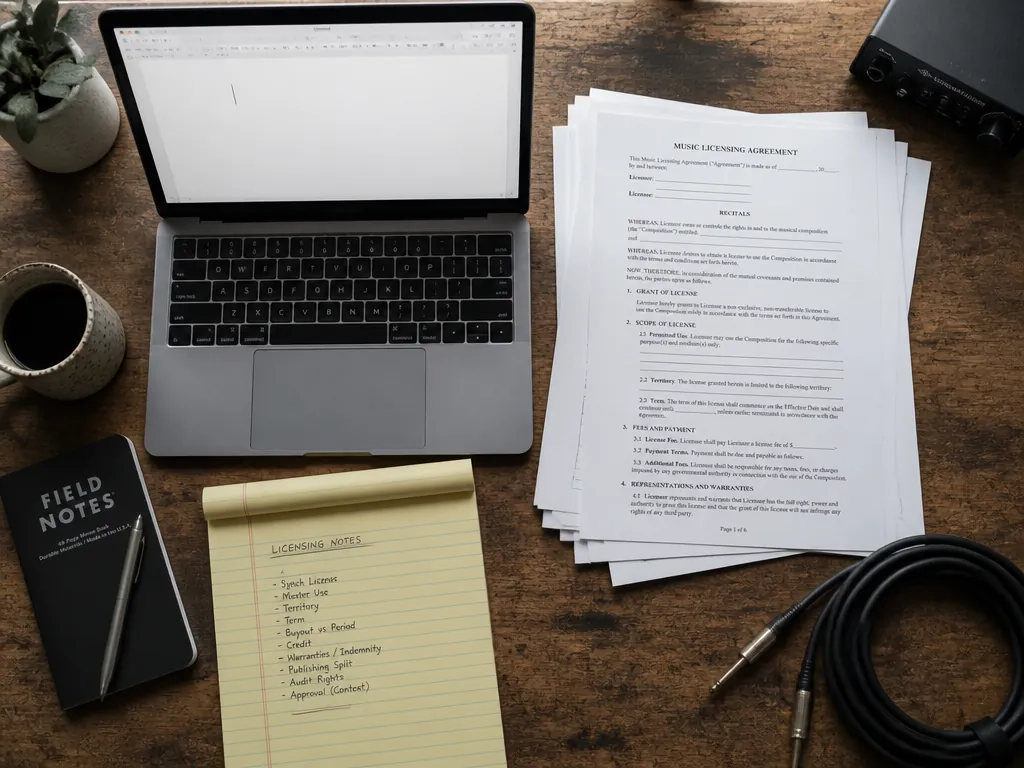
The five-line license check before you ship
Run this once per project, not once per file. It takes about four minutes.
- Tier check. Confirm commercial use is granted on the plan you're on right now, not the plan on the pricing page's top row.
- Survival check. Confirm whether your rights to already-generated tracks continue after you cancel. Some terms grant a perpetual license to what you made while subscribed; some are murkier. Screenshot the clause.
- Claim check. Confirm whether the platform registers its own catalog with content-matching systems. Systems like Content ID match against reference recordings, not against genre or style — but if a platform has registered outputs, a false claim on your video becomes a support ticket and a delay. Whatever tool you use, this one included, that answer should be documented, not folklore.
- Exclusivity check. For anything that becomes a brand asset — a podcast theme, a channel intro — ask whether the output is exclusive to you. If it isn't, treat it as temporary.
- Receipts. Keep the render, the prompt, the date, and the terms version in the project folder. If you're ever asked to prove provenance, that folder is the answer.
None of this is legal advice and none of it is a guarantee. It's the file hygiene that makes a bad week survivable.
What you can't get from a prompt box
James Stinson died in 2002, and half of what Drexciya meant went with him into interpretation. That's the part of this I don't have a clean answer for.
Every few years the scene loses somebody whose contribution was mostly unwritten — the person who ran the distribution, who cut the plates, who taught three producers how to sequence, who was in the room. When it happens, the statements come from the institutions rather than from press, and what you notice reading them is how much of the history was stored in people rather than in files. The records survive. The reasoning behind them thins.
A model trained on the audio has access to the surface of that and nothing underneath it. It heard the string patch; it did not hear the decision to leave the kick out for ninety seconds because the room needed it. When you prompt for the surface, the surface is what you get, and the flatness you hear in the render is not a technical failure so much as an accurate report of what was available to learn from.
I don't think that means don't use the tools. I use them, this publication is built by people who build them, and pretending otherwise would be posturing. I think it means the phrase in your prompt box is doing work you should be aware of. If the city's name is what makes the prompt feel legitimate to you, that's worth noticing. If it's shorthand for a sound you can describe yourself, replace it and get a better render. And if you're making something about this music rather than something that borrows its clothes, spend the money, license the record, credit the person — the catalog is still for sale and the people who built the distribution built it precisely so that would remain true.
Tonight's rule: if the name of a city is doing the work in your prompt, replace it with the sound you actually want — and if you can't yet describe that sound, that's the night's real assignment.
Not sure which tool to use?
Compare the top AI music and sound tools side by side — honest reviews, real pricing, no sponsorships.