The lawsuits over AI music generation are not, in the main, an attempt to stop it. They are an attempt to price it.
That sounds like cynicism. It is closer to a reading of the paperwork. Read past the outrage paragraphs at the top of a complaint — the ones written for the press release — and into the prayer for relief, the settlement announcements, and the corporate development pages of the same rights holders, and a consistent shape appears. The plaintiffs are not asking a court to make generative audio illegal. They are asking a court to establish that a license was required, so that a license can be sold. The damages figures exist to set the top of that range.
I came to this the slow way. I score indie games and short films for a living, which means I spend most of my week deciding whether a cue I need is worth commissioning, licensing, or building. Two winters ago a client's counsel sent back a delivery with one question attached: can you confirm the provenance of the pads in the second act. I could not, in a way that would survive a follow-up. So I started reading dockets the way I read gear manuals, and the thing that struck me was not the moral argument. It was the arithmetic.
The headline number is an anchor, not an estimate
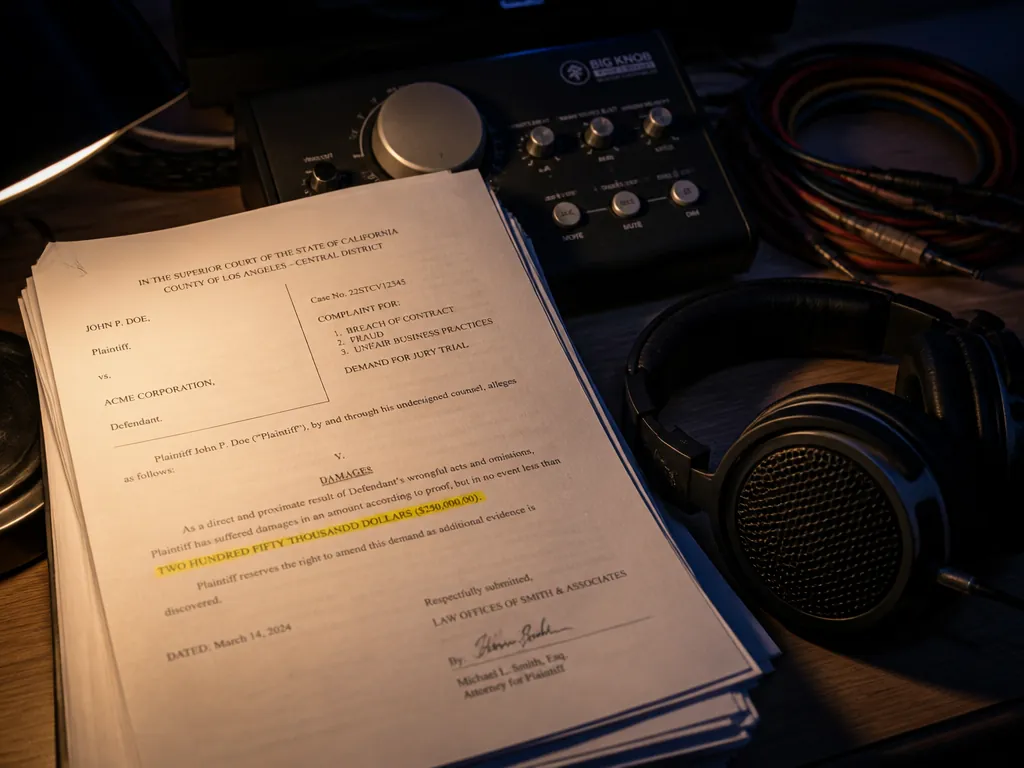
Every one of these complaints leads with a figure large enough to make a headline, and the figure is almost always built the same way: a count of works, multiplied by the statutory maximum.
The statutory scheme is public. Under US copyright law, a plaintiff who elects statutory damages instead of proving actual harm can recover between $750 and $30,000 per work infringed, and up to $150,000 per work where the infringement is found to be willful. Multiply a pleaded list of, say, 30,000 sound recordings by that willful ceiling and you get roughly $4.5 billion. That is the number reporters print.
It is also the number least likely to be paid, and the plaintiffs know it. Four things sit between the arithmetic and a cheque.
The ceiling is a ceiling. $150,000 is the top of a range available for willful conduct, awarded per work at a fact-finder's discretion. The floor is $750. A defendant who documents a good-faith belief in fair use can argue for the reduced innocent-infringement band. The distance between the floor and the ceiling on 30,000 works is a factor of two hundred.
Registration gates the whole election. Statutory damages and attorney's fees are only available for works registered before the infringement began, or within the grace window after publication. Large label catalogues are well-registered; a great deal of other music is not. Any list of works pleaded at scale gets shorter when it meets that requirement.
"Per work" is a fight, not a given. Whether a compilation, an album, or a set of related masters counts as one work or many has consumed a lot of judicial attention over the years, and the difference between those readings can move a demand by an order of magnitude.
And no defendant in this sector can pay the top of the range. A judgment substantially above a company's enterprise value is not a payment; it is a liquidation, and a liquidated defendant distributes cents against secured creditors first. A rights holder recovering pennies on a dead company has traded a growing licensing market for a press release.
So the number's function is structural. It establishes the worst case a defendant must underwrite, which establishes what that defendant will rationally pay to make the worst case go away. Watch what happens to the figure as a case proceeds: it grows. Complaints get amended upward as more works are identified. That is not a forecast being refined. That is leverage compounding on schedule.
Discovery moves these cases; doctrine mostly waits
A complaint pleads what a plaintiff can prove from outside the building. In these disputes that has meant output-side evidence: prompts, run through a commercial service, that produce audio a listener would recognise — the specific horn stab, the specific vocal timbre, the drum break with the same room on it. Exhibits like that are persuasive to a judge and devastating in a news cycle, but they are a sample, not an inventory.
What converts a sample into an inventory is discovery. Ingest logs. Scraping infrastructure and the contracts under it. Deduplication pipelines, which are useful to plaintiffs precisely because they imply someone knew what was in the pile. Internal messages about whether to acquire licenses, which is where willfulness usually lives. And, increasingly, acoustic fingerprinting run against a produced corpus, which turns "a large volume of recorded music" into a spreadsheet with ISRCs in the first column.
Once that spreadsheet exists, the case stops being about theory and starts being about counting — and counting is a settlement input, not a trial input.
This is also why both sides have reason to avoid a verdict. The defendant fears the documents, because internal correspondence about a licensing decision that was considered and declined is the difference between the $30,000 band and the $150,000 band. The plaintiff fears the ruling, because a broad holding that training on lawfully accessed recordings is fair use would not only lose the case, it would collapse the price of every license the plaintiff intends to sell afterwards. Litigation is how the parties establish what each is risking. It is rarely how they intend to finish.
Fair use is a real defence and not the whole fight
Nothing above says the defendants lose on the merits. Fair use is a genuine, four-factor, fact-intensive defence and it applies here with force. But industry conversation tends to compress it into a single word — transformative — and that compression is where a lot of otherwise careful analysis goes wrong.
The Supreme Court's 2023 decision in Andy Warhol Foundation v. Goldsmith re-centred the first factor on the specific use at issue and its purpose relative to the original, rather than on whether the second work felt like a new aesthetic statement. A model that ingests recordings to learn statistical structure is doing something different from a model that emits an output competing in the original's market. Those may be two different uses with two different first-factor answers, arising from the same system.
The fourth factor is where music differs sharply from the text cases, and it is under-discussed. Factor four asks about harm to the market for the work — including the market for licensing it. Generative audio services sell into production music, sync, library, background beds, game loops. That is not an adjacent market to the one recorded music occupies; for a large share of catalogue revenue, it is the same market. A defendant arguing that its outputs do not substitute for the plaintiff's recordings has to make that argument about the exact customer who used to buy a library cue and now types a prompt.
Two further claims tend to travel alongside the headline infringement count, and both are worth more attention than they get.
The first is removal of copyright management information. Section 1202 prohibits knowingly stripping or altering identifying metadata and distributing works knowing it has been removed, and section 1203 attaches its own statutory damages of $2,500 to $25,000 per violation. What makes it strategically interesting is that it does not require proving that any output is substantially similar to any input. It is a claim about how the corpus was handled. On a large enough corpus, the arithmetic gets uncomfortable quickly.
The second is voice, which is not copyright at all. Sound-alike vocals implicate state right-of-publicity law, which varies considerably by jurisdiction. Tennessee's ELVIS Act, enacted in 2024, extended that state's regime explicitly to voice and to tools whose primary purpose is producing an identifiable simulation. Federal proposals addressing digital replicas have been introduced; as of writing, the landscape remains state-led and uneven. A rights holder with a distinctive vocalist has a claim available that survives regardless of how the fair use question resolves.
What a settlement actually converts
When one of these disputes resolves with a license — often bundled with equity, a revenue share, artist opt-in mechanics, and some form of attribution or output filtering — three things happen at once, and only the first gets reported.
The payment happens. Fine.
The plaintiff becomes a counterparty. The theory of harm converts into a revenue line, and once a rights holder's model income is material, its incentive shifts from restricting the category to expanding it under terms it controls. That is not hypocrisy. It is what winning looks like when the objective was a rate rather than a prohibition.
And the precedent does not get made. A settlement produces a contract, not a published opinion. The rest of the industry — every rights holder without the leverage to negotiate its own deal — inherits a market price with no legal rule underneath it. The question of whether unlicensed training was lawful stays open, permanently, having been answered privately for the parties who could afford to ask.
This is what makes the holdout position rational. Whoever litigates longest negotiates against a defendant with less cash and more documents in the record. It is also the riskiest seat in the room: a holdout who takes the case to judgment and loses hands every remaining defendant a defence, and hands every other rights holder a worse rate card than the one they already signed. The strategic divergence between the majors is not a disagreement about the merits. It is a disagreement about the value of going last.
The rights that are not in the room
Here is the part that most affects anyone downstream, and it follows directly from settlement-as-mechanism.
Recorded music sits on a split. The master is one right; the underlying composition is another, controlled by publishers and songwriters. A training license from a label covers what the label controls. It does not, on its own, clear the song. Any service describing itself as fully licensed is describing one side of a split, unless it can name both, and any diligence memo that does not ask which side is being warranted is not finished.
Performers sit outside that too. Session musicians, featured artists, and the neighbouring-rights regimes that apply to them in much of the world were not parties to the negotiation and are not obviously covered by its outcome. Whether AI training and model-output income flows to an artist as record sales, as third-party licensing, or as an entirely new category is a contractual question buried in agreements signed years before anyone modelled a waveform — and the percentage difference between those buckets is not small. That is the second wave of disputes, and it will be brought by artists against labels rather than by labels against technology companies.
And then there is everyone whose catalogue is too small to sue on and too small to license: independent labels, self-releasing artists, library composers, the people who actually made the two-bar loop the model learned the room sound from. They will receive whatever the settlements' opt-in mechanics extend to them, which is a policy decision being made by private parties negotiating on their own behalf.
Geography is part of the price
The last reason to read these cases as pricing rather than prohibition is that prohibition does not travel.
The EU permits text and data mining under the DSM Directive, with a reservation mechanism that lets rights holders opt out in machine-readable form for commercial mining, and the AI Act layers transparency obligations onto general-purpose model providers, including publication of a sufficiently detailed summary of training content and a policy for respecting copyright reservations. Japan's Article 30-4 permits use of works for machine analysis where the purpose is not enjoyment of the work itself, subject to a proviso protecting the rights holder's interests. The UK has consulted repeatedly on where to land. As of writing, these regimes are still converging, and the details shift.
The practical consequence is stable regardless of the details: training is portable and service delivery is global. Any rate a US rights holder can charge is capped by what a competitor can achieve by training elsewhere and serving here. Nobody involved is confused about this, which is another reason the endgame is a number rather than an injunction.
Where this argument is weakest
I would rather state the counter-case than have it stated for me.
The strongest objection is that reputational and catalogue-integrity interests are not reducible to price. A rights holder protecting a signature artist's voice from convincing imitation is defending something a per-work rate does not compensate, and behaviour that looks irrational as pricing looks entirely rational as brand defence. Related: some of this litigation is a bet on legislation. A suit that generates a hostile record and sustained coverage shapes the statutory regime that follows, and a plaintiff optimising for a bill rather than a settlement will behave in ways my thesis reads as inefficient.
And one adverse merits ruling can break the frame entirely. A published appellate decision on the input-side question — either direction — would convert this from a negotiation into a rule, and every projection built on settlement logic would need rewriting the week it issued.
How I read a new filing now
When one of these lands, I no longer start with the allegations. I check five things, in this order.
| What I check | Why it matters | What the weak version looks like |
|---|---|---|
| The prayer for relief | Distinguishes a rate demand from a shutdown demand | Sweeping injunctive language with no proposed licensing framework — usually posture |
| Registration status of the pleaded works | Gates statutory damages and fees entirely | A large work list with no registration allegations pleaded work by work |
| Whether §1202 is pleaded | Signals a claim that survives without output similarity | Absent, meaning the plaintiff is betting everything on substantial similarity |
| Whether output examples name specific recordings | Shows forensic work rather than inference | "Outputs closely resemble plaintiff's catalogue" with no exhibits |
| Who else has already settled | Sets the comparable rate the parties are negotiating against | No comparables, meaning the price is genuinely unknown and the case is riskier for both sides |
None of these tell you who wins. All of them tell you what the plaintiff thinks the case is worth, which is the more useful number.
Who this reading is for, and who should skip it
It is for rights holders sizing a portfolio, licensing executives building a rate card with no comparables, and counsel drafting provenance warranties and indemnity caps into AI-assisted content agreements — people whose actual question is what will this cost and who bears it, not who is morally correct.
Skip it if you are litigating a specific matter, where the merits are the merits and my framing is worth nothing to you. Skip it if your exposure is voice rather than catalogue; that is a state-law problem on a different clock. And skip it if you want a prediction about how fair use resolves for training data. I do not have one, and anyone selling you certainty on that as of writing is selling something.
The money in this fight was never really about stopping the machine. It was about who holds the meter.
Which brings me back to that email about the pads. Every delivery I send now leaves with a plain-text file sitting next to the WAVs: model and version, date, the exact prompt, the license terms as they read that day, and a line for every element I played myself. No client has ever asked for it twice. But the afternoon a lawyer asked me what was actually in a cue and all I could say was that the model made it, I learned that provenance is not a legal position you can take later — it is a file you either wrote at the time or did not.
Not sure which tool to use?
Compare the top AI music and sound tools side by side — honest reviews, real pricing, no sponsorships.