When a song made with an AI generator gets played for a jury, the courtroom hears a voice that belongs to no one, singing words that belong to someone. That split is the whole story. Most legal journalism covering these moments misses it, and so do most of the readers who follow it.
I've spent a decade scoring indie games and short films, and the last few years rendering hundreds of tracks in text-to-music tools, some usable and many mushy. So when coverage of the Caleb Flynn murder trial reported that songs which appeared to be AI-generated, written for a woman who testified about an affair with him, were played in the courtroom, I didn't read it as a novelty item. I read it as a file format question, an authorship question, and a paper-trail question, in that order.
Two things up front. Flynn is entitled to the presumption of innocence, and nothing here is about whether he did what he is accused of. And I wasn't in that courtroom and haven't heard the tracks. This piece is about how to read stories like this one, because there will be more of them.
What most people do
Most people hear "AI-generated" and pick one of two reactions.
The first is dismissal. A machine made it, so it means nothing. The song is a curiosity, the kind of detail that makes a headline travel and then drops out of the analysis. On this reading the AI part is noise, and the real evidence is the texts, the testimony, the timeline.
The second is the opposite. The AI part becomes the sinister part. A defendant who used a song generator reads as someone hiding behind a machine, or someone so detached he outsourced his feelings to software. The tool itself starts to sound like a character in the case.
Court reporting tends to drift toward the second reading without meaning to. The format pushes it there. A day of trial gets written up witness by witness, quote by quote, and an AI song lands in that structure as a reveal, the moment the room went quiet. Nobody stops to explain what a person actually does when they make one of these tracks, because it isn't a crime reporter's job to know what a lyric field is.
Both reactions share the same mistake. They treat the song as one object made by one author. It isn't.
What the evidence suggests
Can an AI-generated song be used as evidence in court?
Generally, yes, the same way a text message, a voicemail, or a notebook page can be, provided the side offering it can show the file is what they say it is and connect it to the person they say made it. In US courts that showing is called authentication; under the federal rules it lives in Rule 901, and most states have a close equivalent. Judges then decide whether the item is relevant and whether its value outweighs the risk of misleading the jury. Courts and rules committees have been actively debating how machine-generated material should be handled, so the specifics are moving, and how any one judge rules varies. This is a description of the framework, not a prediction about any case.
The framework matters because it points at the right question. Not "did a machine make this" but "what part of this did a person make, and can you prove which person."
The human layer and the machine layer
Here's what I know from the production side. In the consumer song generators I've tested, a track usually comes from one of two inputs: a short style prompt where the tool writes everything, or a custom mode where you paste your own lyrics and describe the sound you want. Something like this:
slow acoustic ballad, 72 BPM, D major, intimate female vocal, fingerpicked guitar, light room reverb
Paste in four verses of your own words, hit generate, and a minute later you have a song with a melody you didn't write, a voice that isn't yours, and an arrangement no musician played. Every word in it is still yours.
That's the split. The machine layer is the melody, the vocal timbre, the chord voicings, the mix. It's the part that varies every time you hit regenerate, and it's often the weakest part: smeared consonants, a chorus that wanders off key, a guitar that dissolves into a texture by bar twelve. It tells you almost nothing about the person who made it, beyond a taste in genre tags.
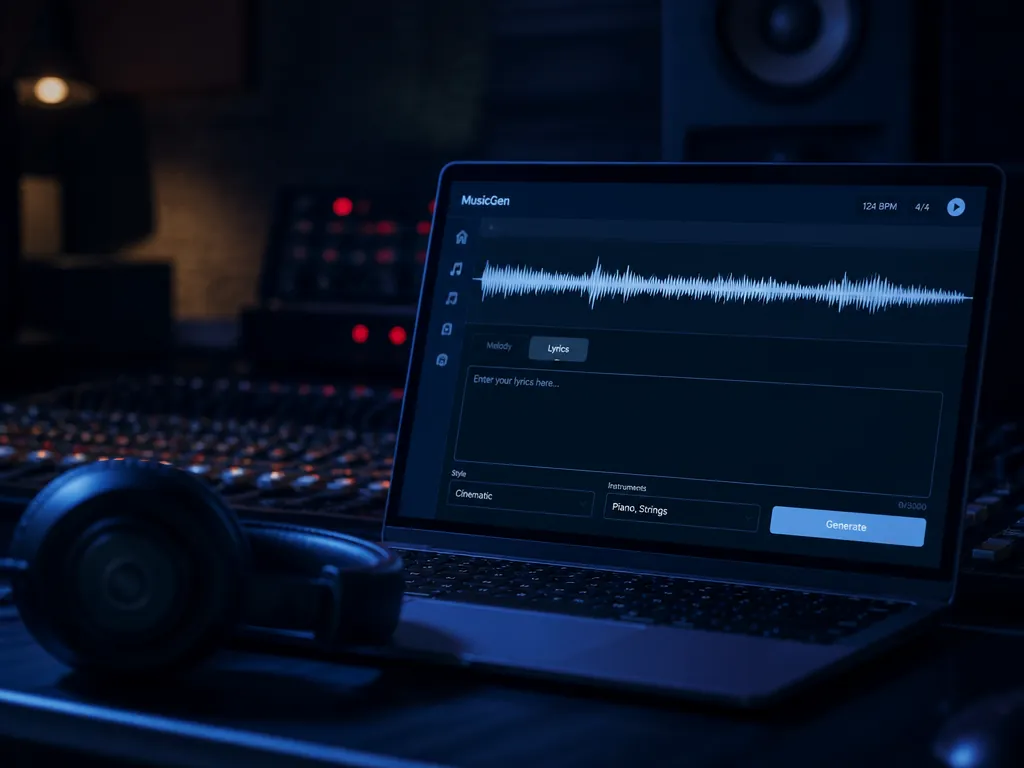
The human layer is the lyrics, the prompt, the choice of which take to keep, and the decision to send it to someone. That's where intent lives, if intent lives anywhere in a song. When coverage describes a witness explaining what particular lines meant to her, that's the human layer being read as testimony, and it's no different in kind from reading a handwritten letter aloud.
The paper trail is the interesting part
The second thing I know from production: these tracks rarely exist as loose files with no history. Most services tie generations to an account. Many keep a library of every render, including the ones you didn't share. The lyrics you pasted often stay attached to the track page. Exported files may carry metadata, and some companies have started embedding provenance markers or watermarks, though what's retained, for how long, and what survives an export varies by service and changes over time. Deleting an app from a phone is not the same as deleting an account, and it's rarely the same as deleting what's stored on a company's servers.
So if you're following a case where AI audio comes up, the song itself is the least informative object in the room. The account behind it can be among the most informative.
What I actually do
When I read a court story with AI audio in it, I run the same four questions I'd run on a client's "we made this ourselves" track before I'd put it in a game build.
- Who wrote the words? Were the lyrics typed in by a person, or generated from a one-line prompt? A song whose lyrics the tool wrote says much less about the sender than a song whose lyrics he wrote.
- What was the prompt? Style descriptions are revealing in small ways. They show what mood someone was reaching for, and they're usually stored alongside the track.
- Where's the account record? Who owned the account, when were the renders made, how many versions exist, and which one was sent? Timestamps do a lot of quiet work in a trial.
- Was the file touched after export? Trimmed, re-recorded off a phone speaker, layered with other audio? Every step between generation and courtroom is a step someone has to account for.
And I translate the phrasing. Crime coverage compresses technical detail into a few stock phrases, and each one hides a question:
| What the coverage says | What it could mean | What I want to know |
|---|---|---|
| "AI-generated song" | Tool wrote everything, or a person wrote lyrics and the tool sang them | Whose words are these |
| "Found on his phone" | Downloaded file, app library, or a shared link | Was it ever sent, and when |
| "Deleted app" | App removed from the device | Does the account and its history still exist |
| "Experts say it was AI" | Judgment by ear, by detector, or by account records | Which method, and how confident |
That last row deserves a note. Detecting AI audio by ear is shakier than people think. I've been fooled by renders and I've misjudged human recordings as generated. Detection tools exist and improve, but none should be treated as a verdict. Account records beat ears every time.
None of this makes me a better judge of anyone's guilt. It makes me a better reader. Good legal journalism already does this with phone records and bank statements; it explains what the document is before it explains what the document means. AI audio deserves the same treatment, and readers can ask for it.
One small thing to try this week: open any song generator with a free tier, paste in four lines you wrote yourself, render one track, then go look at what the account kept, the lyrics, the prompt, the timestamp, the versions you didn't keep. Ten minutes of that will teach you more about what an AI song in a courtroom can and can't prove than any headline will.
The machine sings, but the words, and the record of who typed them, still belong to a person.
Not sure which tool to use?
Compare the top AI music and sound tools side by side — honest reviews, real pricing, no sponsorships.