The stem was forty-one seconds long. A friend of mine tracked a scratch vocal for a game trailer, dropped it in a Discord for notes, and forgot about it. Eight months later somebody sent him a link to a track on a streaming service with a voice on it that had his vowel shapes, his habit of sitting a hair behind the beat, his drop into fry at the end of a line. Not his song. Not his session. Someone had trained on the stem and sold the output as a house vocal, and the first he heard of it was from a fan asking why he'd changed his sound.
His first question was who he could sue. AI voice cloning liability turns out to have three different answers depending on which lever you pull, and those levers are not equally available to someone without a lawyer on retainer.
Who is actually liable when your voice gets cloned
In most cases the liability sits with the person who built and distributed the clone, not with the tool that rendered it and not, at first, with the platform that hosted it. Right-of-publicity claims target whoever commercially used your identity. Platforms in the US generally sit behind notice-and-takedown safe harbors, which means they owe you a response once you tell them, not a duty to find it for you. Whether the company that trained the model carries liability for the training itself is the genuinely unsettled part; it depends on what was in the training data, how the output was marketed, and which jurisdiction you're in. Litigation on that question is ongoing as of writing.
What this means practically: the claim is yours to bring, the discovery is yours to do, and nobody is monitoring the catalogs on your behalf.
Three levers, and what each one costs you
Judge these on five things: what they actually protect, who pays to enforce, how fast relief arrives, whether they reach across borders, and — the one people skip — whether they do anything before the damage.
The right-of-publicity statutes
This is the body of law that covers your identity as a commercial asset, and it's where the last two years of legislative activity has landed. Tennessee's ELVIS Act, effective in 2024, extended the state's personal rights protection to voice specifically and reached the tools whose primary purpose is producing unauthorized replicas. California passed companion laws the same year requiring clear terms and representation before a performer can be contracted into a digital replica. More states are moving; a federal bill, the NO FAKES Act, has been introduced but was not law as of writing, and the US Copyright Office's own digital-replica report recommended Congress fill the gap.
The useful history here is older than the statutes. Bette Midler won against Ford in 1988 over a sound-alike singer; Tom Waits won against Frito-Lay in 1992 on similar ground. Voice as protectable identity is not a new theory. What's new is the volume.
Cost of enforcement: high. These are civil claims. You need counsel, a defendant with an address, and usually a state whose statute applies to you.
Copyright and the takedown pipeline
Copyright protects your recording and your composition. It does not protect your timbre. If the clone was trained on your masters and you own or control them, or if the output reproduces your actual melody and lyrics, you have a fast lane: a DMCA notice, a Content ID claim, a distributor complaint. Streaming platforms and distributors have gotten measurably faster at pulling fraudulent uploads, largely because streaming fraud costs them money directly.
If the clone sings a brand-new song in your voice, copyright has close to nothing to say. That's the whole gap in one sentence, and it's the gap the statutes were written to close.
Cost of enforcement: low per incident, once you know. Finding out is the hard part.
Your own paperwork and provenance
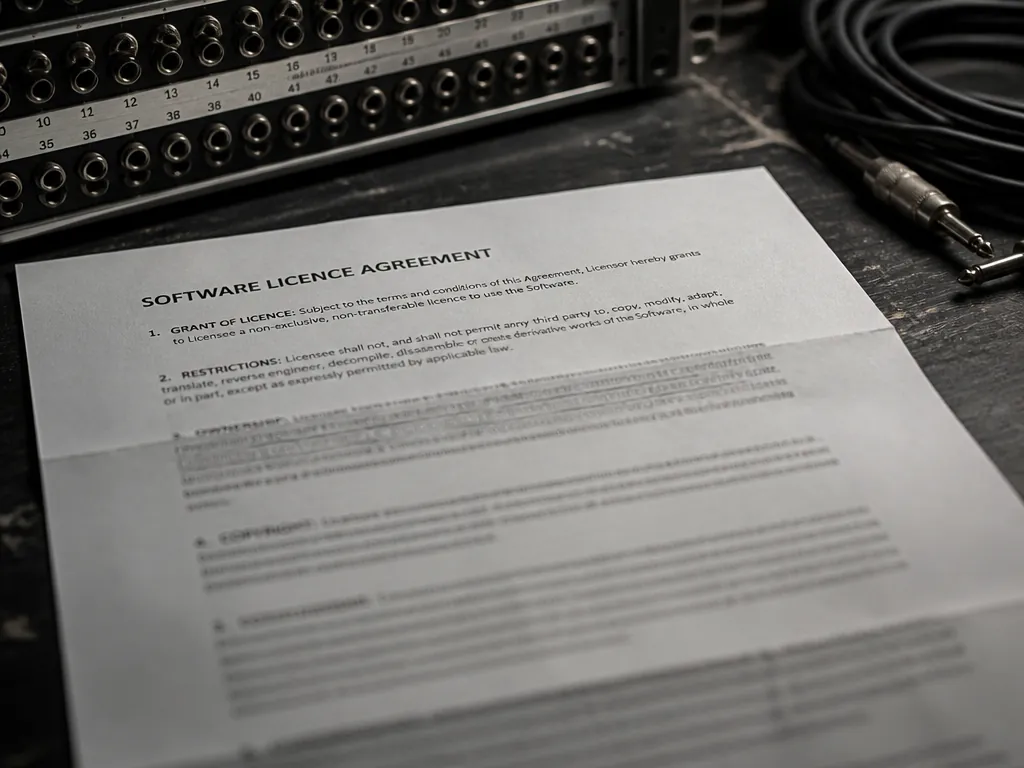
The unglamorous one. Session agreements that state whether the recording may be used to train or generate a synthetic voice, and if so for what, for how long, in what territories. Distribution and sync contracts with the same clause. Content Credentials (C2PA) written into your released files. A dated, hashed archive of raw session audio so you can prove what you actually sang and when.
None of that stops a bad actor. All of it changes what happens next: it establishes the date, it establishes non-consent, and in a contract dispute it moves you from arguing about intent to pointing at a line.
| Right-of-publicity law | Copyright / takedown | Contracts + provenance | |
|---|---|---|---|
| Protects | Your identity, incl. voice | Your recordings and songs | Your consent record |
| Who pays | You, via counsel | You, minimal | You, upfront and cheap |
| Speed | Months to years | Days to weeks | Immediate |
| Cross-border | Weak; state by state | Decent via platform policy | As strong as your drafting |
| Works before harm | No | No | Yes |
Where the verdict lands
The statutes are the loudest development and the least useful on a Tuesday. They matter enormously as leverage — a demand letter citing a real statute lands differently than one citing a vibe — but they're a remedy, and remedies start after you've already lost streams and had fans ask what happened to your voice.
Copyright is the fastest tool you have and only fires under one condition: your actual recording is in there. Check that condition first every time, because when it's met you can have the track down before the weekend.
The paperwork is the only lever that operates in advance, costs close to nothing, and works the same whether the person who cloned you is in Nashville or unreachable. That's the verdict. It's the least satisfying of the three and it's the one that will still be doing work in five years.
What to set up this week
- Add a replica clause to your session agreement. State whether recordings may be used to train or generate a synthetic voice, who may authorize it, and for how long. Silence in a contract is not a no.
- Set alerts on your own name. Platform artist tools, a Google Alert, a monthly manual search of the big streaming catalogs. Ten minutes a month.
- Claim your artist profiles everywhere, including services you don't use. Unclaimed profiles are where fraudulent uploads land.
- Archive raw session audio with dates you can prove. A hash logged somewhere immutable, or files in a service that timestamps. This is your evidence of what you did and didn't sing.
- Enable Content Credentials on export where your DAW or delivery tool supports it. Assume the metadata will be stripped somewhere downstream and attach it anyway.
- Read the training clause in your distribution deal. Some grant broad rights to "new technologies" in language written before any of this existed.
The parts that don't work yet
Audio watermarking survives some transformations and dies to others; re-recording through a speaker, aggressive time-stretching, or a second generative pass will often take it out. C2PA metadata is trivially stripped by any tool that re-encodes. Detection classifiers that claim to identify synthetic vocals produce false positives on heavily processed real vocals, which is most modern pop. Anyone selling you certainty on any of these is selling.
Which is why the durable protections are the boring ones. A signed clause doesn't degrade when someone bounces the file to MP3.
Every vocal session I run now ends the same way: before we stop the transport, the singer reads a twenty-second slate into the same mic chain — name, date, project, what they are and aren't consenting to. It gets bounced as its own 48kHz WAV, hashed, and filed next to the takes. It costs less time than punching in one line, and last spring, when a client asked whether a session vocal could be fed to a voice model for pickups, we didn't have to negotiate. We had it on tape.
Not sure which tool to use?
Compare the top AI music and sound tools side by side — honest reviews, real pricing, no sponsorships.