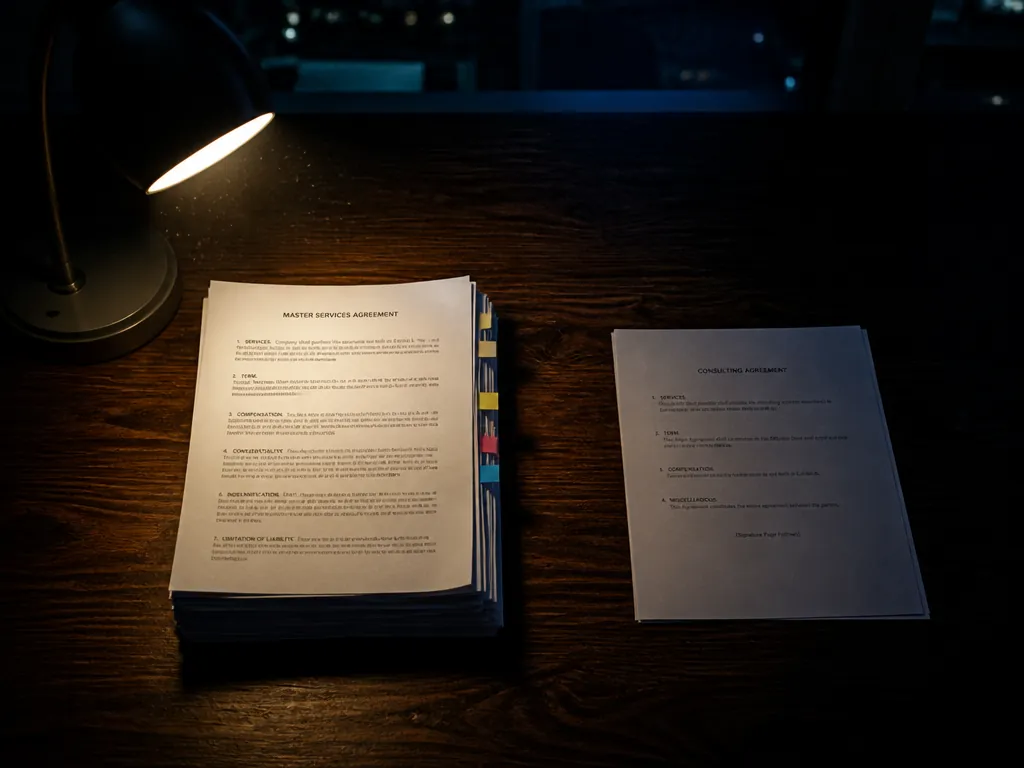
The claim landed on a Tuesday. Forty seconds of a low, detuned pad under a trailer cut for a small studio — a loop I had licensed from a mid-size marketplace six months earlier, non-exclusive, worldwide, perpetual, receipt in my inbox. YouTube's rights panel said the audio belonged to a catalog company I had never heard of. Nine days of back-and-forth later, the thing that actually explained it wasn't the license. It was the marketplace's own corporate page, three clicks deep, listing the catalog company as a subsidiary. That is the shape a conflict of interest usually takes in the sound business: not a scandal with a villain, but a delay, a claim, and a track you can't ship on Friday.
Nobody signs a document announcing an intention to disadvantage their customers. The structure builds itself, one reasonable business decision at a time, and by the time it's costing you a delivery it looks like the normal way the industry works. It's worth walking through in order, because the order is what makes it legible — and what tells you where to look before you pay.
What counts as a conflict of interest when a company sells you sound
A conflict exists whenever the same company controls both what you see and what you buy from. If a platform decides the search ranking, the "recommended for you" row, and the front-page collection — and also owns, funds, or takes a larger margin on some of the inventory in those slots — then its interest in showing you the best fit competes with its interest in showing you the most profitable one. It doesn't require anyone to act badly. It only requires the two jobs to sit inside the same P&L. The same logic applies to publications: a review site that earns a commission on one tool and nothing on another has a thumb on the scale before the writer opens the DAW.
First, the venue takes a cut of everything
The early stage is genuinely neutral, and it's neutral for a boring reason: the platform makes money on volume, from every seller equally. A marketplace connecting sample creators to producers, or an AI generation tool routing a rendered stem to a licensing partner, has no reason to prefer one supplier. Its incentive is to make the match good, because a bad match means a refund and a churned account.
This is the stage where the trust gets built, and it's real trust. Search results are ordered by something close to relevance. Support sides with the buyer. Reviewers write about the platform as a level field, because at that point it is one.
Then the platform learns what sells — and becomes a supplier
Every marketplace accumulates the single most valuable dataset in its category: what people search for, what they abandon, and what they buy. When the demand data says there's a persistent gap — no one is making enough 90 BPM lo-fi drum loops with real room tone, or enough adaptive layered stems for game engines — the platform has two options. Tell the sellers, or make it itself.
Making it itself is not sinister. It's often the better product, because it's built against real demand rather than a creator's guess. It arrives as a house-brand pack, an in-house catalog, an "originals" tier, a first-party model trained on owned material, or a stake in a supplier that already has the inventory. The economics are obvious: on third-party sales the platform keeps a commission, and on its own it keeps the whole thing.
That's the pivot point. Everything downstream follows from it, and nothing about it requires bad faith.
Next, ranking and inventory answer to the same person
Now the search team and the catalog team report up to the same executive, and that executive's number is margin. No one has to write "boost our packs" into the ranking code. It's enough that the house catalog gets the metadata done properly, the preview art commissioned, the demo tracks produced, the placement in the curated collection that the algorithm treats as a quality signal. Third-party sellers get whatever they can do alone.
The result reads as merit. The house material genuinely does look better, load faster, and convert higher — and it also sits at the top because the company that ranks it owns it. From the outside those two explanations are indistinguishable, which is precisely why disclosure matters more than intent. You cannot audit motive; you can audit ownership.
Watch for the second-order version too, because it's the one that hits creators hardest: once the platform is a supplier, it's competing with the sellers who supply it. The renewal terms get quietly worse. Exclusivity clauses appear in the seller agreement. The catalog dilutes toward whatever the house style is, and the weird, specific, human material — the stuff you actually wanted — stops getting made because it stopped being economic to make.
Then the disclosure moves somewhere legal but unread
This stage is almost always the tell. The relationship gets disclosed — companies rarely hide it outright, and public filings, ownership pages, and terms-of-service documents make hiding it expensive. What changes is the location. It migrates from the product page to the terms, from the terms to a linked policy, from the policy to a footnote in a document you agree to by continuing to use the service.
That migration is the most reliable signal available to you. Disclosure written for a reader sits next to the thing being disclosed. Disclosure written for a regulator sits wherever it is technically findable. If you have to search the site to learn who owns the catalog you're licensing, that placement was a decision.
Last, it arrives in your project
Here's where it stops being governance and starts being your Friday. The failure modes are consistent:
- A rights claim on material you licensed, because the platform's affiliated catalog registered the same audio with a content-identification system and the claim bot doesn't read your receipt.
- A license that doesn't survive cancellation. You render the podcast intro, the subscription lapses, and the grant you relied on turns out to have been tied to an active account rather than to the delivered file.
- "Royalty-free" doing two jobs. It can mean no per-use royalty on a non-exclusive grant; it can also sit alongside terms that reserve broadcast, game, or client-work use for a higher tier.
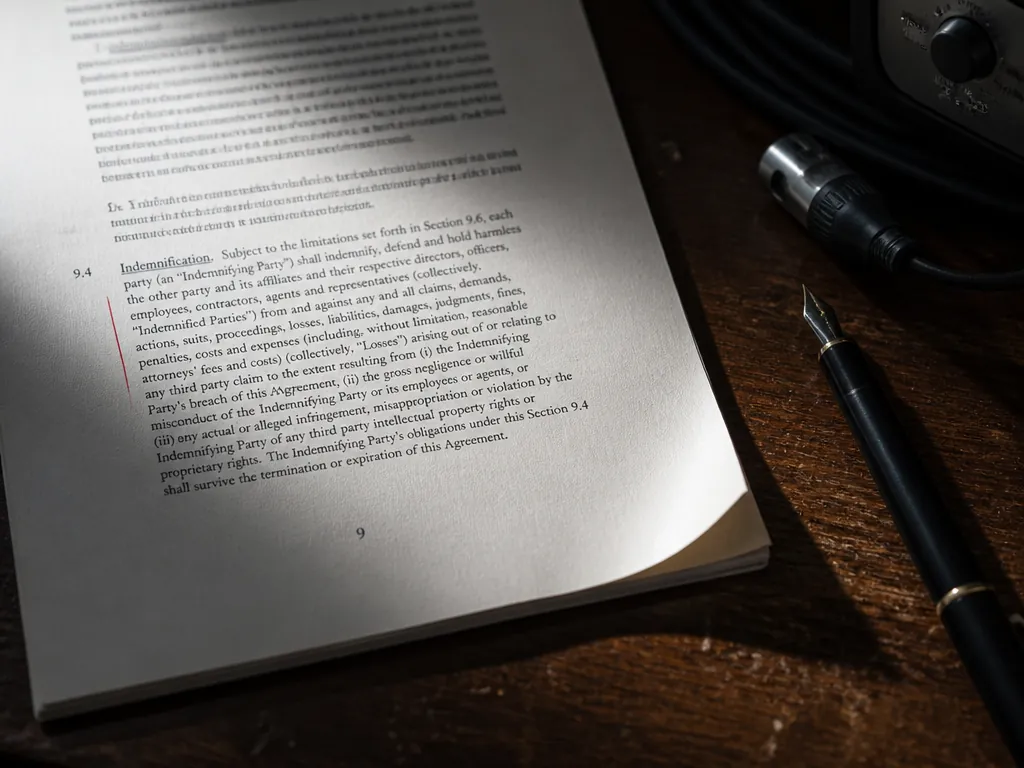
- Indemnification that quietly narrows. The clause covering you if a third party claims the output was trained on their work is the one most worth rereading at renewal, especially with major-label litigation against AI music generators still working through the courts as of writing.
None of that means the platform cheated you. It means the paperwork and the ranking were built by people with a reason to prefer one outcome, and you signed the paperwork.
The five documents that tell you who a platform works for
| Read this | Look for | Bad answer |
|---|---|---|
| The license page (not the marketing page) | Exclusive or non-exclusive; whether the grant is perpetual or tied to an active subscription | "Full commercial rights" with no scope, term, or territory |
| Terms of service, "our content" section | Whether the platform or an affiliate supplies inventory it also ranks | Ownership described only as "partners" |
| About / corporate / investors page | Subsidiaries, parent company, catalog holdings | No named entity anywhere on the site |
| Claims and takedown policy | Who you contact when a rights claim hits, and how fast they respond | A support-ticket link and no stated timeline |
| Any review site's disclosure page | Affiliate relationships, sponsorships, ownership overlap with tools reviewed | The word "may" doing all the work |
Where this publication sits in the same structure
City of Punk publishes reviews and comparisons of AI music tools and also builds in this space, which puts it inside the exact structure described above rather than outside it. That's why the disclosure page exists and why it's linked from the footer of every article instead of buried — the placement is the promise. Apply the same test to us that you'd apply to a marketplace: if a competitor is the better answer for adaptive game loops or for a cleared vocal, the piece should say so plainly, and if it never does, that's information about the publication.
The four-minute check before you license anything tonight
- Open the About or corporate page and write down who owns the catalog. If you can't find a legal entity in two minutes, note that.
- Search the terms for "exclusive," "terminate," and "indemnif" — three searches, thirty seconds.
- Confirm in writing whether your license survives cancellation. If the answer isn't in the document, ask support by email so you have it in text.
- Before delivery, upload a private, unlisted test cut of the final mix to whichever platform your client will publish on, and see whether a claim fires. You want to find that out on a test upload, not on the client's channel.
If the same company that ranks the results also owns the inventory, read the license before you read the reviews.
Not sure which tool to use?
Compare the top AI music and sound tools side by side — honest reviews, real pricing, no sponsorships.