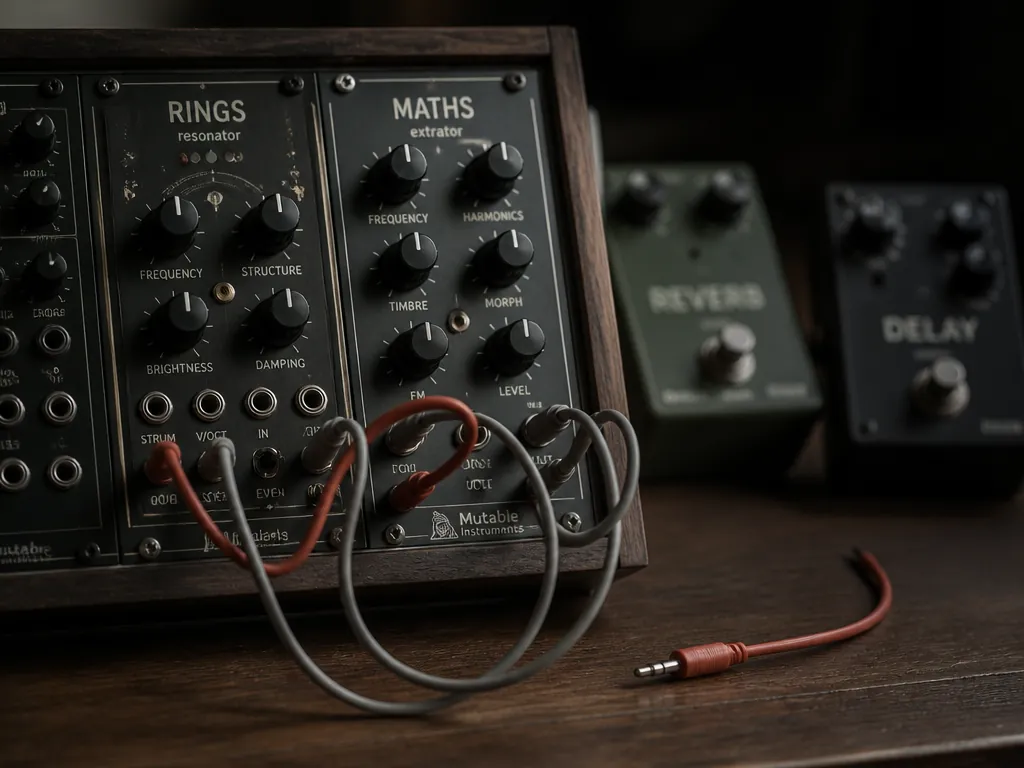
A pad in 31-EDO, a held fifth, a shimmer tail rising an octave above it — and the tail was beating against the source about twice a second, a slow wobble that sounded like a tape machine with a sick capstan. The synth was in tune. The reverb plugin was not, and there was no control on it that admitted as much.
That session is the reason this piece exists, and the number underneath it is worth knowing before you touch a single decay control.
The number: 0.586 cents
MIDI pitch bend is 14-bit — 16,384 discrete values. The MPE specification's recommended default for per-note pitch bend range is ±48 semitones. Spread 16,384 steps across 96 semitones and each step is 0.00586 semitones, or 0.586 cents.
At A440, that is a pitch increment of about 0.15 Hz. Two sines 0.15 Hz apart beat once every 6.7 seconds. So a single step of MPE pitch resolution, held against a reference, produces one swell in the time it takes to say the sentence describing it.
Halve the bend range and you halve the step: at ±24 semitones you are at 0.293 cents, at ±96 you are at 1.17. The number moves with your configuration, which is the first hint that it is a property of the pipe and not of the music coming out the other end.
What that number actually measures
It measures one thing: how finely a controller can describe the pitch of one note to a synth over a per-note MIDI channel. That is all.
It is a good number for that job. The microtonal intervals you are likely to care about are enormous by comparison. The 12-TET major third sits at 400 cents; the 5:4 just third sits at 386.31. That 13.7-cent gap — the thing that makes a barbershop chord lock and a piano chord shimmer — is 23 steps of MPE resolution. 31-EDO divides the octave into 38.71-cent slices, which is 66 steps. Quarter-comma meantone's fifth at roughly 696.6 cents versus 12-TET's 700 is a gap of about six steps.
In other words, the transport is not your bottleneck. If your intonation is off, the pitch bend pipe did not do it.
What it doesn't measure
Here is the longer list, and it is the actual subject of this article.
It doesn't measure whether a tuning table is loaded. MPE transmits pitch deviation. It has no opinion about scales. A synth in 12-TET receiving perfect MPE data plays 12-TET with expressive bends on top.
It doesn't measure whether your DAW passed the channels through. A track set to a fixed MIDI channel collapses all sixteen member channels into one, and the last note's bend wins. Every note in the chord goes wherever the top note went. This is the single most common failure and it looks like a synth problem.
It doesn't measure how bend and tuning table compose. Most synths apply bend as absolute cents on top of the tuned note. So in 31-EDO, bending by what your controller calls a whole step moves you 200 cents while the scale's whole step is 193.55. Your glide lands 6.5 cents sharp of the degree you were aiming at.
And it doesn't measure anything downstream of the synth's audio output. Your reverb never sees a note number. It sees a waveform. If that reverb has tuned elements — comb banks, modal resonators, a pitch-shifted shimmer voice — those elements were tuned by a developer in twelve-tone equal temperament, and they will keep being tuned that way while your source drifts elsewhere.
Does turning on MPE change your synth's tuning?
No. MPE changes how pitch is routed — one note per MIDI channel, so each note carries its own bend, pressure, and slide — but the scale your keys map to comes from a separate mechanism entirely: a Scala file (.scl for the scale, .kbm for the keyboard mapping), a MIDI Tuning Standard SysEx dump, or a tuning-distribution layer like MTS-ESP that a host plugin broadcasts to every instrument that supports it. You can run MPE in strict 12-TET, and you can run 31-EDO from a boring five-octave controller with no MPE at all. They solve different problems and it is worth holding them apart in your head, because when the chord sounds wrong you need to know which one to go check.
The session, step by step
Assume an MPE controller, an MPE-capable soft synth with Scala or MTS support (Surge XT is the free reference implementation and reads both), and a reverb with at least one pitched algorithm.
1. Load the scale in exactly one place. Either an MTS-ESP master broadcasting to every instrument, or a .scl/.kbm pair loaded per-synth — not both. Two tuning sources fighting is a debugging afternoon you will not enjoy.
You should hear: play a major third. The roughness that lives in a 12-TET third settles down. In 31-EDO the third is 387.10 cents, 0.78 cents off pure, and the chord sits still instead of pulsing.
2. Set the MPE zone and confirm the bend range. Lower zone, master channel 1, member channels 2–16, per-note bend ±48 semitones.
You should see: the synth's readout reporting 48, or an RPN 0 message with value 48 arriving on the member channels at handshake.
3. Play a triad into a MIDI monitor. Three note-ons, three different channels.
You should see: channels 2, 3, 4 (or wherever the rotation starts). All three on channel 1 means MPE collapsed somewhere between the controller and the plugin — check the track's MIDI channel setting first.
4. Test how bend lands against the scale. Hold a degree, bend up by one controller-defined whole step, listen to where it arrives.
You should hear: either a clean arrival on the next scale degree, or a slow beat against a held reference. The beat means bend is running in absolute cents and your glides pass through the degrees rather than landing on them. Decide now whether that is a bug or the sound.
5. Print the dry instrument before you reverb anything. 48 kHz, 24-bit, stems split by voice group if different parts will get different tail treatment.
6. Audit the reverb for pitched elements before you touch decay time. Open the algorithm list and find out what is actually resonating. Diffusion networks have no fixed pitch. Comb and modal resonator banks do. Shimmer voices do.
You should see: resonator parameters labelled in semitones, shimmer intervals labelled +12, −12, or +7.
7. Handle the shimmer interval. An octave is a 2:1 ratio in nearly every tuning that keeps the octave, so ±12 survives your scale intact. A fifth does not: 700 cents in 12-TET, 701.955 pure, about 696.77 in 31-EDO. If the reverb plugin offers a cents trim on the shifted voice, dial the difference in.
You should hear: the flutter between shimmer and source slowing into a drift, then stopping.
8. Tune the resonator bank, or switch algorithms. If the bank quantizes to semitones you cannot reach 38.71-cent divisions from inside it. Three ways out: apply a global fine-tune or pitch offset to the whole instance, move to a diffusion-only algorithm with no fixed pitch, or keep the mistuning deliberately and treat the beating as motion — in which case state the rate to yourself, because a 3 Hz beat in a five-second tail is a tremolo you chose.
9. Set predelay so the dry interval speaks first. 20–40 ms is enough to let the attack state the chord before the tail comments on it. With microtonal material this matters more than usual — the tail is the part most likely to be wrong.
10. Pull tail modulation down on any tuned algorithm. Reverb chorus detunes taps by cents. Depth past a few cents erases the distinction you spent the last nine steps protecting. Save the modulation for the diffusion-only instance.
You should hear: the tail losing its lushness and gaining definition. That trade is the point.
Which reverb elements survive a microtonal source
| Element | Survives? | What to do |
|---|---|---|
| Diffusion-only (plate, hall, FDN) | Yes — no fixed pitch anywhere | Nothing. Use it freely |
| Tuned comb / modal resonator bank | Only if you can reach your scale degrees | Cents trim, global detune, or switch algorithm |
| Shimmer at ±12 | Yes — the octave is 2:1 in your scale too | Leave it |
| Shimmer at +7 or +5 | No — off by 2 to 5 cents depending on temperament | Trim in cents, or drop to octaves |
| Modulated / chorused tail | Partially — modulation depth is detune | Keep depth low on tuned algorithms |
| Spectral freeze | Mostly — it resynthesises what it heard | Watch low-frequency bin quantization |
Before you render
- Freeze the tail and run a high-resolution FFT (32768-point, Hann window). Partials should land within a couple of cents of your scale degrees.
- Confirm the tuning source is still loaded — MTS-ESP masters can be bypassed by a stray track-disable.
- A/B the reverb bypassed and engaged on a sustained fifth. If engaging it introduces beating, the tail is in a different tuning than the source.
- Put the scale name in the stem filename.
pad_31edo_wet.wavcosts nothing today and saves an hour in six weeks. - Archive the .scl and .kbm alongside the project. Tuning files go missing faster than presets.
The myth is that MPE plus a scale file makes your chain microtonal. The accurate version is that MPE plus a scale file makes everything microtonal right up to the synth's audio output — after which your reverb, which never sees a note number and has no idea what temperament you are in, is tuned by hand or not at all.
Not sure which tool to use?
Compare the top AI music and sound tools side by side — honest reviews, real pricing, no sponsorships.