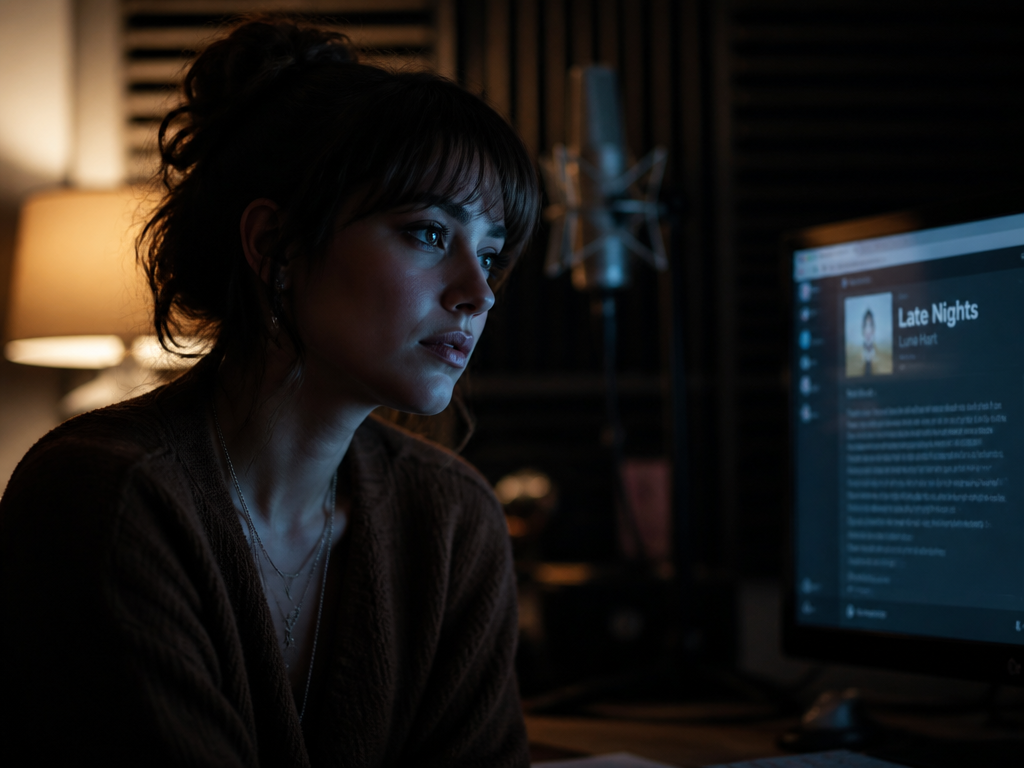
You publish a track. Weeks later, someone screenshots the page and sends it to you: under your song title, a paragraph you didn't write, generated by a model, telling listeners what your song is "about." You didn't approve it. You can't easily remove it. And it's wrong — not offensively wrong, just confidently, blandly wrong, the way a summary is wrong when nobody who made the thing was in the room.
This is the current front line in the fight over Spotify features: not whether the app plays music, but whether the platform gets to author the frame around it. For music industry observers and digital rights advocates, that shift — from distribution to interpretation — is the part worth watching closely.
The trigger this time was an AI-generated context blurb surfacing next to songs. An established artist saw one attached to her own work, said publicly that she and her collaborators hadn't asked for it and didn't want it, and pointed to the obvious ask: let artists opt out. The complaint landed because it wasn't precious. It was procedural. Who decided this, and why can't I turn it off.
What most people do
Most listeners, and honestly most artists, treat these features as neutral plumbing. A blurb appears; it looks like metadata; metadata has always been there. Release year, genre tag, credits. One more line of gray text under the title reads as house-keeping, not editorial.
That's the assumption the platform is counting on. When a feature looks like infrastructure, nobody audits it. You scroll past a genre label without asking who assigned it. So an AI-written summary slots into the same visual real estate and inherits the same presumed innocence — even though a genre tag is a category and a summary is an interpretation. One sorts your song. The other explains it.
The default artist response is also passive, because the friction is designed in. There's rarely a visible toggle. You find out the feature exists when it's already live on your page, and the path to challenge it isn't printed under the paragraph you want gone. So most people do nothing. They notice, they wince, they keep working. The feature stays.
What the evidence suggests
The evidence suggests two separate problems, and it's worth keeping them apart.
The first is accuracy. Generated summaries lean on whatever the model can infer — lyrics scraped for keywords, a genre guess, maybe a press line. That produces confident text about songs the model has no access to the meaning of. A track written about grief gets flattened into a mood word. A deliberately ambiguous lyric gets resolved into a single reading. The problem isn't that AI can't parse language; it's that a song's meaning frequently isn't in the language, and a summary that pretends otherwise mislabels the work on its own storefront.
The second problem is consent, and it's the durable one. Even a perfectly accurate blurb was published about someone's work without their sign-off. That's the objection that doesn't dissolve when the model improves.
Here the precedent matters. Some years back Spotify made the shuffle button the default on album pages. Adele objected — albums are sequenced on purpose — and the platform quietly changed the behavior for albums. It's a small case, but it establishes the shape of the thing: a named artist with leverage identifies a default that overrides artistic intent, and the platform walks it back for everyone. Not through policy, through pressure.
The lesson digital rights advocates should take from that isn't "artists win." It's that these decisions run on defaults, and defaults are set unilaterally and reversed only under public heat. The person with a catalog and a press megaphone can force a change. The independent act with 4,000 monthly listeners inherits whatever the leveraged artist happened to complain about. Artist agency, as currently structured, scales with fame.
Can artists opt out of Spotify AI features?
It varies, and that's the honest answer. Some platform features offer a toggle in the artist dashboard; others ship as a default with no obvious off switch, which is exactly what generates these public disputes. If you want to know where a specific feature stands, check the artist tools in your distribution or platform dashboard first, then the platform's current help documentation, because these controls change and any specific claim I make here will age. The reliable read is structural: opt-out tends to arrive after the objection, not before the launch.
What I actually do
I'm a sound designer, not a recording artist with a catalog on the front page. But I place work on platforms, and I watch this closely because it rhymes with every AI-adjacent fight I've sat through in production. So here's my actual posture.
I assume the frame is not mine to control, and I compensate upstream. Anywhere I do own the metadata — the description field, the credits, the artist bio, my own site — I write the context myself, in plain declarative language, so there's an authored version of the truth that predates any generated one. If a model later summarizes my work, at least it's summarizing from something I wrote.
I keep the receipts. Screenshots of anything auto-generated on my pages, dated. Not because I expect to sue anybody — because the Adele case worked on evidence and visibility, and a complaint with a screenshot travels further than a complaint without one.
And I don't confuse this with a fight about AI as a tool. I use AI in my own work daily; it's an instrument. The objection isn't the technology. It's a platform deciding, on your behalf and without a switch, what your song says.
If you're an artist, a short version:
- Fill every metadata field you control, in your own words, before the platform fills the gaps for you.
- Screenshot auto-generated text on your pages and date it.
- Check your dashboard for opt-out toggles periodically, because they appear quietly.
- When a feature overrides intent, say so publicly and specifically — defaults reverse under visibility, not silence.
The myth is that Spotify features are neutral infrastructure that describe your music without changing it. The more accurate version is that some of these features are editorial acts published in your name, and the only ones getting turned off are the ones somebody with a loud enough voice objected to first.
Not sure which tool to use?
Compare the top AI music and sound tools side by side — honest reviews, real pricing, no sponsorships.