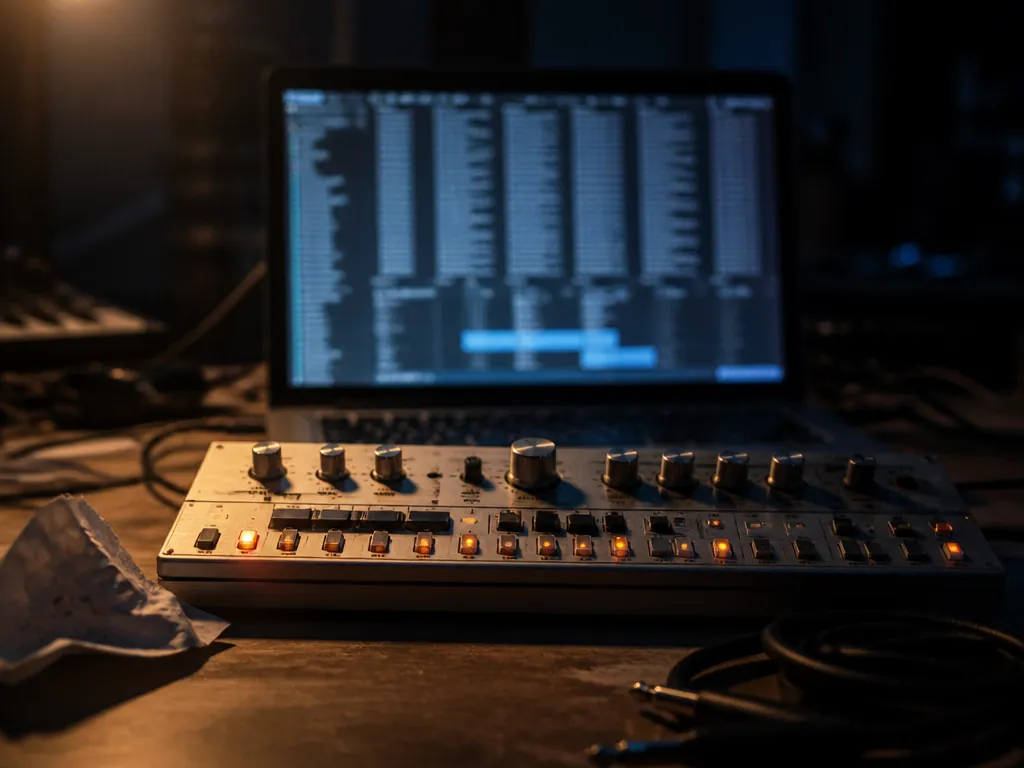
At 2am on a Tuesday I had a 303 line looping at 138 BPM in A minor, filter resonance climbing across sixteen bars, and the only reason it existed was a folder of free samples I had unzipped out of boredom. The download button said 505. Three of those files ended up in the track.
That gap — 505 on the button, three in the session — is the most useful thing I know about free rave packs, and none of it is a complaint about the pack. The pack was good. 505 is an honest number. It is also a measurement of exactly one thing: how many audio files are inside the zip.
What a number like 505 is actually counting
A sample count is a file count. That is the whole claim, and it is the only claim a pack can publish without asking you to trust its taste.
Here is how the arithmetic works. Take one acid patch. Record one sixteen-step pattern with slides and accents on the right steps. Render it in four keys, at two tempos, as a bar-long loop and as a one-shot stab, dry and through the pack's plate reverb. That is thirty-two files from one idea, and every one of them is a real, usable, differently-named piece of audio that somebody had to render, name and check. Do the same across pads, stabs, leads, risers and hoovers, and you reach 505 without padding a thing.
That is not a scam. It is a unit problem. Nobody can print "41 genuinely distinct ideas, 12 of which are excellent" on a download page, because the second half of that sentence is an opinion and the first half invites an argument. So file count is what gets printed: accurate, verifiable and nearly weightless.
The other thing the number hides is proportion. In a rave pack that size, 303 material is a folder, not a library. Acid sits alongside seven or eight other folders, which means the headline number is describing a rave collection while you are shopping for one specific sound.
From 505 files to 19 keepers
Here is what one pass looked like — one project, one night, a game trailer cue that needed to sound like a 1992 warehouse without paying anyone's clearance rate.
- Anything with baked-in reverb went first. A wet acid loop locks you into someone else's room, and you cannot take a tail back out.
- Then near-duplicates. If I had the loop in A, I did not need it in A# and B; my sampler transposes.
- Then anything already cooked into a limiter. Squashed loops sit on top of a mix instead of inside it.
- Then the recognition check. Two of the leads I had heard on other people's uploads, which tells you nothing about quality and everything about how crowded that particular sound already is.
Nineteen files survived to the session. Of the nineteen, three survived the arrangement: one acid loop retuned down two semitones, one stab, one noise riser played backwards.
Three out of 505 is a 0.6 percent hit rate, and I would download that pack again tomorrow.
Be clear about what that ratio is, though. It is my number, from one night, with one brief, filtered by one person's taste and one project's tempo. A DJ building at 150 BPM would keep a different nineteen. A podcast editor looking for a four-second sting would keep two and be delighted. The ratio is not a score for the pack. It is a description of how sample packs work: you are buying — or in this case not buying — a lottery ticket with reasonable odds and no downside.
Are free rave samples safe to use in a commercial track?
Usually yes, if the license grants commercial use — and the only way to know that is to open the license file that came inside the download rather than the page that sold you on it. Those two documents disagree more often than you would like.
The vocabulary matters, because it is doing real work:
- Royalty-free means no ongoing per-use payment. It does not mean free of conditions, and it does not mean free of charge.
- Free can mean free of charge with commercial use granted, free for non-commercial use only, or free in exchange for an email address and an attribution line. All three get called free.
- CC0 / public domain is the loosest, and the rarest for produced material.
- No redistribution clauses are near-universal and mostly aimed at people reselling the pack. Read them anyway if you are shipping a game with the audio in an unpacked assets folder, because "distributing the sample" and "distributing your track" can look different to a lawyer than they do to you.
The other friction is automated matching. Widely-shared loops sometimes trip Content ID on video platforms, not because you did anything wrong but because somebody else built a release on the same loop and their distributor registered the recording. Dispute processes exist for exactly this situation and the material usually clears, but the delay lands on your release date, not the pack author's. If a loop is going into something with a deadline attached, it is worth a minute to check whether it is one of the famous ones.
I am a sound designer, not a lawyer. What I can tell you is what the terms tend to say and where they hide. Keep the license file, the download page and the date in the project folder — it costs you one screenshot and can save you an afternoon of archaeology two years later.
What the number doesn't measure
Everything that determines whether a 303 loop works in your track is invisible to the file count. This is the part I check before I commit an evening.
| What you actually need to know | Why it matters for an acid line | How to check in under a minute |
|---|---|---|
| Sample rate and bit depth | 44.1kHz is fine for music; video work runs at 48kHz, and every conversion is another chance to smear the top of a resonant sweep | File info in your browser, or the clip properties in your DAW |
| Key and tempo labelling | A loop labelled Am that is actually a detuned A#m will fight your bass all night and you will blame your monitors | Play it against a sine at the named root |
| Dry or wet | Baked reverb and delay cannot be removed, and a wet acid loop drags someone else's room into your mix | Solo it. If the sound blooms after the last note, it is wet |
| Loudness | Loops printed through a limiter arrive pre-cooked and refuse to sit behind anything | Look at the waveform. Sausage shape means the decisions were made without you |
| Mono compatibility | Artificially widened basses can partly vanish on a phone speaker or a club sub | Flip the master to mono. If the low end thins out, the width was fake |
| Unique sources versus variants | 505 files might be 40 ideas wearing different hats | Sort by name and file size — variants cluster together obviously |
Free pack or generated? For acid specifically
This is where I should be honest about the tools we spend most of our time testing. Generators fix the two problems a pack cannot: they will hit your exact tempo and key, and nobody else has the render.
What they are still weak at is the behaviour that makes a 303 line a 303 line. The character lives in the interaction of accent, slide and a filter envelope that opens fast and closes faster — motion, not timbre. Text-to-music models tend to smooth motion. You ask for a screaming resonant sweep and get a polite filtered saw with a tasteful, evenly-spaced arpeggio. Low-mid mush is common in dense rave renders, and mush plus a resonant bass is a fight over the same 200Hz. Some renders come out perfect on the second try and some come out wrong nine times running, which is the part of prompt-roulette nobody puts in the marketing.
What helps, consistently, is describing performance rather than genre:
acid techno instrumental, 138 BPM, A minor
TB-303 style bassline, 16th-note pattern,
heavy accent and slide between notes,
resonant low-pass filter opening slowly over 16 bars then snapping shut
dry signal, no reverb, no vocals, drums minimal
The reasoning: "accent and slide" and "snapping shut" name what the instrument does, which gives the model something to imitate beyond a genre average. Asking for dry keeps the reverb decision yours. Asking for minimal drums makes the result easier to fit under what you already have, and stops a printed kick from fighting the one in your session. If the tool offers stems, take them — an acid line trapped inside a full mix is a line you cannot retune, gate or sidechain on its own.
Commercial rights on generators vary by tier, and they get revised. Check the terms attached to the plan you are actually on, on the day you release, not the summary you read last year.
Making a borrowed line yours
Four moves, in order. Each takes about a minute.
- Retune in semitones, not cents. Move it to your key and stop at three or four semitones of travel. You should hear the character stay intact; when it starts sounding like a rubber band, you have gone too far and should pick a different file.
- Resample it through something. Print the loop through drive, tape saturation or a coloured channel strip, then re-import the print. You should see an asymmetrical, fatter waveform and hear the top of the resonance harden into something that cuts.
- Automate the filter yourself. Open slowly across eight or sixteen bars and close it in a beat. You should hear individual accents surface and duck rather than one smooth swell — that asymmetry is what reads as a performance.
- Break the loop. Mute a step, cut the last sixteenth, reverse one bar in four. You should hear something the other few thousand people who downloaded that pack will not have.
Do all four and the fact that the source was free stops being audible, which was always the point. The pack gave you a starting timbre. The moves gave you a part.
Judge a pack by how many files are still in your session an hour later, not by the number printed on the download button.
Not sure which tool to use?
Compare the top AI music and sound tools side by side — honest reviews, real pricing, no sponsorships.