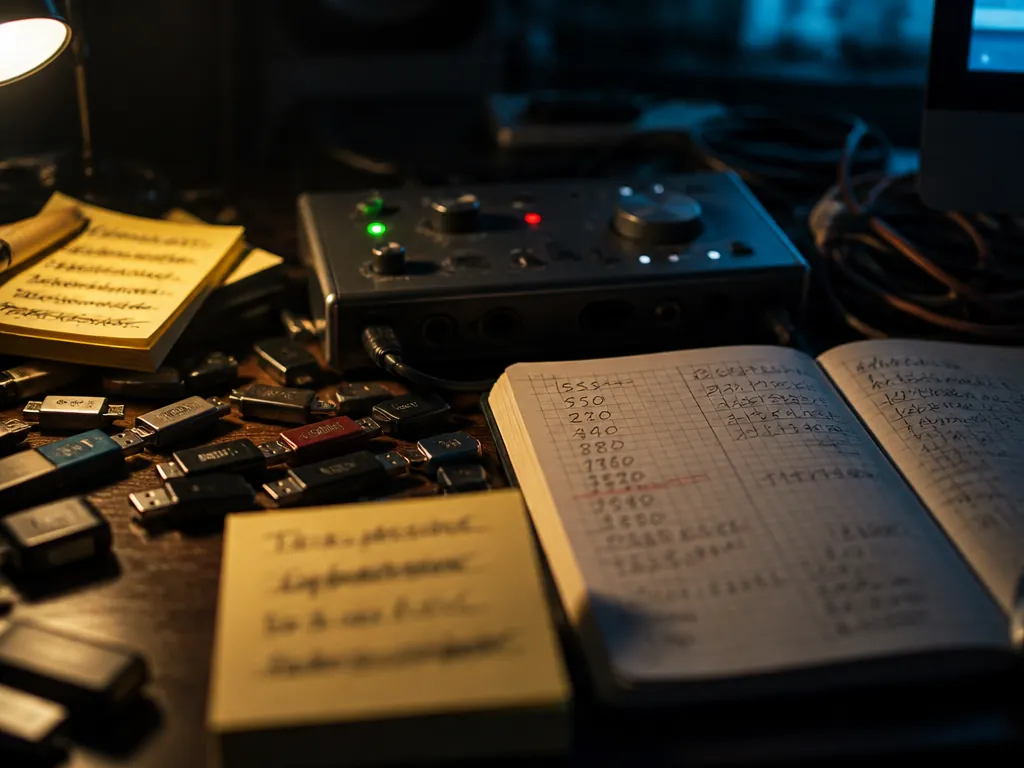
Last Tuesday I dragged 63 free 808 one-shots — four packs I'd hoarded over about two years and never once opened — into a tuner and a spectrum analyzer, and went through them one at a time.
Nine of them landed within a few cents of the note in their filename. Twenty-two had no note in the filename at all. Two were labeled F and sat closer to F#, which is the kind of error you don't hear as wrong pitch — you hear it as "this mix feels weird" for forty minutes before you find it. The rest were fine, honestly. Clean sub, usable tails, nothing embarrassing.
The free sample packs weren't the problem. My folder was. I had been treating a pile of unlabeled sine waves as a library, then blaming the samples when nothing in the library was findable.
That's the actual story with free 808s, and it's worth saying plainly because the received wisdom is the opposite. The received wisdom is that you get what you pay for, that free packs are the leftovers, and that the paid boutique 808 collection is what separates a track that hits from one that doesn't. Hold up on that. Fidelity has not been the bottleneck for a long time. An 808 kick used as a bass element is, at its core, a sine wave with a fast downward pitch envelope and a long decay. It is one of the least complicated sounds in your project. What makes one usable and another useless is almost never the recording — it's whether you know its pitch, its decay length, and where it is at 2am.
What you're actually auditioning when you audition an 808
Used as a drum, an 808 is a kick with a boomy tail. Used as bass — the hip-hop, trap, and drill application, and increasingly the electronic one — it's a monophonic bass instrument that happens to have a transient. That changes what matters.
Three things decide whether a given one-shot earns a slot:
Fundamental pitch. The tail settles on a note. A1 is 55 Hz; G1 is about 49 Hz; E1 is about 41 Hz; C1 is about 33 Hz. If the tail lands at 41 Hz, that sample is an E1 whatever the filename says. Everything you do afterward — tuning to key, layering, sidechaining — depends on knowing this number.
Decay. At 140 BPM, a quarter note is roughly 429 ms and a dotted eighth is roughly 321 ms. An 808 with a 1.2-second tail is a completely different instrument from one with a 300 ms tail, and no amount of ADSR trimming makes the short one into the long one. You need both in the folder.
Distortion character. This is where free packs genuinely differ from each other. A clean sine 808 disappears on a phone speaker. One that's been driven through saturation, a guitar amp sim, or a tape stage generates harmonics an octave or two up, which is what makes it audible on laptop speakers and earbuds. Neither is better. They're two different tools, and most producers only keep the clean ones because those sound bigger on studio monitors, then wonder why the track vanishes on a phone.
Notice that none of those three are quality judgments. They're metadata. Which is exactly why free packs get unfairly maligned: paid libraries sell you the metadata as much as the audio, and free ones frequently ship a zip full of 808_final_v2.wav.
Are free sample packs actually royalty-free?
Usually yes for use in your music, and usually no for passing the samples on to anyone else — but "royalty-free" is a phrase covering at least four different arrangements, and the readme in the zip is the only thing that tells you which one you have.
The families you'll run into:
- Royalty-free, no redistribution. The common one. Use the sounds in commercial releases, don't repackage or resell the raw samples. Magazine and blog packs mostly live here.
- CC0 / public domain. Do anything, no attribution needed. Common on community upload sites.
- Creative Commons with attribution or share-alike. Free, but with strings — attribution in your credits, or in the share-alike case, terms that can propagate to derivative work. This is the one that quietly causes problems for people who grab everything from community sample sites without reading the per-file license.
- Free-tier downloads from a commercial platform. Free to grab, governed by that platform's subscription terms, which can change and can differ depending on whether you were subscribed when you downloaded.
The honest version: these terms vary by source and they get revised. I'm describing the shapes, not making you a promise about any specific pack. Two habits cover you. First, keep the readme or license file inside the sample folder — not in Downloads, not in a browser tab you'll close. Second, if a pack has no license file and no terms page anywhere, treat that as a defect and don't build a release around it. A sound you can't document is a sound you can't clear if someone asks, and "I found it on a forum" is not documentation.
The 60-second audition
This is the part that turned my Tuesday-night pile into something I use. Every incoming 808 gets one minute, and it either earns a name or gets deleted. Not archived. Deleted.
| Check | How | Keep it if |
|---|---|---|
| Pitch | Tuner or analyzer on the tail, not the transient | You can name a note with confidence |
| Decay | Play it against your project tempo | It's clearly short, medium, or long — not mush |
| Mono | Sum to mono, listen again | Sub survives; anything stereo-wide down there is a liability |
| Phone test | Play through a laptop or phone speaker | You can still hear the note, not silence |
| Transient | Solo the first 20 ms | There's a click/knock you can keep or kill independently |
Then rename it. My scheme is 808_[note]_[decay in ms]_[character] — so 808_F1_900_saturated.wav or 808_C1_280_clean.wav. It's ugly and it works, because six months later I need an F that rings for most of a bar and I can find it by typing "F1_9" into the browser search field.
The upfront cost of this is real. Sixty-three samples took me a bit over an hour, including the deleting. What it bought was the end of the twenty-minute scroll that used to happen every time a track needed low end — the scroll that kills whatever idea you had before you found the sound.
Where free 808s come from, including the newest well
Four reliable sources, roughly in order of curation quality: music-magazine sample packs, which are assembled by people who make records and generally arrive labeled; producer blogs and independent sound designers giving packs away as portfolio pieces, which are hit-or-miss but sometimes extraordinary; free tiers of commercial sample platforms, usually well-tagged and license-clear; and community upload sites, which have enormous range and per-file licensing you have to read individually.
The fifth is AI generation, which is our beat here, so let me be specific about where it actually helps and where it doesn't.
It doesn't help much with the one-shot itself. Text-to-audio models are trained and evaluated on full musical passages, and asking one for an isolated sub-bass hit tends to get you either a full drum loop you have to carve up or a sound with far less energy below 60 Hz than you wanted. Sub-bass is where generative models are weakest — it's a region with little perceptual information and a lot of loudness, exactly the trade a generative model learns to skimp on. Prompt-roulette is real down there.
Where it does help: texture on top. Generate a short atonal metallic hit, a room-mic thud, or a distorted vocal syllable, high-pass it aggressively at 120–200 Hz, and layer it over a clean tuned sine 808. The generated layer carries the character on small speakers, the sine carries the weight. That's a legitimate use of the technology, it works today, and it doesn't require the model to be good at anything it's bad at. If you go this route, the same license question applies and it's less settled than it is for sample packs: read the specific generator's commercial-use terms before you put it on a release.
Tuning one to your track
Once a sample has a known pitch, this takes about ninety seconds.
- Find the key of your project. If you're working from a melody loop, look at the bass note of the first chord.
- Load the 808 into a sampler and set its root note to the pitch you measured — not the pitch in the filename. You should see the sampler's root key match your tuner reading.
- Play the root of your key. You should hear the 808's tail sit still against the melody instead of slowly beating against it. A slow wobble means you're a few cents off; a fast one means you're a semitone off.
- Trim the decay to your groove. At 140 BPM, start around 320 ms for busy patterns and 800 ms for sparse ones, then adjust by ear.
- Check in mono, then on a phone. You should hear the note, not a pressure feeling. If it disappears, add saturation until harmonics appear an octave or two up.
That's the whole workflow. It's not clever. It's the thing that separates people whose low end works from people who keep buying packs looking for the sound that will do it for them.
Back to the folder
My 63 became 19. The one I've used the most since is from a magazine pack — a slightly overdriven F1 with a 900 ms tail and a knock on the front end I can gate off when the mix is busy. It cost nothing. It has been in three commercial pieces. The four boutique 808 packs I've bought over the years are still sitting in a folder called TO SORT, unlabeled, doing nothing, which tells you exactly how much money has to do with any of this.
The myth is that free sample packs are the compromise you make until you can afford better sounds. The more accurate version is that the sounds were never the compromise — the missing labels were, and those you can fix in an hour with a tuner and the willingness to delete things.
Not sure which tool to use?
Compare the top AI music and sound tools side by side — honest reviews, real pricing, no sponsorships.