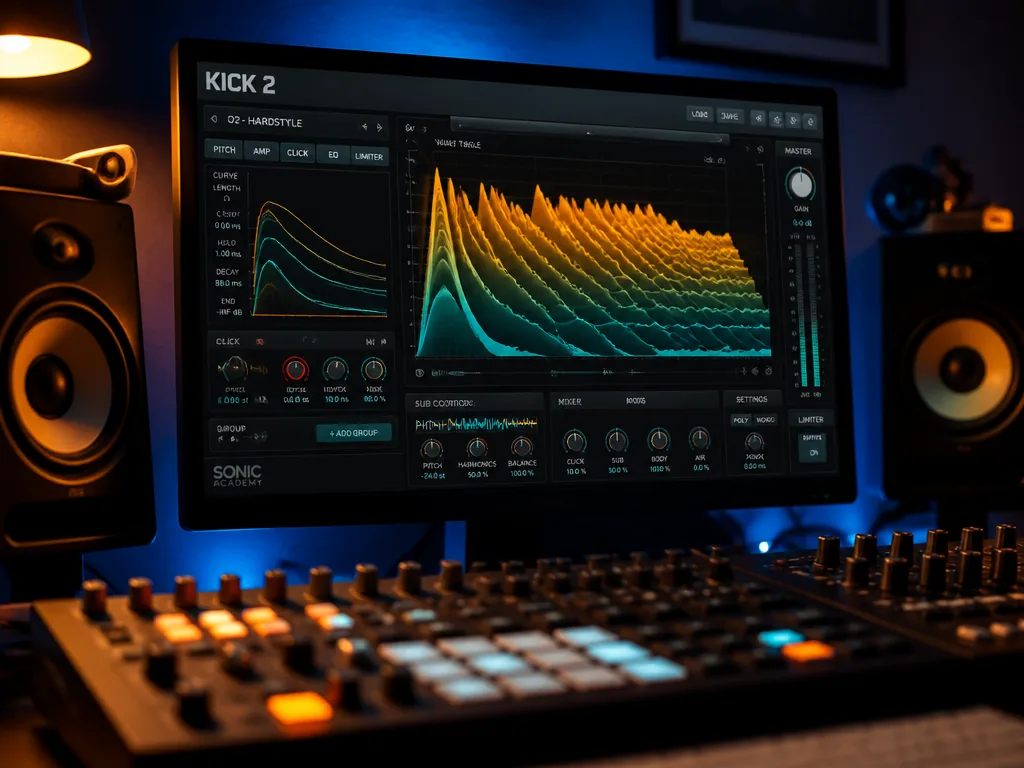
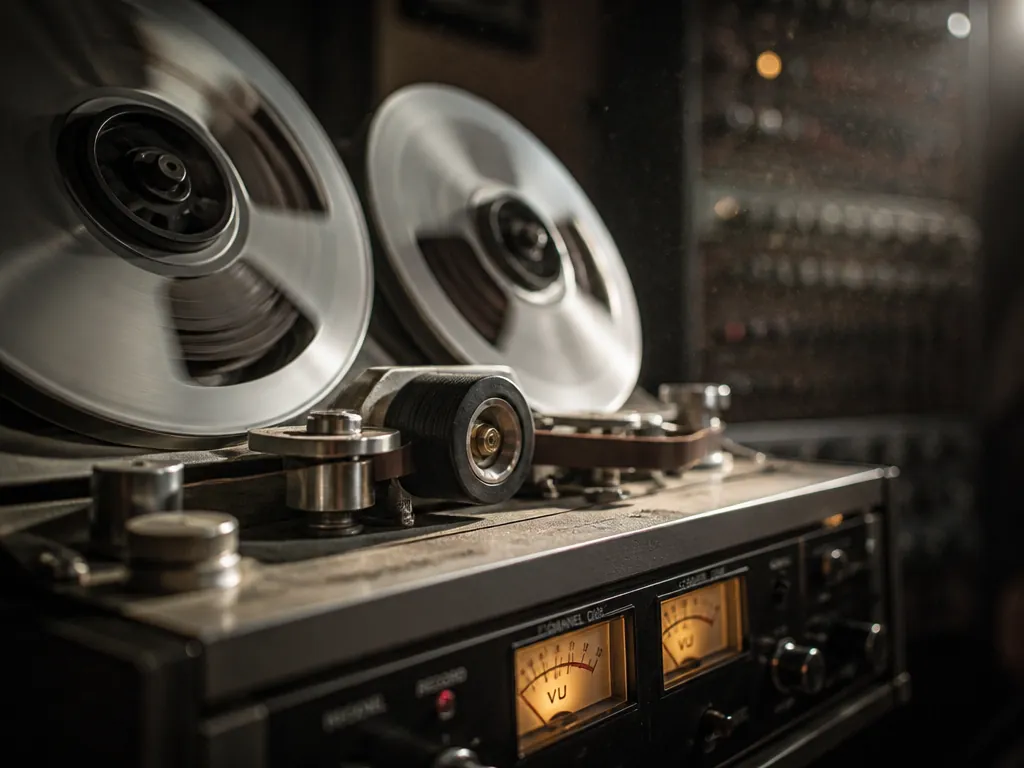
The job was a 90-second title sequence for a short film, due Friday, and the director wanted the synth bed to sound like it had been through a machine with a motor in it. So I had two three-head tape echoes open on the same send: one I paid for in 2019, and one of the free audio plugins that surface on release threads every few months with a screenshot of a virtual transport and a claim about modeling the record chain. Same source — a detuned analog bassline at 96 BPM in C minor, printed at 48 kHz — same repeat rate, feedback at zero, wet signal only, output levels matched by ear and then by meter to within 0.2 dB.
Then I did the thing you do when you want to stop arguing with yourself: printed both wet paths, flipped the polarity on one, and summed.
The measurement, and what it actually proved
They did not null. Obviously they did not null — but the residual is the interesting part. What was left sat around 18 dB below the individual prints, and it was not broadband. Most of it lived above 5 kHz, which is the head-gap loss and the playback EQ disagreeing, and a slow warbling component that never nulls at all because wow and flutter are stochastic. Two runs of the same plugin won't null against each other if the modulation is free-running.
So the test told me nothing about which one was correct. Neither is correct; both are unofficial emulations of a machine with a rubber pinch roller and 40 years of drift. What the test told me was where the two differed: the paid one had more high-frequency loss per pass, so its fourth repeat was already a dark smear, while the free one kept enough top end by pass four that the repeats fought the dialogue stem. That is a mix decision, not a quality ranking, and I could have gotten there with a low-pass in the feedback path if the plugin had exposed one.
Why the free ones got technically serious
None of the DSP here is secret. Head spacing that scales with motor speed, allpass diffusion networks for a spring tank, per-pass HF loss, record-chain compression before the tape, hiss whose spectrum shifts with transport speed — these are published, well-trodden techniques, and a competent developer working from service manuals and a real unit can land somewhere defensible. Several of the better ones now ship as source-available or copyleft-licensed projects with builds for Linux alongside Mac and Windows, which is worth noticing on its own: a plugin you can compile is a plugin that survives your next OS upgrade.
What you're paying for in the commercial tier, when you're paying for anything real, tends to be oversampling, componentized nonlinearity, GUI performance, and someone answering support tickets in 2029. Those are not nothing. They are also not always audible at the level you're printing.
Does a free plugin's license affect who owns your master recording?
No — a plugin license governs the software, not the audio you render through it. Copyleft terms like GPL-3.0 attach obligations to distributing the code (and modified builds of it), and proprietary freeware EULAs restrict copying and resale of the binary. Neither is a claim on your master recordings, and no reputable audio developer asserts one. If you ever find a plugin EULA that reaches toward the output, that's a reason to close the installer, not a reason to hire a lawyer.
The terms are still worth reading, for second-order reasons. Free-with-an-account plugins can carry telemetry, activation servers that must be reachable at load time, or license grants limited to non-commercial use — that last one is rare in audio but it exists, and "free" and "free for commercial work" are different sentences. Sample-based instruments are the genuine exception: a sample library's license does govern what you may do with the recordings inside it, which is a different legal object from a plugin that generates or processes your own audio. Read the developer's own terms rather than a forum summary, and get advice from someone qualified when there's real money attached.
Read these specs before it touches a master
| What to check | Why it matters | What it predicts you'll hear |
|---|---|---|
| Oversampling (and whether it's switchable) | Nonlinear stages alias without it | Inharmonic grit mirroring down from the top octave on bright sources |
| Head spacing tied to repeat rate | Real machines move one motor, not three heads | Whether multi-head patterns stay musical as you sweep the rate |
| Per-pass HF loss and feedback filtering | Controls how repeats decay into the bed | Repeats that darken and disappear vs. repeats that pile up and mask |
| Dry-path handling | Some plugins run dry through the whole chain | Phase and level shifts on bypass; a mix that changes when you A/B |
| Latency reporting | Host delay compensation depends on it | Smearing on parallel sends, or a mix bus that loses its transients |
Test each of these in five minutes with a click train and a bright noise burst, not with a mix you already love. A click through a single playback head tells you the delay time is honest. A noise burst pushed into the record head tells you whether the saturation aliases. On the free unit that night, it aliased — audibly, on a source with a lot of 10–12 kHz content — until I ran it inside an oversampled container and drove it 6 dB softer.
Where the free ones still cost you
Archival risk is the real invoice. If a hobbyist project disappears and you reopen a session in three years, an unrendered send is a hole in the mix. My rule since a 2021 session went sideways this way: anything free that ends up on a delivered master gets printed to its own stem, at full bandwidth, with the plugin's preset exported next to the project file — and for source-available plugins, a copy of the installer or the tagged source archived with the session. Version pinning doesn't exist in this tier; a developer can change the algorithm in a point release and your recall no longer recalls.
CPU is the second cost, mostly on spring-tank emulations running long allpass chains at high oversampling. Freeze early. The third cost is preset ecosystems, which is a polite way of saying you'll do more of your own dialing, which is not obviously a loss.
Back at the title sequence
The free one printed. Not because it beat the paid plugin on the null test — the null test doesn't award points — but because its brighter fourth repeat, once I put a shelf after it and pulled 2 dB at 3.5 kHz, sat under the dialogue in a way the darker emulation kept refusing to. That was a 15-minute decision that I'd spent an hour intellectualizing.
The part I'd defend in a room full of engineers is the process, not the pick: level-match, print, listen at delivery loudness, then check the aliasing on your loudest, brightest source before you commit. Price told me nothing about the sound. It told me something about how long the plugin will still open, which is why the stem got printed.
If it survives a level-matched A/B and a full-bandwidth render of your brightest source, it's good enough to print — archive the installer and move on.
Not sure which tool to use?
Compare the top AI music and sound tools side by side — honest reviews, real pricing, no sponsorships.