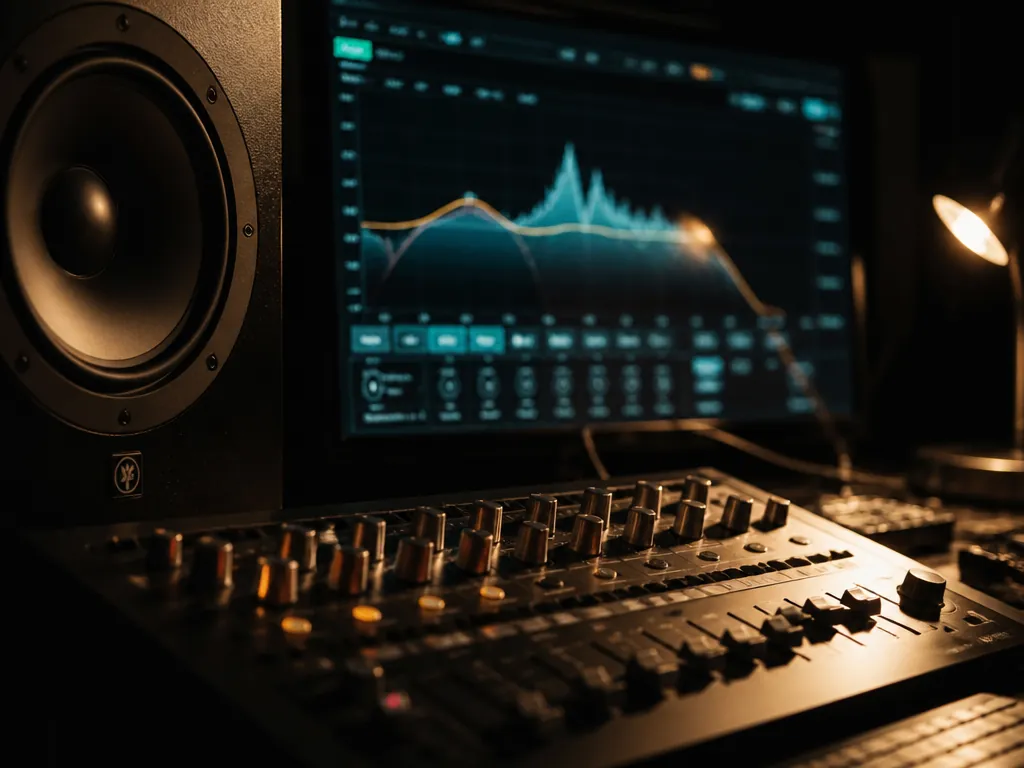
The vocal sat fine until bar 33, when the pad came in. Suddenly there was a 220 Hz shelf of mud that hadn't existed thirty seconds earlier — two sources, one frequency region, one of them arriving late. Cutting 4 dB at 220 with a static band fixed the collision and hollowed the pad everywhere else in the track. That single problem is the reason producers go shopping for free EQ plugins in the first place, and the reason most of them come home disappointed: a plain parametric can't know when the pad is playing.
What you want is frequency-dependent dynamic processing — a band that only moves when something triggers it. Three options in that space cost nothing, and they are not interchangeable.
The thing a static curve cannot do
A compressor reacts to the whole signal. Duck 3 dB because of a kick, and the hi-hats duck too. A static EQ reacts to nothing; it's a fixed sculpture. Between them sit two designs worth understanding before you download anything.
A dynamic EQ gives each band its own detector and threshold. The band sits inert until the level in its detection range crosses a line, then it moves — attack, release, ratio, the whole compressor vocabulary applied to one slice of spectrum. A multiband compressor splits the signal into bands with crossover filters and compresses each independently. Related, not identical: dynamic EQ leaves the signal path intact and adds a moving filter on top, so at rest it is closer to transparent. Multiband always has crossovers in the path, phase behavior and all.
The newer wrinkle is spectral processing, where the signal is transformed into frequency bins and each bin gets its own gain reduction against a matching sidechain bin. It's the finest-grained version of the same idea, and it costs latency. That tradeoff runs through everything below.
How I'd decide
Six criteria, in the order they actually bite:
- Detection and sidechain routing. Can a band be triggered by another track? Can the detection band be decoupled from the band being moved — listening at 3 kHz, cutting at 220? This is where free tools fence off features.
- Phase mode and latency. Minimum phase is free and smears phase. Linear phase and FFT modes report latency your DAW must compensate. If you're monitoring a vocalist or bouncing loops for a game engine, latency is not an abstraction.
- Workflow under deadline. How many clicks to a working band at 3 p.m. on a Friday. Real criterion. The best-sounding processor you avoid opening is worth nothing.
- License durability. Freeware is a favor a developer can withdraw. Open source under GPL cannot be un-published; someone can always compile it again.
- Format and host coverage. VST3, AU, CLAP, LV2, standalone. AAX is the recurring gap — Avid's SDK involves registration and signing that hobbyist and open-source projects rarely clear. Pro Tools users, plan accordingly.
- CPU. Eight instances on a laptop, not one instance in a demo project.
ZL Audio: the open-source spine
ZL Audio's equalizers are the most interesting thing to happen to free dynamic EQ in a while, mostly because the source is on GitHub under GPL. Per-band dynamics with independent detection, mid/side and stereo handling, selectable phase modes, and a collision-detection display that shows where two sources are fighting rather than making you guess. The developer has been pushing into full spectral/FFT dynamic processing, where the sidechain drives per-bin gain rather than a filter curve.
The honest negatives: the project moves fast, and fast-moving means beta builds, renamed parameters, and the occasional behavior change between versions. Load a beta into an empty session before you put it on a mix you owe someone. The spectral resolution controls are genuinely unintuitive on first contact — you are choosing a window size and trading time resolution against frequency resolution, and the UI doesn't hold your hand. No AAX, as of writing. And GPL has a real consequence: it's fine for your music, but if you ever ship a plugin of your own, the license travels.
TDR Nova: the fastest hands in the room
Tokyo Dawn Labs' Nova has been the default answer to "free dynamic EQ" for years, and the reason is workflow. Four dynamic bands plus a wideband stage, a parallel topology that stays musical when you push it, and a layout you can operate without reading anything. Thirty seconds from insert to a band that ducks 220 Hz when the pad enters. Nothing below beats it on time-to-result.
The negatives are structural. Nova is freeware, not open source — no source, no guarantee it survives a developer's change of plans or the next OS transition. It's also the deliberate free tier of a paid product: the GE edition unlocks capability, and external sidechain routing has historically been on the paid side of that line. Check the current feature matrix before you build a mix template around a routing assumption. And four bands is four bands. When a dense arrangement needs eight surgical moves, you're stacking instances.
LSP Plugins: the industrial rack
Linux Studio Plugins is the least glamorous and most quietly useful of the three: a large GPL suite covering parametric EQs with high band counts, multiband compressors, sidechain compressors, gates, and dynamic processors, built for LV2, VST3, CLAP, LADSPA, and standalone JACK use. If your criterion is format coverage across hosts I don't control, nothing free comes close.
The negatives are equally plain. The interfaces are engineering-first — dense grids of numeric fields, meters everywhere, very little visual seduction. You will spend an evening learning where things live. The suite is Linux-first in its center of gravity; Windows builds are maintained, macOS support has historically been the weakest leg. And the dynamics tools lean multiband rather than true per-band dynamic EQ, which is a different sound at rest.
| Criterion | ZL Audio | TDR Nova | LSP Plugins |
|---|---|---|---|
| Source available | Yes (GPL) | No (freeware) | Yes (GPL) |
| Per-band dynamic EQ | Yes, with spectral modes | Yes, 4 bands + wideband | Multiband-oriented |
| Decoupled/external sidechain | Yes | Gated toward paid tier | Yes |
| Time to first working band | Medium | Fast | Slow |
| Format breadth | VST3/AU/CLAP, no AAX | VST3/AU, no AAX | LV2/VST3/CLAP/standalone |
| Survives developer walking away | Yes | No | Yes |
Who this is for, and who should skip
If you mix three tracks a week on a laptop and want the mud gone before dinner, Nova is the correct tool and the band ceiling will never bother you. Skip it if your routing depends on one track triggering another and you're not paying for the upgrade.
If you're building a template you expect to reopen in five years — a game score with adaptive stems, an archive of client sessions — the ZL line is the one to learn. Skip it if beta churn will cost you a deadline this month.
If you run Linux, or you host plugins in something unusual, or you want one suite covering gates, multiband, and EQ from a single build system, LSP is the answer and the ugly UI is a one-evening tax. Skip it if you need a polished analyzer to think.
The verdict that emerged from a month of using all three: Nova stays on the insert chain for speed, ZL handles the collisions that need decoupled detection and gets learned properly, and LSP fills the utility slots. But the criterion that outranks output quality here is the boring one. Every mix you save is a bet that the plugin opens again.
Freeware is a favor. Source is a guarantee.
Not sure which tool to use?
Compare the top AI music and sound tools side by side — honest reviews, real pricing, no sponsorships.