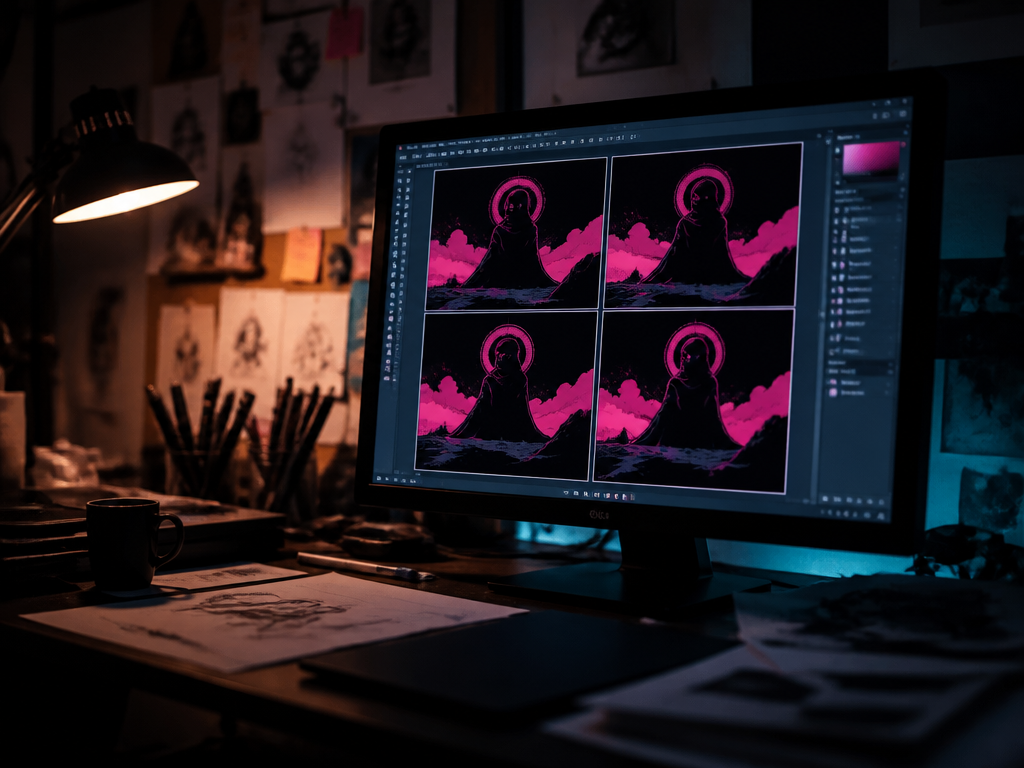
Last month I ran a small test. I opened a platform-native image tool — the kind now bolted onto every social app — and typed a prompt naming a friend's illustration style. She's a working cover artist with maybe forty thousand followers and a recognizable line: heavy black fills, a specific magenta, faces that never quite look at you. I didn't upload anything of hers. I only used words.
The AI image generation model gave me back four pictures. One of them had her magenta. Not close — exact. The kind of exact that only happens when a system has seen a lot of a specific person's work and learned to reproduce it on request. I didn't publish it. I sat there feeling the thing you feel when a machine hands you evidence of something you'd rather not have proven.
What that experiment actually measured
One prompt is not a study. But it measured the thing the marketing pages don't: the model had ingested enough of a named creator's output to recreate her signature without her name attached to a single credit or a single dollar. She never agreed to be a style preset. She was one, anyway.
That gap — between what a creator agreed to and what the model can now do — is the whole story. And the platforms know the gap exists, because they keep building features that walk right into it and then quietly walking them back.
The pattern, named plainly
The clearest recent example: Meta shipped a feature that could generate images referencing real Instagram accounts. Point it at a public profile and it would produce pictures in that account's visual territory. The response from creators and talent representatives was immediate, and Meta pulled it, with a statement about intending a useful creative tool. The tool was useful. That was the problem. It was useful with people's work and without their say.
What's worth noticing isn't the reversal. It's the default that produced the feature in the first place. Building a thing that references real accounts is a choice you make when your starting assumption is that public equals available. The retreat came after the backlash, not before the build — which tells you where consent sat in the priority list.
This is not a Meta-specific defect. Across the major platforms, the recurring arrangement is opt-out: your content is eligible for training or generation features unless you find the setting, understand it, and switch it off. Some platforms have added toggles. Some have added them in jurisdictions that legally required them and nowhere else. The burden of protection lands on the person with the least time and the least leverage — you.
What platforms actually disclose (and what they don't)
Here's the honest state of it, framed to stay true after the specific policies change:
- The terms of service usually grant broad rights. When you post, you typically license the platform to host, display, and adapt your content. Whether that license extends to training generative models is often left ambiguous, and ambiguity favors the platform.
- "Public" is doing heavy lifting. Many training and feature pipelines treat publicly visible content as fair to use. Setting an account to private changes what's scrapeable, but not always what's already been ingested.
- Opt-outs are frequently forward-looking only. Turning off a training setting may stop future use. It rarely claws back what a model already learned. A style the system already absorbed stays absorbed.
- Disclosure is thin on specifics. Platforms rarely tell you which of your posts went where, or whether a given generation feature drew on your particular account. You get a policy paragraph, not a receipt.
None of that is a legal opinion — read your platform's current terms, because they shift, and the meaningful details live in the fine print, not the announcement blog. But the shape holds: the systems are built to make participation easy and refusal effortful.
A short audit you can run this week
You won't stop a trained model from knowing what it knows. You can shrink your future exposure and document your position. Twenty minutes, roughly:
| Check | Where to look | What you're doing |
|---|---|---|
| AI/training setting | Account privacy or data settings | Opt out of model training where the toggle exists |
| Generative feature eligibility | Same settings menu, often separate | Some platforms split "training" from "AI features" — turn off both |
| Public vs. followers-only | Account privacy | Decide what's genuinely public on purpose, not by default |
| Regional rights | Settings, sometimes via VPN check | EU/UK/EEA users often have opt-outs others don't; know yours |
| Metadata / watermark | Export settings, or a tool like Glaze/Nightshade for visual art | Add friction for scrapers; understand it's a deterrent, not a wall |
If you're an illustrator or photographer specifically, look into style-cloaking tools. They don't undo what's done, and they degrade over time as models update, but they raise the cost of copying your future work.
What I changed, and what I didn't
After the magenta, I did the boring stuff. I opted out of every training toggle I could find on the accounts I actually use. I moved my portfolio to a site I control and left the platforms as a shop window, not a warehouse. I started watermarking source files even when it's ugly, because ugly is cheaper than surprised.
I did not delete my accounts, and I'm not going to tell you to. The reach is real and the work has to be seen. That's exactly the leverage the defaults rely on — the platforms know you can't afford to leave, so they set the terms accordingly and let you find the off switch on your own time.
My friend, for the record, was less upset than I was. "It was always going to happen," she said, which is either wisdom or the sound of someone who's tired. Both, probably.
So here's the one thing to do this week: open the settings on the account where you post the most, find the AI or model-training toggle, and turn it off — then screenshot the date. Not because it fixes the past, but because it's the smallest honest way to go on record that your work was never free for the taking.
Not sure which tool to use?
Compare the top AI music and sound tools side by side — honest reviews, real pricing, no sponsorships.