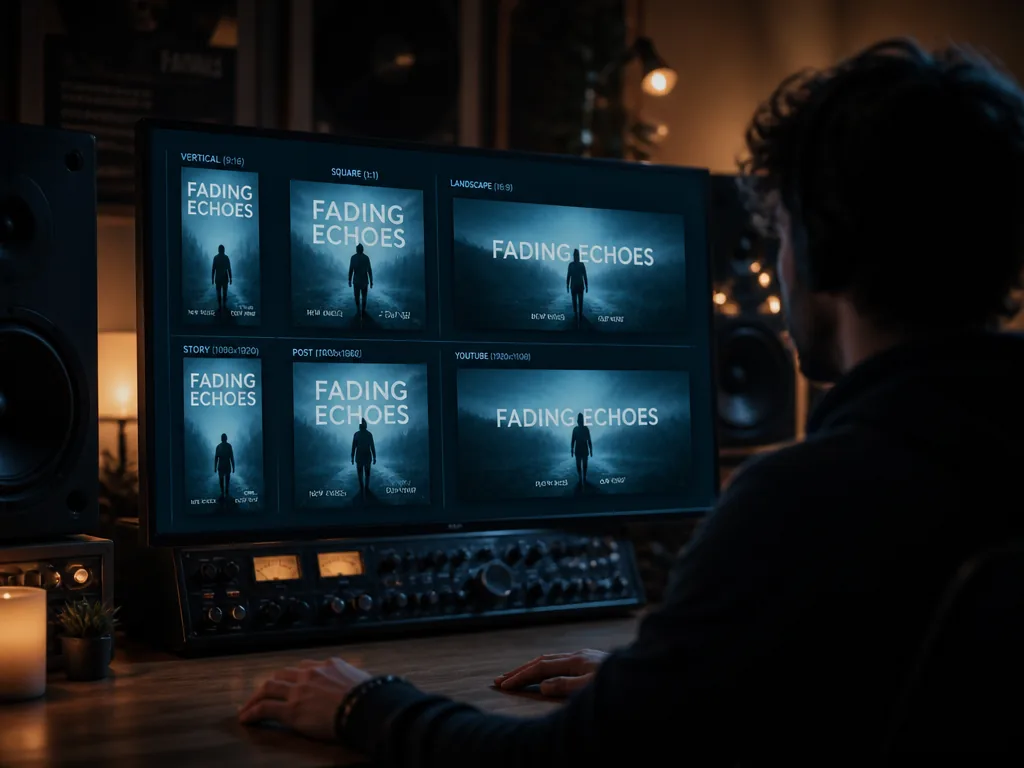
The track is mastered. 48kHz WAV, streaming-ready, uploaded three days early because for once you were organized. Then you open the release checklist and remember the part nobody warns you about: a vertical clip for TikTok, a slightly different vertical clip for Reels, a 16:9 lyric piece for YouTube, a square loop for the feed, a canvas for Spotify, and something — anything — for the story that goes up the morning of the drop. One song, six visual assets, and a budget that assumed the song was the expensive part.
This is the math that sends most independent artists toward AI music video generators, and it is worth being honest about what those tools do and do not solve. They are fast and they multiply formats. They are also inconsistent, occasionally uncanny, and indifferent to what your song is actually about. So the real question is not whether AI is "good enough." It is which job on your release calendar belongs to a machine, which belongs to a person, and which you should do yourself in an afternoon.
Why one song is now six deliverables
Discovery moved to the feed. A listener finds you inside a vertical video before they ever open a streaming app, and the platforms that surface music now reward whoever shows up most often with something watchable. That means the visual layer is no longer decoration on top of a finished track — it is the surface the track travels on.
The friction is obvious. Traditional music-video production runs on a timeline of weeks and a budget most self-releasing artists spend on mastering and distribution combined. You cannot commission a director for a Tuesday single. But you also cannot post the same static cover art six times and expect the algorithm to treat you kindly. So the work becomes a volume problem with a taste problem hiding inside it, and that is where the three ways of solving it start to diverge.
Three ways to make the assets, three criteria that matter
Set the contenders side by side: an AI music video generator, a hired human editor or director, and doing it yourself in an editor you already own. Judge them on three things that actually decide the outcome.
- Speed and volume — how many usable clips, in how many aspect ratios, by Friday.
- Control and intent — how precisely the result matches what the song is about.
- How it reads — what survives on a phone, at 2x, thumb hovering, sound often off.
No single tool wins all three. The verdict is in how they split.
Speed and volume: the machine wins, and it isn't close
Give an AI generator an audio file and a prompt, and you can have a rough visual in minutes and a set of variants in an afternoon. More importantly, most tools export the same concept across aspect ratios, so the vertical and the square and the 16:9 come out of one session instead of three edits. That is the whole appeal — not that any single clip is a masterpiece, but that you can produce the loop, the teaser, and the lyric piece in the time it takes a human editor to answer your first email.
A hired human is the opposite. You are buying quality and specificity by trading away speed and count. One strong piece, maybe two, on a timeline measured in weeks. DIY sits in the middle: fast if you have a template and a stock library, slow the moment you want something bespoke.
For sheer format multiplication, AI is the honest answer. If your problem is "six deliverables by Friday," this is the column that solves it.
Control and intent: this is where AI stumbles
Here the picture flips. Tell a human editor "I want the second verse to feel like the ceiling is lowering — slow push-in, desaturate as the bass drops out," and they will build exactly that. AI generation is closer to negotiation than instruction. You write a prompt, you get an interpretation, and the gap between them is the part that eats your afternoon.
Be honest about the failure modes, because they are real and they are consistent:
- Faces drift. Any recurring character warps between shots. AI has no memory of the person it drew four seconds ago.
- Temporal flicker. Textures shimmer and boil frame to frame in a way that looks fine paused and cheap in motion.
- Mushy renders. Complex prompts collapse into brown-gray soup. The more you ask for, the less coherent the result.
- Beat-blindness. Most tools do not cut to your track unless you force the timing in post, so the "music video" ignores the music.
The workaround is discipline. Abstract, textural, motion-driven concepts survive AI generation far better than narrative or anything with a consistent human face. If your song wants a story with characters, hire someone. If it wants light, color, and movement under a beat, the machine can carry it — provided you direct rather than gamble.
How it reads: the audience never sees your intentions
The last criterion is the only one your listener experiences. On a phone, at speed, with the sound off half the time, what actually holds a thumb?
A well-directed human piece reads as intentional — and audiences feel intention even when they can't name it. But a clean, on-beat AI loop with strong color and clear motion reads better than a bad human edit, and it reads far better than static cover art posted six times. The failure state that loses viewers is not "AI-looking." It is boring, off-beat, and repetitive. AI can be boring and off-beat if you let it. It does not have to be.
A working split
Here is how the criteria resolve into a decision rather than a debate:
| The asset | Best tool | Why |
|---|---|---|
| The anchor video (the one on your artist channel) | Human, or heavily human-directed | Intent and consistency matter most; it lives for years |
| Vertical loops, teasers, feed clips | AI generator | Volume and format multiplication win here |
| Lyric video | DIY in an editor | Templates make this fast and fully controllable |
| Canvas / story cover | AI or DIY | Short, textural, low stakes |
And a prompt that respects what the tool is good at:
Slow drifting macro shot of ink dissolving in water, deep indigo
into black, soft caustic light, high contrast, subtle grain,
no text, no faces, camera barely moving, 9:16
The reasoning: no faces, so nothing to warp. Abstract texture, so no narrative to collapse. "Barely moving" fights the shimmer instead of inviting it. And it leaves the beat-cutting for post, where you control it. You are aiming the tool at its strengths and steering it away from every place it breaks.
The verdict, arrived at rather than announced
There is no winner because these are not competing for the same job. AI music video generators win the volume war — the loops, the teasers, the six-formats-by-Friday grind that no human budget solves. A human editor wins the anchor piece, the one asset where intent has to survive contact with an audience for years. DIY wins the middle, wherever a template plus your own taste beats both. The artists who look prolific right now are not choosing one column. They are running all three and knowing which asset belongs where. If you want the loops handled without babysitting the render, that volume layer is exactly what a tool like City of Punk is built to feed.
The failure mode is treating this as a loyalty test — AI-purist or AI-refusenik. The tool is an instrument. It has a range. Play inside it.
Last release, I hired a friend to shoot the anchor video, cut the lyric piece myself over a weekend, and generated eleven vertical loops of blue smoke moving under the chorus — none of them a face, all of them cut to the kick in post. The smoke clips outperformed the video I paid for. I am not sure whether that is a lesson or a warning, but I know which column I reached for first the next time.
Not sure which tool to use?
Compare the top AI music and sound tools side by side — honest reviews, real pricing, no sponsorships.