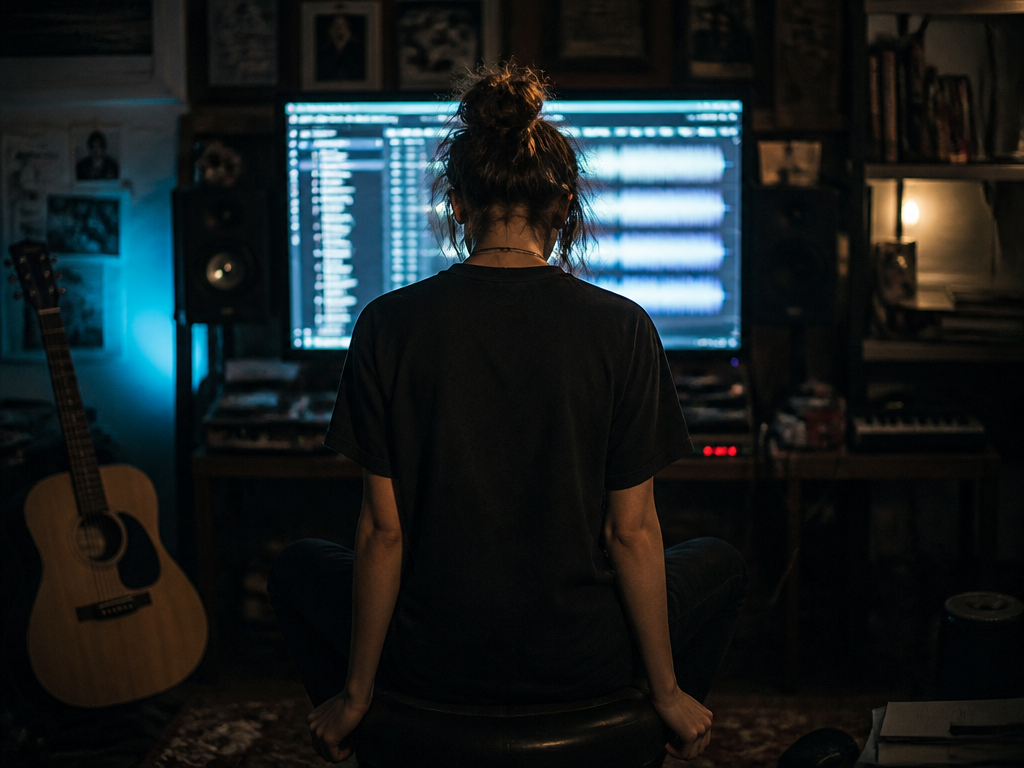
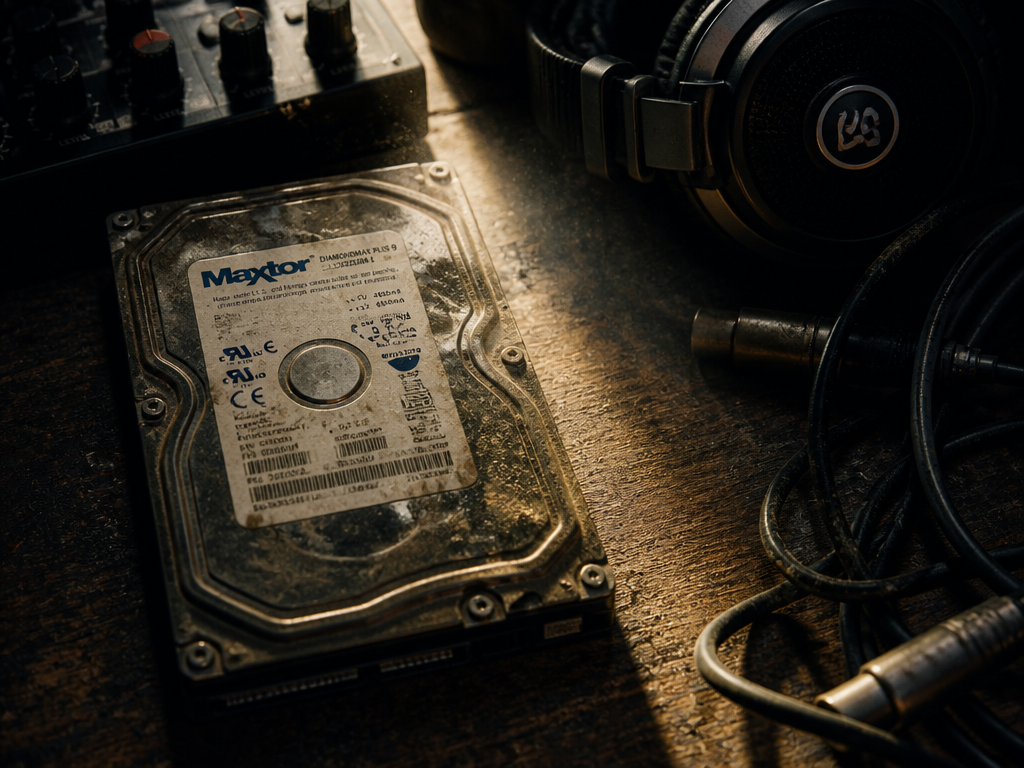
An artist opens a search box, types her own name into a public index of AI training data, and watches the results stack up. Not a track or two. Her catalog. Including songs the public has never heard — material that never left a hard drive, that no streaming service ever hosted, that existed, as far as she knew, only between her and the people she chose to share it with.
That moment has happened to more than one musician in the last couple of years, and it is the cleanest way to understand the consent problem at the center of AI music generation. The training data that makes these systems work came from somewhere. The question almost nobody asked out loud, until artists started checking, was whether anyone said yes.
What "trained on" actually means here
When a tool generates a passable lo-fi loop or a synthwave bed in seconds, it is drawing on patterns learned from a corpus — often a very large pile of audio and metadata scraped from the open web and from datasets assembled by researchers. The model does not store the songs the way a sampler stores a break. It stores statistical relationships: what tends to follow what, what a "moody trap intro at 140 BPM" tends to sound like.
That technical distinction is real, and it is also where the field quietly slipped its argument in. Because the model does not keep a copy, the reasoning went, the source recordings do not really matter once training is done. The output is new. No harm, no foul. A lot of otherwise careful people have nodded along to that.
It is worth tracing how a room full of smart engineers and musicians came to believe it.
Where the belief came from
The belief that training audio is fair game did not arrive fully formed. It accreted, one reasonable-sounding step at a time.
Step one was "publicly available." Early machine-learning research leaned on whatever could be downloaded at scale. Images, text, audio — if a crawler could reach it, it went in the pile. "Publicly available" became shorthand for "okay to use," even though those are not the same sentence. A song posted to a platform is visible to the public. That was never the same as licensed for ingestion into a commercial model.
Step two was the research exemption. A lot of the foundational datasets were built by academics, under norms — and in some jurisdictions, legal carve-outs — that treat non-commercial research more permissively than commercial exploitation. Researchers published, and the field treated their corpora as community resources. Fair enough, in context.
Step three was the leap. Commercial products got built on top of, or in the spirit of, those research datasets and methods. The permissions did not travel with them. What was tolerated for a paper became the foundation of a paid service, and the underlying "we can use this" never got re-examined. The belief outran its source.
By the time anyone with a back catalog ran the search, the assumption was load-bearing. Entire products depended on it being true. The trouble is that an assumption being load-bearing does not make it sound.
The source is thinner than the belief
Here is the honest state of play, as of writing: whether training a commercial model on copyrighted recordings without permission is lawful is genuinely unsettled. There are active lawsuits. There are conflicting opinions across jurisdictions. There are companies that license their training data and companies that do not, and they are competing in the same market while telling very different stories about how their sound got made.
What is not unsettled is the consent question, which is separate from the legal one. The musicians finding their work in these datasets did not opt in. Most were never asked. For an artist, the discovery that unreleased material is in the pile lands differently than a sample-clearance dispute, because it is not about a missed check. It is about control over work that was never offered to anyone. The offense is upstream of the money.
That is the part the "the output is new, so it's fine" argument cannot reach. You can believe, accurately, that a generated track is not a copy of any one song, and still understand why the person whose unreleased demos trained the system feels robbed. Both things are true at once. The technical defense answers a question the artist isn't asking.
Why the room is split
Walk into any studio conversation about this and you will find the divide. Some producers — including some very successful ones — treat AI tools as another instrument, no more fraught than a sampler in 1988, and they are not wrong that every new music technology has provoked the same panic. Others, looking at the same tools, see their own labor in the training set and refuse on principle.
The split is not really about whether AI is good or evil. Both camps are reacting to the same vacuum: there was no consent step, so everyone is improvising their ethics after the fact. The producer who shrugs and the artist who is furious are both filling a hole the industry left open when it decided "publicly available" was a permission slip.
If you make sound, or buy it
For a rights-conscious musician, the practical move is unglamorous: read what a tool says about its training data, and weight the difference between a vendor that licensed its corpus and one that stays vague. "We can't disclose our sources" is itself a disclosure.
For a buyer who needs clean, clearable audio in a project this week, the same question applies, framed commercially: can this output be traced to a defensible source, and does the license actually indemnify you? A model trained on consented or owned material — the approach City of Punk takes — is not a moral flex. It is the version of the question that holds up when a client's lawyer asks where the music came from.
The technology is not the scandal. The skipped step is.
Not sure which tool to use?
Compare the top AI music and sound tools side by side — honest reviews, real pricing, no sponsorships.