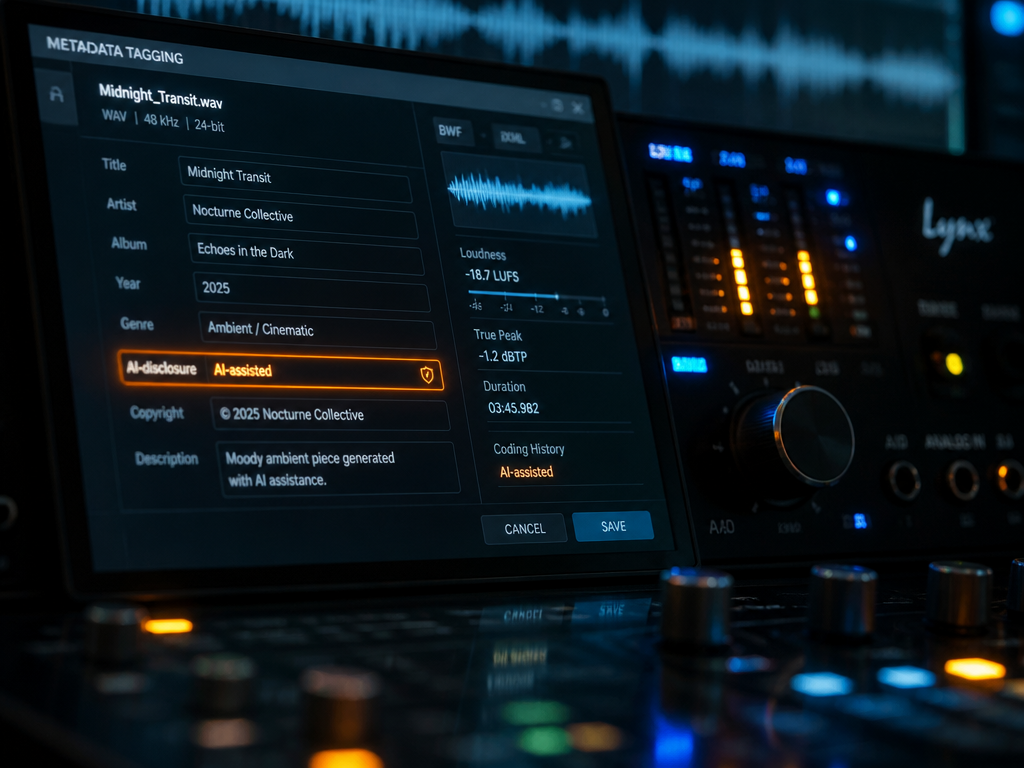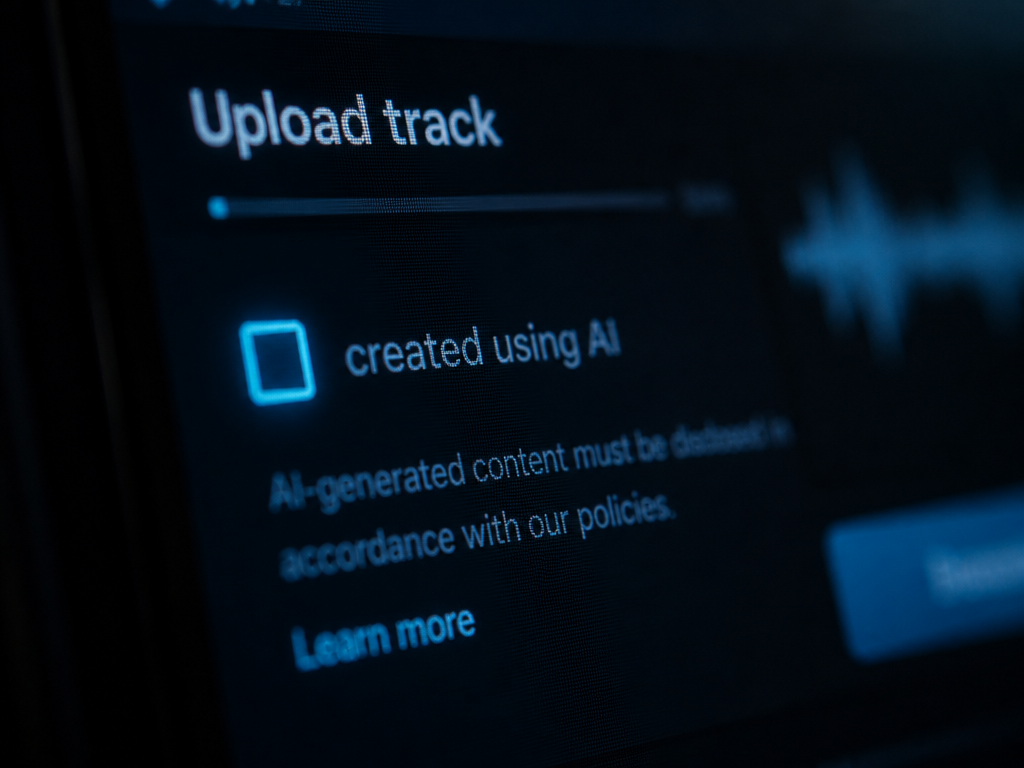
A checkbox showed up in an upload flow last year that read something close to "This track was created using AI." No tooltip. No definition. If you scored the pad with a soft synth preset and topped a real bass take with an AI-generated vocal ad-lib, do you tick it? If you wrote every note but ran the master through an AI stem separator, do you tick it? The person uploading has no idea, and — this is the part worth sitting with — neither does the platform, most of the time.
That checkbox is the visible edge of a much larger effort to build AI music labeling standards: a coordinated attempt by the recording industry's trade bodies to classify how machine-generated audio gets disclosed on streaming services. Before you tick anything, it helps to know where this idea came from, who actually decided it, and how much of it is enforceable versus aspirational. The short version: the belief that there is a settled standard is running ahead of the standard itself.
Where the standard actually came from
The framing you have probably absorbed is that "the industry agreed on AI labeling." That is true in the way a group of people agreeing to split a check is true — it depends who was at the table and whether anyone brought a card.
The push came from the major international and national recording-industry organizations, joined by a cluster of rights groups and distributors. They published a shared position: recorded music should carry metadata indicating whether and to what degree generative AI was involved. The proposal centered on a metadata field — a tag that travels with the file, readable by platforms, in principle surfaced to listeners.
Two things about that origin matter. First, it is a voluntary metadata recommendation, not a law and not a binding platform requirement. Trade bodies can propose a schema; they cannot compel a distributor in another jurisdiction to honor it. Second, the consensus is real at the top and thin at the bottom. The executives signed on. The DIY artist uploading a lo-fi loop pack through a budget distributor was not in the room, and the schema was not built around that person's workflow.
So the "standard" is better understood as a strongly-endorsed convention. That distinction is the whole story.
The two-tier idea, and where the line smears
The classification most proposals converge on has two rough buckets:
- AI-assisted: a human made the core creative decisions, and AI tools helped — think generative stems you edited, a model that suggested a chord voicing, cleanup and separation.
- AI-generated: the substance of the track was produced by a model from a prompt, with limited human authorship of the actual musical content.
On a slide, that is a clean two-tier system. In a session, it is a smear. Where does an AI-generated bassline you spent three hours re-sequencing and re-pitching land? What about a fully human composition where the only vocal is a cloned timbre? The taxonomy assumes authorship is a single dial from zero to one hundred, and production does not work that way. You layer. You resample. You run a human take through a model and a model output through your hands.
The tiers are useful as a conversation starter and shaky as a compliance test. Nobody has published a workable rule for the middle, because there is no clean rule to publish.

Do I have to label AI music before I upload?
Right now, for most independent uploads, disclosure is a distributor-by-distributor requirement, not a universal legal one. Whether you must declare AI involvement depends on the terms of the specific distributor or platform you use — not on a single industry rule. Some upload flows now ask directly and treat a false answer as a terms-of-service violation. Others say nothing. The safe reading: check the terms of the service you are actually uploading through, because that contract, not the trade-body announcement, is what binds you.
That is the honest answer. Anyone telling you there is one universal labeling law is describing a destination, not the current map.
What platforms actually check
There are two separate things happening, and they get confused constantly.
Disclosure is what you declare — the checkbox, the metadata field. It relies on your honesty.
Detection is what the platform figures out on its own. Some services have deployed classifiers that flag tracks as likely fully AI-generated, and they have reported high internal accuracy figures and claimed that a large share of new daily uploads trip the flag. Treat those specific numbers as snapshots of a moment, not fixed facts — they move, and they are self-reported.
Here is the tension: detection targets fully-synthetic tracks reasonably well and struggles with the assisted middle exactly where the taxonomy struggles too. A model cannot reliably tell that your vocal was cloned or that your drums came from a prompt if you produced around them. So detection catches the obvious cases, disclosure is supposed to catch the rest, and the rest is where the burden quietly lands on the person being honest.
The source is thinner than the belief
Put the pieces together and the shape is clear. A real, well-intentioned convention exists. It was authored by organizations with authority over their members and no authority over everyone else. It is voluntary. Its central distinction breaks down in the exact zone most working producers operate in. Enforcement is a patchwork of distributor terms and imperfect classifiers.
None of that makes labeling pointless. Transparency about how a track was made is a reasonable thing for listeners to want, and metadata that carries provenance is genuinely more useful than a viral guessing game about which songs are "fake." But the belief — that there is now a firm, shared standard you can simply comply with — outruns the source it rests on.
A short checklist before you tick the box
- Read the actual disclosure question in your distributor's upload flow, and its definitions if any exist.
- If a track's core melody, lyrics, or vocal identity came from a model, lean toward declaring it. That is the clearest case.
- If AI only touched production tasks — separation, cleanup, mastering assists — note it in your own records even if the form does not ask.
- Keep your project files and prompt history. If a claim is ever questioned, your session is the evidence.
- Do not rely on "nobody will detect it." Rely on "I answered the question I was actually asked, truthfully."
The standard will keep shifting under you; your working notes will not.
The rule of thumb for tonight: if a human could not have made that part without the model, disclose it — and when you are unsure, describe what you did rather than guessing which label is "right."
Not sure which tool to use?
Compare the top AI music and sound tools side by side — honest reviews, real pricing, no sponsorships.