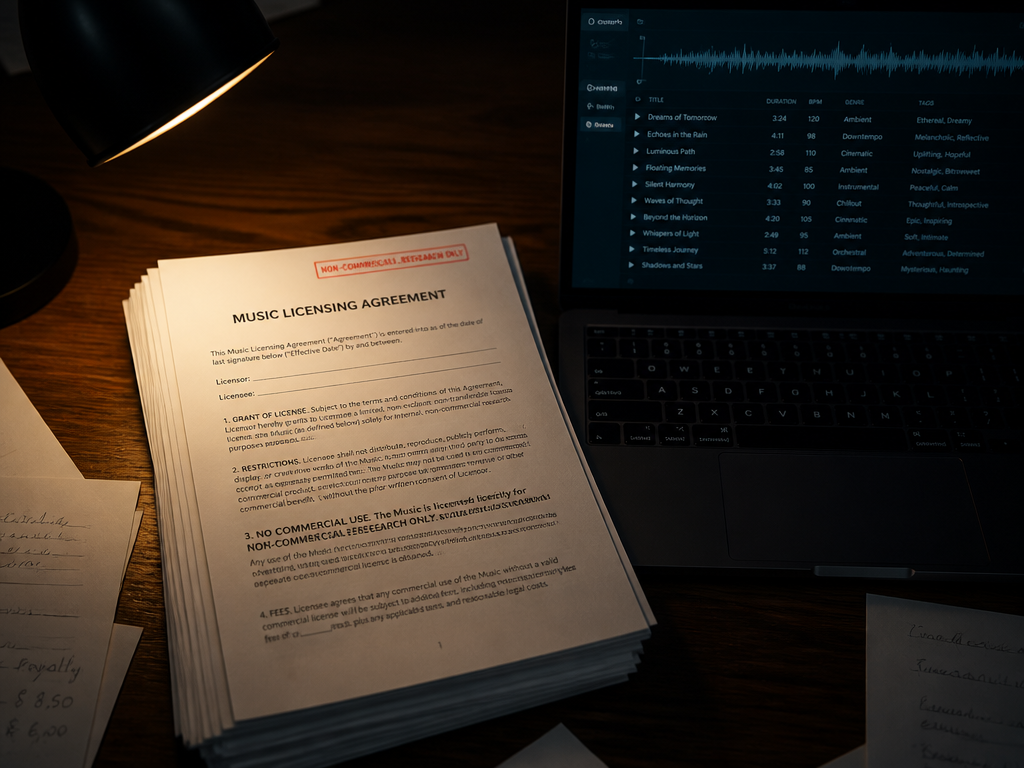
The email came in at 11:40 on a Thursday, three days before delivery: Please confirm no generative AI was used in the delivered assets. One line, no definitions. I ran the session in my head — the stem separator that rescued a guitar take off a phone recording, the drum synth with a neural kit-randomizer, one 128 BPM pad that began as a text prompt and ended up buried under three layers of my own processing. Which of those was I confirming? That questionnaire is where most arguments about AI songwriting ethics start, and it points at the wrong end of the pipe.
Here is the verdict, in one sentence: the ethics of AI in music is a supply-chain question rather than a disclosure question, and the part you can actually act on is which contracts you sign, not which button you press.
The myth: the line runs at the render button
You have heard this one, probably from both directions in the same week.
The prosecution version: if a model touched it, it isn't yours, and putting your name on it is a small fraud. The defense version: I disclosed it, so we're square — the listener knows, the listener chooses, done.
Those two camps hate each other and share a premise. Both locate the moral event at the render: one moment, binary, capturable by a checkbox. Declare which side of the line you're on and the ethics resolve.
It's an appealing myth because it is checkable. Every previous panic in this trade eventually resolved into something checkable. The sampler had its decade of "is that even playing." The drum machine had its decade. Auto-Tune had its decade, and then it became a genre. Producers who lived through those arguments have a reflex: the tool panic passes, the work gets judged on whether it moves people, calm down.
That reflex is mostly right and it fails here on one specific point, which is the whole subject of this piece. When you cleared a sample, there was a named rights holder, a signed document, and a waveform you could point at. The ethical question and the paperwork question were the same question, and both were inspectable from the artifact. With a generated stem, the ethically load-bearing event happened months before you opened your DAW, inside a training run, involving people you cannot name, under terms you cannot read. Nothing about it is visible at the render.
So the render is where the argument happens and it is the one place the answer definitely isn't.
The evidence, part one: the labels arrived, and they tell you almost nothing
Credit where it's due: the transparency proposal that artists spent two years demanding got built. As of writing, Deezer tags fully AI-generated uploads and keeps them out of algorithmic recommendations. Spotify has announced AI-disclosure fields carried through the DDEX standard, so distributors can pass along whether AI was used in vocals, in instrumentation, or in post-production. YouTube requires disclosure of realistic synthetic content in some categories. Details in this area move fast enough that you should check where each of these stands the week you read this, not take my word for it.
So the labels exist. Look at what they carry.
They carry information about your process. Did a machine make the vocal. Did a machine make the bed. That is a real thing to know, and the DDEX-style split between vocals, instrumentation, and post is more thoughtful than the single "AI" stamp people were arguing about.
They carry nothing about provenance. A track built on a model trained entirely on a production library whose composers signed for it gets the same tag as a track built on a model trained on a scrape of the open web. The disclosure regime answers a question about the tool and stays silent on whose work is inside the tool. That is not a scandal — the explicit tag doesn't tell you whether a record is any good either — but if you were waiting for labeling to settle this for you, it hasn't and structurally can't.
There's a second effect worth naming, because it is where your market standing actually lives. The tag makes AI use a machine-readable signal, and machine-readable signals get filtered on. Not by listeners, mostly. By playlist editors, sync libraries, music supervisors, and distributors who now have a field to sort by. The disclosure you make for honesty's sake becomes a filter someone else runs at scale. Both of those things can be true and you should plan for the second one.
The evidence, part two: "trained on licensed data" is four different sentences
This is the phrase doing the most work in the marketing of every music model that wants enterprise money, and it has a range of meanings wide enough to drive a catalog through.
| What the vendor says | What it can mean | What to ask |
|---|---|---|
| "Licensed training data" | They bought a production-music catalog outright, one flat fee, from composers who signed a buyout years earlier for library placement | Which catalog? Did the original contributor agreement contemplate model training? |
| "Our own content library" | They own a stock platform and updated its contributor terms | Could contributors opt out without losing distribution? |
| "Publicly available data" | Scraped | Nothing. That is the answer. |
| "Partnerships with rights holders" | A deal covering some fraction of the corpus | What fraction? Does the money reach songwriters or stop at the label? |
| "We honor opt-outs" | Future training runs may exclude you if you found the form | Does it apply retroactively to models already shipped? |
The two poles are public. In June 2024 the major labels sued Suno and Udio over training on copyrighted recordings, and there have since been reported moves toward licensing arrangements between some of those parties. By the time you read this, that could be settled, appealed, or restructured into something unrecognizable — treat any specific status you remember as expired and look it up.
At the other pole, Stability trained Stable Audio on a licensed production-music library rather than a scrape, and said so plainly, which is more than most vendors do. The honest negative on that approach: a licensed corpus is a narrower corpus, and you can hear it. Models trained on production libraries tend to render production-library music — competent, mid-tempo, harmonically safe, the sonic equivalent of a stock photo of a handshake. You are trading breadth of reference for cleanliness of provenance, and that trade shows up in the output, not in a footnote.
The cross-domain test is instructive here. In images, the tool that marketed hardest on clean data trained on its own stock library, and stock contributors reported finding their work in a training corpus under terms they had signed for stock distribution. Nobody scraped anything. Everything was licensed. Contributors were still angry, and the anger was not irrational: consent to one use is not consent to the use that competes with you. The music version of that story is already in motion inside every library catalog that got acquired in the last five years.
So "licensed" is not a synonym for "consented," and neither is a synonym for "compensated on an ongoing basis." Three separate questions, one marketing word.
The mechanism: nobody can audit a render, including you
Here is why the disclosure framing keeps failing, mechanically.
Sample clearance has forensics. You can A/B the waveform. A musicologist can write a report. A court can listen. The evidence lives in the artifact and anyone with ears and a spectrum analyzer can participate.
A model output has none of that. Weights are not a sample library; they don't hold retrievable copies of the training set in any ordinary sense. Memorization happens at the edges — push a model hard toward a named artist and a signature cadence and you can land uncomfortably close to something specific — but there is no diff you can run between your render and a corpus you were never shown.
Four consequences follow, and they are the actual shape of this problem:
The accusation is unfalsifiable from the audio. If someone says your track is built on stolen work, you cannot disprove it by playing them the track. You can only produce paperwork.
The paperwork is the vendor's, not yours. You are being asked to warrant a chain of title whose first link is a contract you have never seen, between two parties neither of whom is you.
You cannot unbake it. If a corpus turns out to be contested after you shipped, there is no equivalent of swapping the sample and re-mastering. The provenance question attaches to the model, and the model is in every render you made with it.
Time runs the wrong way. Sample clearance is a problem you solve before release. This is a problem that can arrive two years after release, attached to a lawsuit you are not a party to.
That last one is why the smart version of this worry is not about credibility at all. It's about exposure.
The mechanism: where the risk actually lands
Three contracts stack up behind any commercial track with a generated element in it.
Contract one is between the vendor and whoever's music trained the model. You cannot see it. You will never see it. Its existence and its terms are asserted in marketing copy.
Contract two is the vendor's terms of service, which you can read and should. The recurring traps, in rough order of how often they bite: free and entry tiers frequently grant no commercial rights at all, with commercial use appearing a tier or two up; ownership of outputs is sometimes a license rather than an assignment; and the rights you hold to work made during a subscription do not always survive cancellation. Every one of those varies by vendor and changes without much announcement, so read the current version rather than the version someone summarized in a forum thread.
Contract three is between you and your client — the sync agreement, the work-for-hire, the game-audio deal. Somewhere in it is a representations-and-warranties clause where you state you have all necessary rights and agree to indemnify them if you don't.
Notice the shape. The party with the least information about contract one is the party who signs the strongest promise in contract three. Vendor indemnity is the only thing that partially rebalances that, which is why I now read the indemnity clause before I read the feature list. It is usually gated to business tiers and it is usually capped, and a cap set at some multiple of your monthly subscription is not a legal defense fund. It is a gesture. A gesture is still better than silence, because a vendor willing to indemnify has internal counsel who believes something about their corpus, and that belief is the most honest signal you will get out of them.
The credibility question, honestly
The worry underneath most of this is simpler than the legal machinery: does using this make me a fraud, and will people find out.
Straight answer, from watching how it actually plays: listeners are not running forensics. The penalty, where it exists, is administered by peers and gatekeepers, and it attaches to a specific thing. Not to tool use. To abdication.
The distinction holds up under pressure. Nobody in a mix session has ever asked whether the reverb was convolution or algorithmic. Nobody asks whether the bass was played or programmed. The line that people actually enforce is whether there was a decision-maker — whether someone heard the render, judged it against a purpose, and rejected forty of them. Prompt-to-master with no editing, presented as authored, is the case that draws contempt, and it draws contempt partly because it's usually also bad, in the specific way that unchosen things are bad: no arc, no restraint, no wrong-sounding choice that turns out to be the hook.
Two honest qualifications.
First, the penalty is wildly uneven by room. In game audio and post, where the brief is "forty seconds of tension bed that loops seamlessly and doesn't fight dialogue," nobody cares how the bed was made. In singer-songwriter contexts, where the entire product is a claim about a person's interior life, an undisclosed generated topline is a genuine breach of the thing being sold. Same tool, different contract with the audience.
Second, and this is the uncomfortable one: a large share of the work being displaced was never the work anyone was defending on artistic grounds. Cue-library wallpaper, corporate underscore, the two-minute uplifting-tech bed. That tier is where models bite first and hardest, and it was a real income floor for a lot of working composers. The credibility conversation and the income conversation are not the same conversation, and blending them weakens both — you end up making an argument about art while what you're actually protecting is a rate card. Make the rate-card argument openly. It's a good argument. It doesn't need the metaphysics.
How I'd decide before a tool touches a paying session
Six things, in the order I check them.
Provenance specificity. Does the vendor name what they trained on, or gesture at "licensed and publicly available sources"? That second phrase is a compound: the second half eats the first. Specificity is not proof, but vagueness is reliably informative.
Who got paid, and on what basis. Flat buyout of a catalog is different from an ongoing pool, and both are different from a label deal that may or may not reach the writers. Ask which one it is. Vendors who have a good answer publish it.
Output license and its tier gate. What rights does your current plan grant, in writing — not the plan on the pricing page you looked at last year. Confirm commercial use, confirm whether it survives cancellation.
Indemnity. Present, absent, capped, tier-gated. Absent is a legitimate reason to keep a tool in sketching duty only.
Uniqueness. Can another user prompt their way to something substantially identical, and does the vendor claim exclusivity of your output? For sync work this matters more than provenance, because the failure mode is two brands with the same bed.
Exit. Do you get stems and full-rate files, or a stereo bounce you cannot fix later? Stems are also an ethics feature: they are what lets you replace the questionable element without rebuilding the track.
Who this is for, and who can skip the whole question
Take this seriously if you deliver to anyone with a rights clause: sync, library, advertising, game audio, film, any work-for-hire with a warranty in it. You are the one who signs the promise, and "the vendor said it was licensed" is not a defense you want to be building at the point you need it.
You can mostly skip it if the output never leaves your room, or never survives to the master — reference sketches, arrangement tests, a generated pad you replace with your own before bounce. One caveat worth stating plainly, because I've done it: a sketch you keep listening to becomes an arrangement you keep. Idea laundering is quiet and it is not covered by any of the above.
Reconsider entirely if you're an artist whose audience relationship is built on authorship. Not because the tools are dirty, but because that audience is buying a claim, and the claim is the product.
The honest takeaway
This is not a purity test, and I'm not running one. I use models. I'll keep using them. What I've stopped doing is treating the disclosure checkbox as though it discharges the obligation, because the obligation lives upstream of the render, in a contract I can't see, signed by people who mostly didn't know a model was coming.
What you can control is the record you keep. So here's the rule, and it takes ten seconds: before any generated element goes into a paying session, write four things beside it in your project notes — tool, plan tier, date, and what the vendor claims it trained on — and if you can't fill in that fourth field, the element stays a sketch and never becomes a stem.
Not sure which tool to use?
Compare the top AI music and sound tools side by side — honest reviews, real pricing, no sponsorships.