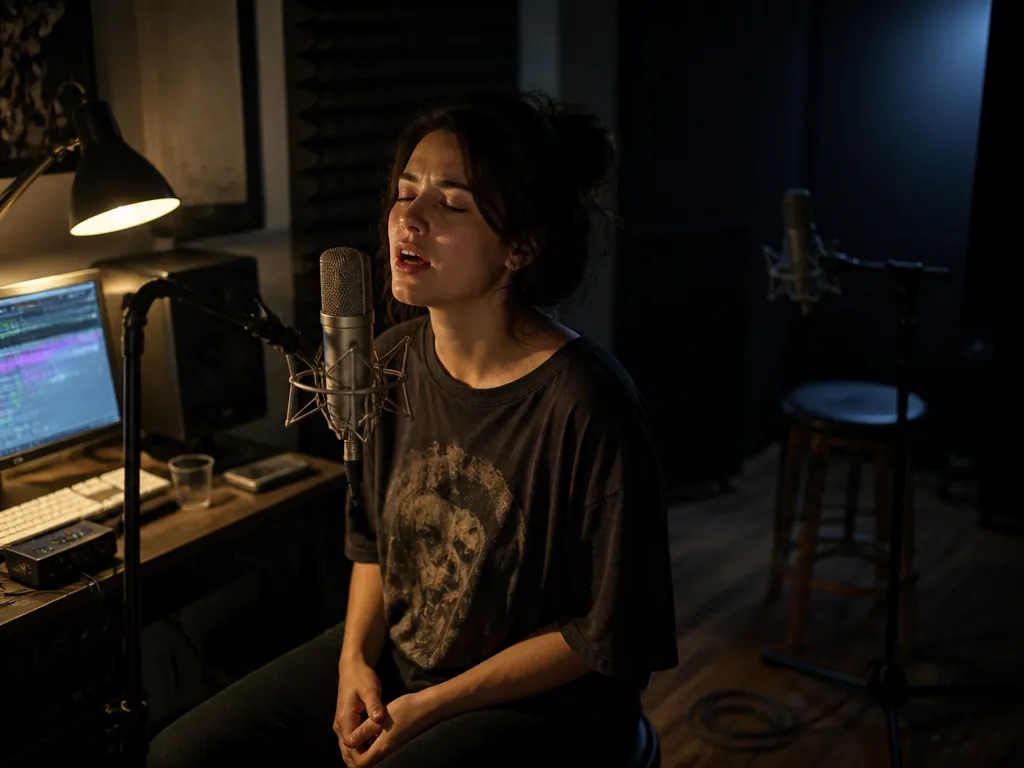
I spent an afternoon cloning myself. Forty-one seconds of dry vocal from a 2019 game trailer — me counting in over a click, no reverb, nothing under it — was enough for a consumer voice model to hand back a version of me singing a chorus I have never sung. Ten minutes, start to finish. The render was mushy through the low mids, the sibilance sat too far forward, and the vibrato had that even, machine-metered wobble. A friend who has heard my voice on twenty projects still couldn't pick the fake out of three files. That is the working state of AI voice cloning and unauthorized covers: the barrier is no longer skill or money. It is forty seconds of clean audio and the willingness.
Then I checked what I had broken. Nothing, as it turns out — I own the trailer stem and I own the throat. But run the same procedure against a singer in Kathmandu whose catalog sits on YouTube in a hundred clean, isolated takes, and the answer gets complicated in ways that surprise most producers.
What NIL rights actually cover, and why copyright isn't the same thing
NIL stands for name, image, and likeness — a right of publicity governing commercial use of who you are, as distinct from what you made. Copyright protects fixed works: a specific recording, a composition, a lyric sheet. A voice's timbre is not a fixed work. It is an identity marker, closer to a face than to a song, and in most jurisdictions it lives under a different statute — or under no statute at all.
That split is the whole problem. When someone uploads a cloned vocal singing an original song in an artist's voice, no recording was copied and no melody was taken. The infringed thing is the person. Copyright, the tool every musician knows how to reach for, is aimed at the wrong target.
| The claim | What it can reach | Where it gets thin |
|---|---|---|
| Copyright in the recording | Reuploads, remixes, and stem-lifts of your actual master | A model output containing none of your audio |
| Copyright in the composition | An AI cover of your song — the melody and lyrics stay yours | A new song, never written by you, in your voice |
| NIL / right of publicity | Commercial use of your voice or name as an identifier | Places with no publicity law; non-commercial and parody use |
| Platform policy | Fast takedowns, no lawyer, no filing fee | One platform only; reupload takes seconds |
The bottom row is where most artists actually live, and it is the weakest row on the table.
Nepal's problem is a timing problem
Nepal's copyright framework dates to 2002 — drafted when the threat model was a pirated CD in a shop in New Road. It contemplates copying. It does not contemplate synthesis. Reporting out of Kathmandu describes artists who find covers in their own voice, take screenshots, post public demands for removal, and then discover their complaint doesn't map cleanly onto an existing offence category. Officers take the report. Nobody is certain what it is a report of.
Meanwhile the asymmetry compounds. An anonymous channel can generate and upload faster than a working musician can file. Every hour spent policing a catalog is an hour not spent recording. And there's a sharper irony coming: as platforms roll out AI-detection and content-matching systems, an artist whose voice has been cloned onto hundreds of tracks can find their own uploads flagged against the fakes. The originals arrive late to a database the copies got to first.
The regional picture is moving faster than the statute books. As of writing, an Indian court granted Arijit Singh interim personality-rights protection against platforms offering his cloned voice — a signal that South Asian courts will treat voice as an identity interest even where the legislation is silent. Tennessee's ELVIS Act wrote voice into its publicity statute outright. Denmark has moved toward giving people a copyright-style claim over their own face and voice. These are different legal instruments reaching for the same thing from four directions, which tells you how unsettled the ground is.
The other side of the counter
Here is where it would be easy to write a villain, and dishonest to do it.
A cafe owner in Thamel who plays AI covers all afternoon isn't running a piracy operation. He needs eight hours of pleasant, familiar-sounding music, and a channel hands it over free, ad-light, and endless. He is not thinking about likeness law. He is thinking about a speaker in the corner.
And if you're reading this as a video editor with a travel cut due Friday, or a game dev who needs adaptive folk-flavored loops for a bazaar level, you already know the appeal. A model that returns three minutes of usable 48kHz material in ninety seconds is a genuinely good deal against a sample-clearance process that could take a month and might fail. The problem isn't that you want the render. It's that almost no vendor publishes its training set, so "was a working Nepali singer's catalog in there" is a question you structurally cannot answer from the outside. Terms vary widely by tool and change often — read the actual license before a client cheque depends on it.
Keep receipts, on both sides of the microphone
If you're an artist:
- Archive dated originals — session files, dry stems, upload timestamps. Provenance is your evidence, and it needs to predate the fake.
- Screenshot the infringing upload with the channel name, URL, and date before you file. Uploads vanish; your claim shouldn't vanish with them.
- File on two tracks: the platform's likeness or impersonation form, and — where the fake reuses your melody or lyrics — a straight composition claim. The second one is the stronger tool and the one artists reach for least.
- Register what you can register. A weak statute still works better with paperwork behind it.
If you're the one prompting:
- Describe timbre, never people. "Warm mid-range female vocal, breathy on sustains, slight nasal edge" is a usable prompt. A living artist's name in the box is the thing that turns a render into a liability.
- Log the prompt, model version, seed, and date for every keeper. When a client's legal team asks where the vocal came from, a one-line answer ends the conversation.
- Favor tools that state their training-data and commercial-use position in writing — City of Punk's comparison pages track which ones actually do, because that's the line that decides whether you can ship.
The measurement nobody has
The clone of me is still sitting on my drive, forty-one seconds of input turned into a chorus I never wrote. I've listened to it maybe thirty times. I can hear it isn't me — something in the way the breath resets before a phrase, a stiffness where I'd normally drag behind the beat. I cannot tell you what percentage of me is in that file, and neither can anyone else.
That's the unresolved part, and it isn't a legal gap so much as a scientific one. Detection systems are getting good at answering was this synthesized — that's a signal-forensics question with a signal-forensics answer. Nobody has a reliable method for the question NIL law actually asks: how much of this specific person is present in this output, and at what threshold does it stop being homage and start being them? Courts are being handed that question now, in Mumbai and Nashville and eventually Kathmandu, and they're answering it with ears and intuition because there is no unit to answer it with.
So what would that unit even measure — the acoustic fingerprint, or the thing a listener recognizes as a person?
Not sure which tool to use?
Compare the top AI music and sound tools side by side — honest reviews, real pricing, no sponsorships.