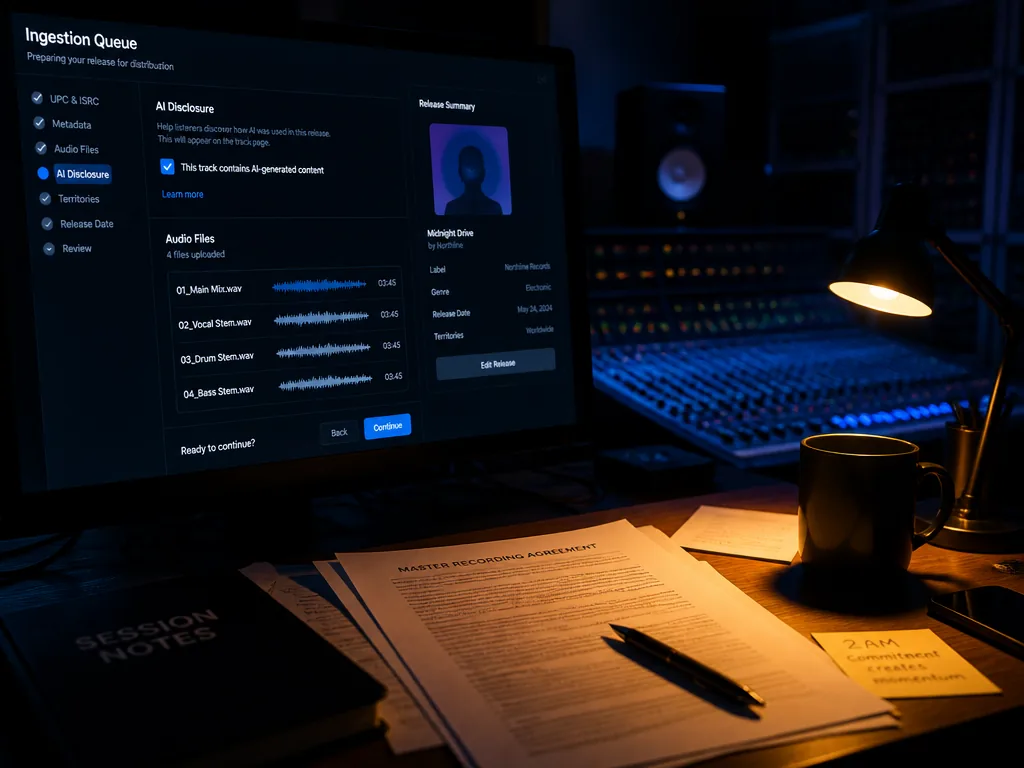
The loop that started this piece was sixteen bars of hi-hats. I generated them in a plugin, resampled them into a sampler, hand-swung the timing, ran them through a broken-sounding tape emulation, and dropped them under a bassline I played badly on a Juno. The record is mine. The hats are not, exactly. And when I got to the upload form, I stopped, because Beatport AI policy enforcement had just gone from a paragraph in a terms page to an actual detection system sitting between my WAV and the store.
So here is the question, the one you have probably already asked yourself at 1am with a bounce sitting in a Dropbox folder: does a generated element in my track get my release pulled?
The short answer, as of writing: almost certainly not, because the rule targets records that are fully machine-generated rather than records that used a machine somewhere in the chain. The longer answer has a grey zone in the middle, and that grey zone is where most working producers actually live.
What the rule draws a line around
Beatport's position on this is not new. The store published a policy against fully AI-generated music in early 2025. What changed is that a policy without a detection layer is a request, and a policy with one is a filter. The store has since added third-party detection to screen uploads, and framed the move as matching what its own users said they wanted.
The distinction the platform keeps returning to is between generative systems used as instruments inside a human-authored record and generative systems used to produce the record. That is a real line, and it is worth noticing that it is the same line most producers already draw intuitively. Nobody thinks a Serum preset writes the track. Nobody thinks an arrangement prompted end-to-end in a text box is your arrangement either.
Where it gets less comfortable is that the line is drawn in language, and enforcement happens in audio. A classifier does not know that you played the bass. It knows what the rendered file sounds like.
The 77% number, read properly
The headline stat attached to this rollout is that 77% of surveyed users said they want music made fully by people. On its own that is the kind of number that makes me suspicious, because platforms commission surveys that agree with them.
What makes it credible is the rest of the breakdown. Roughly 8% said they were fully open to AI-generated tracks, and around 13% said they would accept them conditional on artists being paid fairly. That is a distribution, not a slogan. The conditional group is the interesting one: those respondents aren't objecting to synthesis, they're objecting to uncompensated training. That is a licensing complaint wearing an aesthetic costume, and it will outlast whatever detection tool is running this quarter.
For you, the practical read is this: your buyers on that store skew hard toward wanting a person behind the record. Not toward wanting an analog signal path. Toward wanting authorship. If your promo copy leans on the tools, you're advertising to the 8%.
How detection works, and where it gets it wrong
Detection systems for generated audio work by looking for statistical fingerprints in the rendered file — spectral regularities, phase behaviour, the particular smoothness that end-to-end models leave behind in the top octave and in reverb tails. They are classifiers producing a confidence score, not oracles producing a fact.
Which means two failure modes, and you should assume both exist:
False negatives. A fully generated track that has been resampled, pitched, saturated, sidechained and mastered is a much harder target than a raw render. Anyone determined to game this will be re-recording their output through analog-ish processing, and some of it will get through.
False positives. This is the one that costs you. Heavily-processed, loop-pack-derived, quantised, cleanly-mastered electronic music is not obviously different, at the level of spectral statistics, from generated material. Minimal tech-house built from a commercial one-shot library is exactly the kind of record a classifier can misread. I have not seen a published accuracy figure for the store's detection, and you should treat the absence of one as a reason to keep receipts rather than as evidence of anything sinister.
The mechanism that actually matters to you, then, is not the classifier. It is the appeal path — whether a flag is a rejection or the opening of a conversation you can win with evidence.
Where your workflow sits
| Workflow | Realistic status |
|---|---|
| AI mastering or AI stem separation on your own recording | Clear. Processing, not authorship. |
| Generated one-shots resampled into your own sequenced pattern | Clear in intent, occasionally grey to a classifier. |
| A generated pad or texture buried under a mix you arranged | Grey. Depends on how much of the render survives. |
| A generated 8-bar loop that is the track's main hook, arranged by you | Genuinely contested. Defensible, not safe. |
| Text-to-music full render, then EQ and a limiter | Likely flagged, and reasonably so. |
| Text-to-music full render sold as a human production | The thing the policy exists to stop. |
The part where the answer is "it depends"
Three cases where I can't give you a clean rule, and won't pretend otherwise.
Generated vocals. Vocals are the hardest thing these models do, and also the thing that carries the most rights risk. A generated topline is not only a policy question on one store; it is a potential voice-likeness question, a publishing question, and a question about what your distributor will indemnify. The tooling has run ahead of the paperwork here, and I would not build a release around it yet.
Sample packs of unknown provenance. A lot of packs released in the past couple of years contain generated material that isn't labelled as such. You inherited that risk without agreeing to it. If a pack's marketing is vague about how the sounds were made, assume it might be, and don't build your hook out of it.
Where "assisted" stops. Nobody has published a percentage. There is no threshold that says a track is 40% generated and therefore fine. The honest framing is compositional: if you removed every generated element, would there still be a record? If yes, you're on the human side of the line, whatever a classifier says on a given Tuesday.
What to do before you upload
Keep session receipts. Your project file, dated, with MIDI you played and automation you drew, is the single most useful artefact you can produce in an appeal. Bounce a stems folder at the same time you bounce the master. This costs you thirty seconds and saves a week of email.
Be accurate in metadata rather than defensive. If a store or distributor offers an AI-disclosure field, fill it in honestly. Under-declaring to avoid friction is how a small flag becomes an account problem.
If you run a label, put this at intake, not at release. Ask every artist, in writing, what generative tools touched the record and where. One line in your submission form. You are not policing anyone; you are making sure that when a flag lands, you can answer inside a day instead of chasing a producer who has since gone quiet on Instagram.
And assume this spreads. The trade-body support behind this enforcement means the direction of travel is toward disclosure requirements across distribution, not toward one store having a quirk. Build the habit once.
Who this actually hits
If you play instruments, record hardware, or sequence from scratch, this changes nothing about your work and mildly improves your competitive position — the store is thinning out a category of upload you were competing against for placement.
If your workflow is loop-pack-heavy, quantised, and clean, you're not the target, but you are the most likely false positive on the store. Keep sessions. Nothing else changes.
If you have been shipping full text-to-music renders under an artist name, this store is closing to you, and the honest thing to say is that the platform's own users asked for that. The market you want is elsewhere: production libraries, sync, content beds, places where the buyer's brief is function rather than authorship. That is legitimate work. It is not this store.
And if you're a DJ sourcing rather than uploading: enforcement is a floor, not a guarantee. Detection has holes. Your ears and your knowledge of who makes what will keep being better filters than any classifier.
The grey zone will stay grey for a while, because the technology is moving faster than the definitions, and every clarification the industry publishes will be a definition written after the fact.
Rule of thumb for tonight: if you deleted every generated element from the session and there'd still be a track, upload it and keep the project file — if there wouldn't be, that record belongs somewhere else.
Not sure which tool to use?
Compare the top AI music and sound tools side by side — honest reviews, real pricing, no sponsorships.