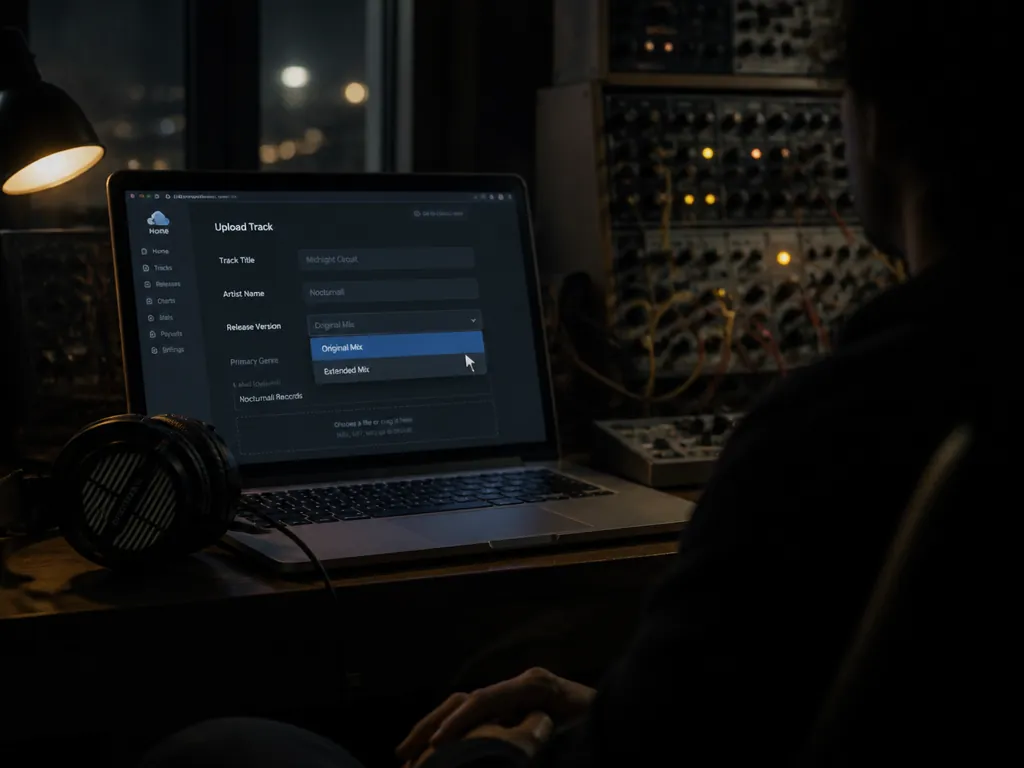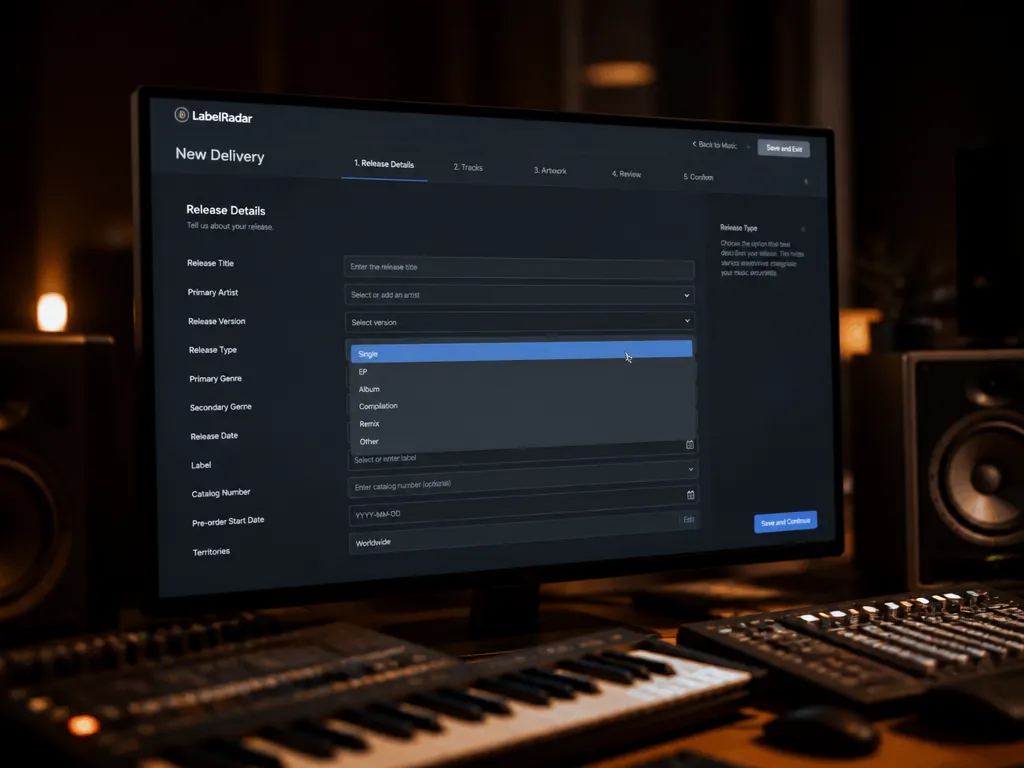
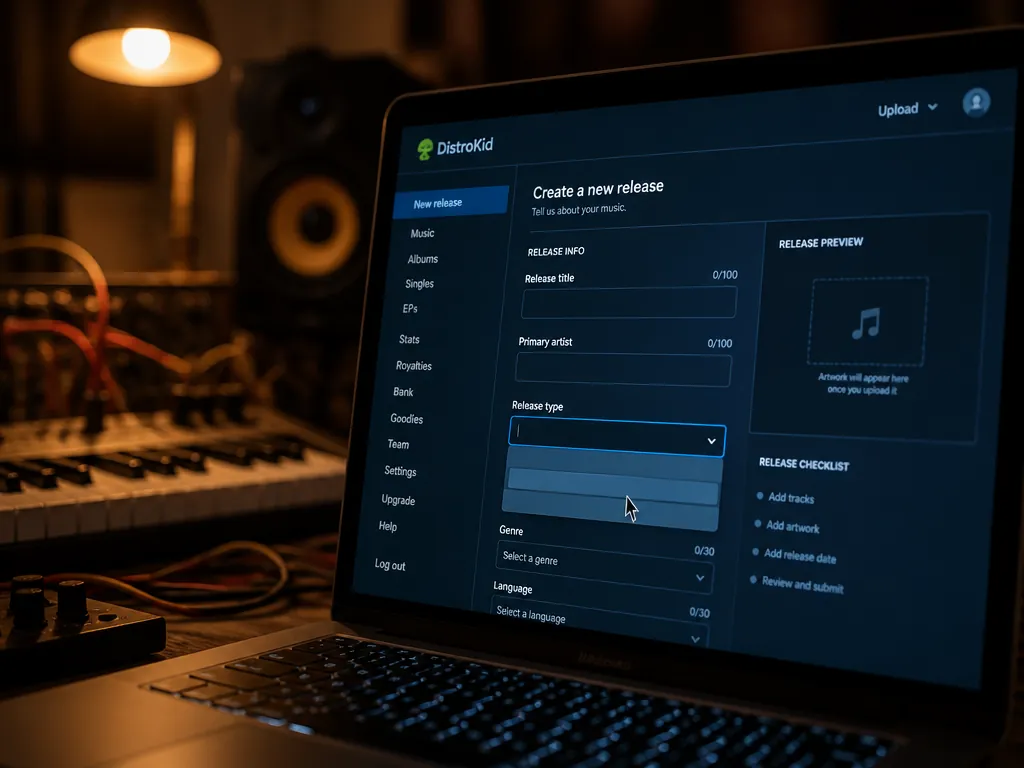
The first time regulation touched a session I was on, it was not a courtroom. It was a dropdown menu.
A client's distributor had added a field to the release form: AI involvement — None / Assisted / Generated. Three options, no definitions, no tooltip, and a delivery deadline that afternoon. The cue was a 92 BPM industrial bed in D minor: a generated pad I had time-stretched and filtered, sitting under a bassline I played on a keyboard, over drums I built from a kit I bought in 2019. Which of the three is that? The form does not say. The answer decides whether the track is chart-eligible in some territories, deprioritized in others, and — if the answer is wrong — whether the label breached a warranty it signed without reading. That dropdown is what AI music generation policy actually looks like from inside a release schedule. Not a statute. A metadata field with consequences.
The myth: someone is about to rule on whether this is allowed
The line I hear most from label people, and from journalists who cover them, is some version of we're waiting for the law to land. There is an implied date. A supreme court somewhere, a directive, a moment when generative music is declared legitimate or illegitimate and everyone updates their contracts accordingly.
That moment is not coming, and planning around it is the expensive mistake. Not because the legal questions are unimportant — training-data licensing is the largest unresolved question in recorded music right now — but because the rules that govern whether your release charts, monetizes, and survives an audit are being written by four different kinds of body at four different speeds, and the fastest of them is not a legislature.
The evidence: three layers, three clocks
Courts are moving, and they are not converging. In the United States, the through-line has been the human authorship requirement: the Copyright Office has repeatedly held that purely machine-generated output is not registrable, and federal courts have affirmed that position on appeal. That is a copyright-ability question, not a legality question, and the distinction gets flattened constantly in trade coverage. A track can be entirely lawful to release and still have a thin or unregistrable claim in the parts a machine produced. Separately, the training-data suits brought by rightsholders against generative music companies have moved in several jurisdictions, and a German court has found for a collecting society on the question of memorized lyrics reproduced by a general-purpose model. As of writing, several of the biggest disputes have resolved into settlements and licensing arrangements rather than published doctrine — which matters enormously, because a settlement produces a licence for the parties and precedent for nobody.
Statutes are slower and strictly territorial. The EU's AI Act phases in transparency obligations — disclosure of training-data summaries, marking of synthetic output — on a timetable that has nothing to do with your Q3 release calendar. Voice and likeness protection is advancing state by state and country by country: Tennessee's ELVIS Act, proposals in Denmark treating likeness closer to a property right, a federal US bill that has been pending long enough to be quoted at three consecutive conferences. Nothing here produces a single global compliance standard. It produces a map, and your risk is per-market.
Private rulebooks move in days. Chart bodies have begun publishing eligibility criteria for releases involving generative tools. Streaming platforms have shipped disclosure fields, impersonation policies, and spam filters aimed at high-volume uploads. Distributors have rewritten their terms so that the artist warrants the accuracy of the AI disclosure — meaning the party carrying the risk is the one filling in the dropdown. None of this required a vote. A platform can change the rule in a release note on a Tuesday, and the change binds you the moment you accept the updated terms.
That is the actual regulatory environment: a thin, slow layer of law underneath a thick, fast layer of private policy that most people in the chain have never read.
Can AI-generated music chart?
In most territories with published criteria, yes — with conditions. The bar that chart bodies and platforms have converged on is not no machine involvement. It is a set of four claims about the recording: that a human made creative decisions that rise above operating the tool, that the inputs and training were licensed or otherwise authorized, that no identifiable artist's voice or likeness was cloned without consent, and that the release complies with the same anti-manipulation rules that already govern streaming fraud. Meet those and the release competes normally. Fail one and it can be excluded, delisted, or held pending review.
What nobody has published is a threshold you could measure. No chart body has said eight bars of human performance or forty percent original stems. The human-authorship test is qualitative and, at present, essentially unauditable from the audio alone. Which leads to the thing worth internalizing: eligibility turns on what you can document, not on what you used.
The mechanism: how a disclosure flag actually travels
This is the part that gets skipped, and it is where the money sits. Follow one flag from the render to the chart.
- The tool. You generate a stem. Some tools embed provenance metadata in the file; content-credential standards exist and are gradually being adopted. Read the licence tier you generated under — commercial terms on most platforms differ by plan, and the terms attached to the output are the ones in force on the day you generated it.
- The session. You bounce to 48kHz WAV, and any embedded provenance dies at the render. A DAW mixdown is a new file with no memory of its parents. From this point forward, the only record that the pad was generated is a record you keep by hand.
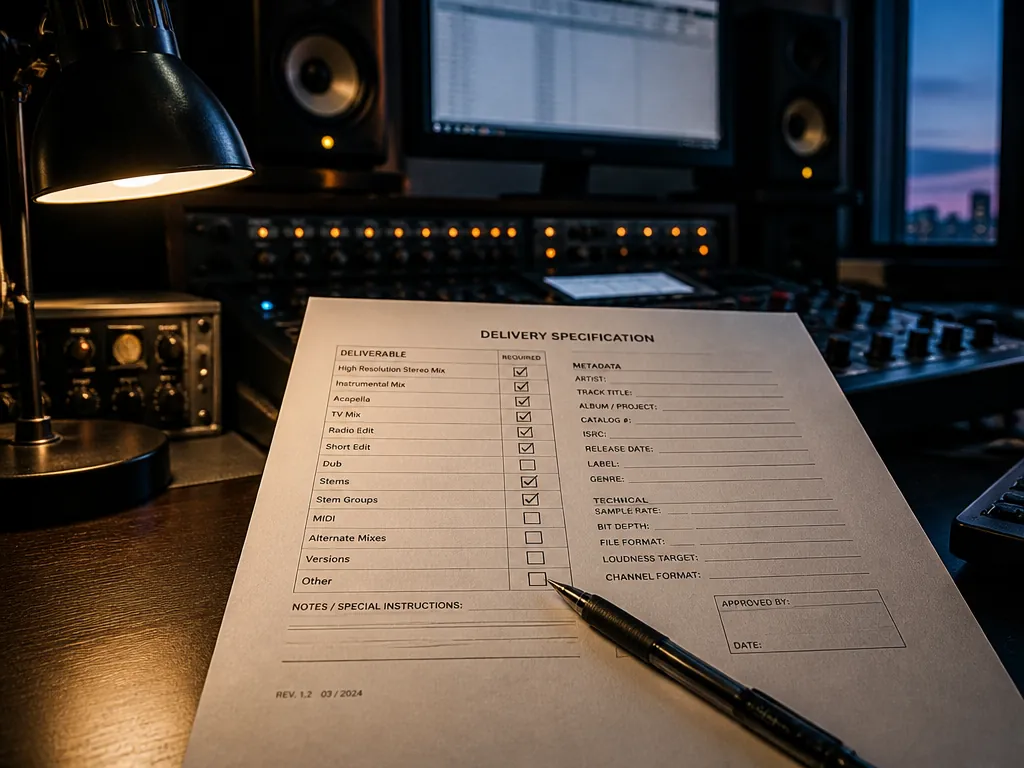
- The delivery. The distributor's form asks the question, and the answer is written into standardized delivery metadata — the DDEX-style fields the industry uses to move a release downstream. You are self-reporting, under warranty, into a schema that has more granularity than the three-option dropdown you were shown.
- Platform ingestion. The flag propagates. Platforms may also run their own classifiers over the audio, tag what they think is synthetic, and route high-volume or anomalous uploads to fraud review. Detection is probabilistic. It produces false positives on heavily processed human recordings and false negatives on well-arranged generated ones.
- Chart bodies and societies. They largely inherit the flag rather than re-derive it. They ask for documentation when something is queried — a takedown, a competitor complaint, an anomalous streaming curve.
The chain breaks in two places. It breaks at step 2, where machine-readable provenance stops existing. And it breaks at step 3, where a claim that no one downstream can verify becomes a contractual warranty. That second break is the real exposure for a label: not a regulator's fine, but a distributor's indemnity clause and a chart body's power to declare a release ineligible after it has already been marketed.
What survives a query
| The claim on the release | Who tests it | Evidence that holds up |
|---|---|---|
| A human authored it | Chart body, registry, sync buyer | Session files, dated project saves, performance takes, a written note of who decided what |
| Inputs were licensed | Distributor, platform, opposing counsel | Screenshot or PDF of the tool's terms and your plan tier on the generation date; sample clearances |
| No cloned voice or likeness | Platform, artist's representatives | Prompt log showing no artist name; signed release from any real vocalist |
| No manipulated streams | Platform fraud team | Marketing spend records, playlist pitch history |
The pattern across all four rows: everything that survives is something you wrote down at the time. Nothing is recoverable from the WAV.
A short version for a release checklist: record the tool and version string, the date, the plan tier, the prompt or seed, which elements are generated versus performed, and who at the label approved the disclosure. Six lines. Attach it to the asset, not to someone's inbox.
The honest takeaway
The risk register for a label in 2026 is not will this be legal. It is three narrower things. Contractual: you have warranted a disclosure you may not be able to substantiate. Catalogue: portions of a recording may carry a weaker rights claim than your metadata implies, which matters at sync, at sale, and at any due diligence event. Eligibility: chart and platform criteria are territorial, unstandardized, and revisable without notice, so a compliant release in one market can be a queried release in another.
And a fourth, less discussed: detection errs in both directions. I have heard human performances — a saturated Rhodes through a broken spring reverb — that sound more synthetic than anything a model rendered that week. A wrongly flagged release is a business problem even when you are entirely in the right, and your defence is, again, documentation you either kept or did not.
None of this is an argument against the tools. The pads are useful. The renders are still mushy in the low mids more often than the demos suggest, vocals remain the hardest thing to get right, and prompt-roulette is a real cost on a deadline. Those are craft problems. The regulatory problem is quieter and more boring: the industry is being governed by forms, and almost nobody is filling them in with evidence behind the answers.
So here is my own practice, offered as evidence rather than advice. Next to every session folder I keep a plain text file called provenance.txt, one line per cue: date, tool, version string, plan tier, the prompt verbatim, and which bars I played. It takes about ninety seconds per cue and it has already saved me one very unpleasant afternoon with a publisher's lawyer. The dropdown will keep asking a question the audio cannot answer — the only thing that answers it is the note you made before the render.
Not sure which tool to use?
Compare the top AI music and sound tools side by side — honest reviews, real pricing, no sponsorships.