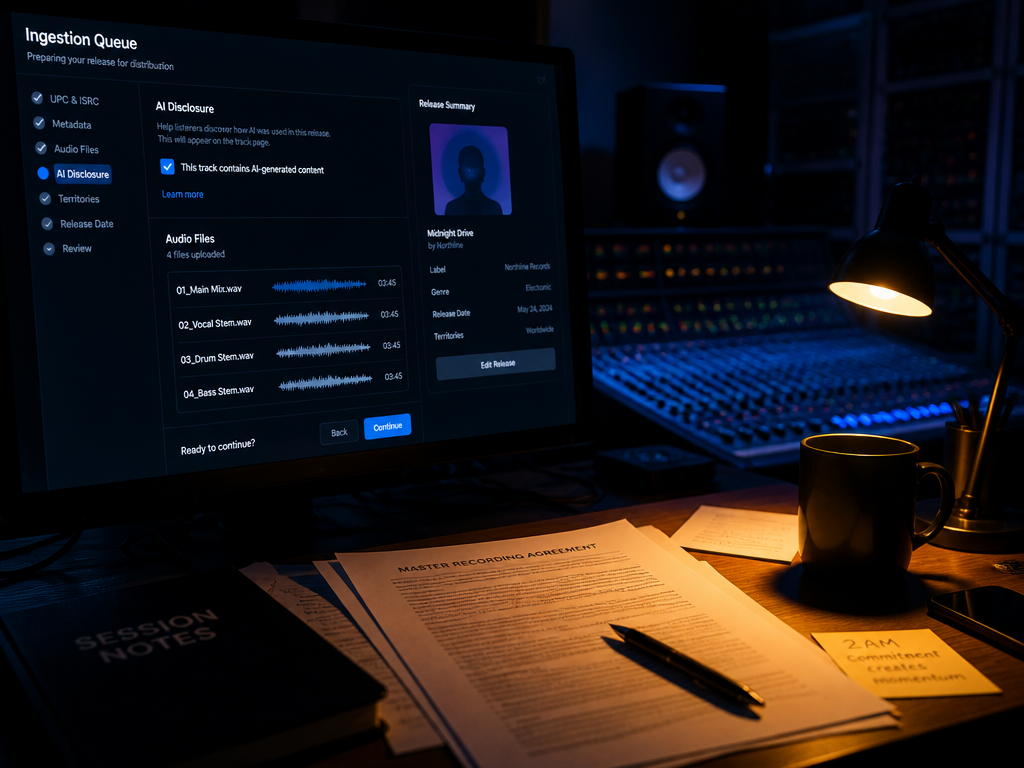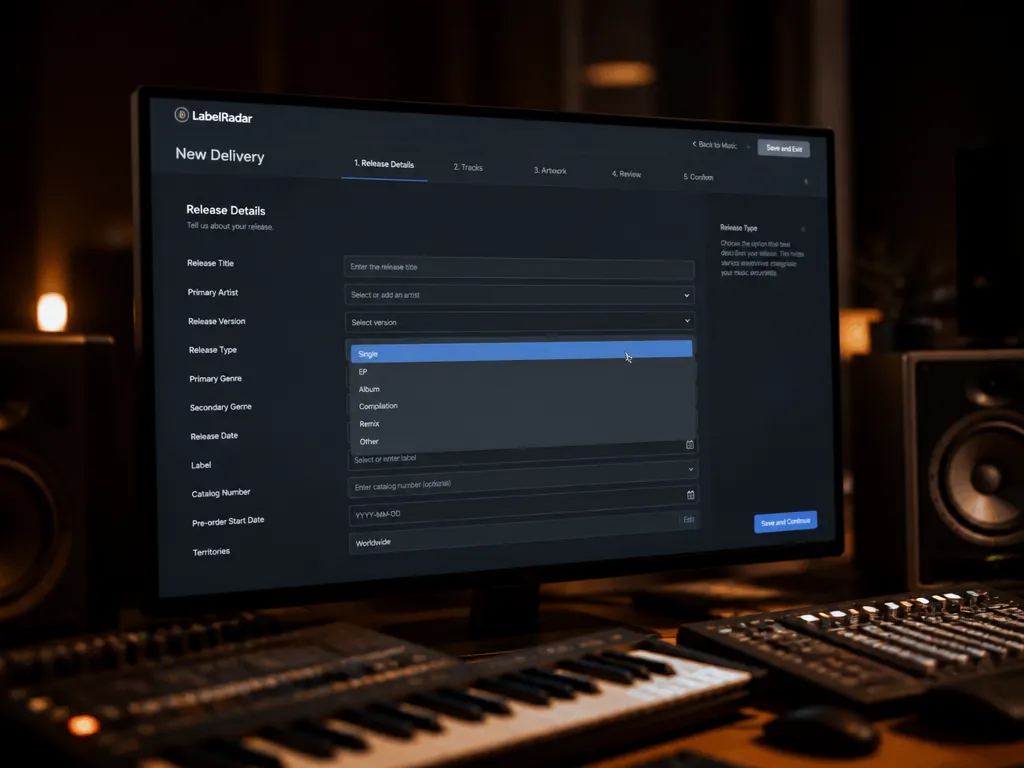
The dropdown appeared halfway through a delivery form, sitting between the ISRC field and the release date: Was AI used in the creation of this recording? Three options, no definitions, no tooltip. I had a track open in the other window with a human topline, a bassline I'd played badly and quantized, and a pad I'd generated, regenerated, and finally pitched down two semitones because the first eleven takes came out mush. The honest answer was "yes, sort of, in a way this form has no box for." That gap — between how AI-generated music actually gets made and how the industry is asking people to declare it — is where the next two years of chart policy get fought.
The myth: there's a detector at the door
Ask around a label office or a curator Slack and you'll hear a version of this: somewhere in the pipeline, a classifier listens to incoming audio, scores how likely it is to be machine output, and anything over the threshold gets held out of the chart. The rules are coming, the story goes, and the rules are a filter.
Smart people believe this because the adjacent systems really do work that way. Content ID fingerprints a recording against a reference database and acts without a human in the loop. Stream-integrity systems on the DSP side watch play patterns — impossible listening hours, bot-shaped session curves, one IP with forty accounts — and strip the counts server-side. If the plumbing already recognizes stolen audio and fake plays, a synthetic-audio detector sounds like the obvious next module to bolt on.
It isn't there. Not as the load-bearing part of any eligibility regime that's been put forward publicly.
What the labels actually asked for
A coalition of major and independent labels, publishers and trade bodies has put a set of chart-eligibility criteria on the table. Stripped to their spine, they ask four things of a release: that a human meaningfully authored it, that the rights underneath it were cleared lawfully, that the streams behind its position weren't manipulated, and that any AI involvement was declared up front.
Read those again and notice what's missing. Not one of them describes an analysis of the audio file. Every one describes something a person has to declare, warrant, or evidence. The proposal isn't a filter. It's a paperwork regime — and it's framed as a boundary rather than a ban, with room left for AI inside a human-led process.
The label concern underneath it is not aesthetic snobbery, whatever the discourse says. A chart position is a price signal. Advances, sync fees, playlist consideration, festival billing and radio adds all key off it, and they key off it because the number is understood to represent scarce, expensive, slow work. When a track built in an afternoon of prompt-roulette sits at the same number as one that took nine months and a string session, the signal stops meaning what the people buying against it think it means. The coalition is defending a measurement instrument, not a genre.
Can AI-generated music chart?
Under every proposal published so far: yes, with conditions. Nothing on the table bans machine-assisted records from the charts. What the criteria target is a release with no identifiable human author, unlicensed material in its lineage, or an inflated stream count — any one of which is disqualifying on its own, AI or not. A record where you wrote the parts, made the arrangement calls, and used generative tools the way you'd use a sampler or a session player is meant to remain eligible. These are proposals rather than a finished rulebook, so check what your chart provider has actually adopted by the time you read this.
The mechanism is metadata, not forensics
Here's what actually happens when your release goes out. Your distributor sends the audio, and alongside it an XML message — DDEX ERN is the industry standard — describing the recording: its ISRC, its title, its contributors and the role each one played. That message is how a DSP learns anything about your track that isn't in the waveform. An AI-use flag lives there, as a declared field, riding with the delivery through the DSP and on to whoever computes the chart.
Which means enforcement is contractual, not forensic. When you tick that box, you're making a warranty inside your distribution agreement. Lying is breach: takedown, chart removal, account termination, clawback of accrued royalties. That's the same lever the industry already pulls against stream fraud, and it behaves the same way — decent after the fact, useless in advance.
Detectors do exist, and they'll keep improving. They also answer a different question than the one being asked. A classifier can tell you a stem sounds model-shaped. It cannot tell you who wrote the chord progression, whether the training data was licensed, or whether the person who uploaded it holds the rights. Authorship and provenance aren't properties of the audio. And the hard calls all live in hybrid work, which is now the ordinary case: generated bed, played topline, human mix, one AI-cleaned vocal take. A tool tuned to separate pure synthetic from pure human is at its least reliable exactly where the eligibility question gets interesting.
Where the human-authorship line actually breaks
Four real sessions, none of them exotic:
- You generate sixty loops, keep eight bars, and build a four-minute arrangement around them. Whose composition is that?
- You write and perform everything, then use a model to clean a noisy vocal take and extend a tail by two seconds. Is that an AI record?
- You prompt the full instrumental, write and sing the topline yourself, and mix it over three days. Human-led, or human-decorated?
- You license a legacy stem-separation and generative bundle inside your DAW that you'd never think of as "an AI tool." Does the box apply?
Nobody has published a threshold that resolves these. The criteria say human authorship should be central; they don't say whether that's measured in stems, in minutes, or in decisions.
What a disclosure-ready release looks like
Until the definitions firm up, the defensible position is evidence, kept at the moment of creation rather than reconstructed under pressure.
| What you did | What to declare | What to keep |
|---|---|---|
| Generated beds, loops or textures | AI use in production, with the tool named | Prompt log with dates, raw renders, the edited stems |
| Wrote and performed parts over generated material | Human authorship of composition and performance | Project file with playable MIDI/audio takes, not a bounce |
| Used AI cleanup, separation or extension | Tool-assisted post, if the form allows that granularity | Original take alongside the processed version |
| Used any reference, sample or voice | The clearance chain | License PDF, the terms page as it read on your generation date |
That last cell is the one people skip. Commercial-use grants and ownership language on generative platforms get revised, and the version that matters is the one in force when you hit render — screenshot or PDF it, because the live page won't remember. We keep a running file at City of Punk on how each major platform words its commercial-use grant for exactly this reason.
The honest takeaway
Disclosure regimes catch the conscientious and miss the fraudulent, and anyone telling you otherwise is selling something. Someone running a synthetic-catalog farm with bot streams will tick whatever box gets the release live. What the warranty actually buys the industry is liability transfer and a paper trail — a clean basis for pulling a record and terminating an account after the fact.
Which is why the criterion with real teeth is the stream-integrity one. It's measurable server-side, it requires no opinion about where art ends and output begins, and it targets the behavior that does the actual damage. The threat from a flood of machine-made catalog was never that it takes the number one spot. It's payout dilution at the bottom of the pool, thousands of tracks at a time, and that's a royalty-accounting problem wearing a chart-policy costume.
What this piece doesn't answer
I can't tell you where the authorship threshold lands, because nobody has drawn it. I don't know whether the flag ends up per-recording or per-element, whether DSPs will ever surface it to listeners, how an artist is supposed to warrant the lawfulness of training data they can't audit, or what happens to catalog delivered before the field existed.
When you want the answers, skip the press releases. Read your chart provider's published methodology page, then the warranty clause in your distributor's terms, then DDEX's release notes for the metadata field, then the credits panel in the DSP app to see what's actually being surfaced. In that order — the rules always show up in the delivery spec before anyone announces them.
By the time the industry agrees on what counts as human, the answer will already be sitting in a metadata field somebody else filled in on your behalf.
Not sure which tool to use?
Compare the top AI music and sound tools side by side — honest reviews, real pricing, no sponsorships.