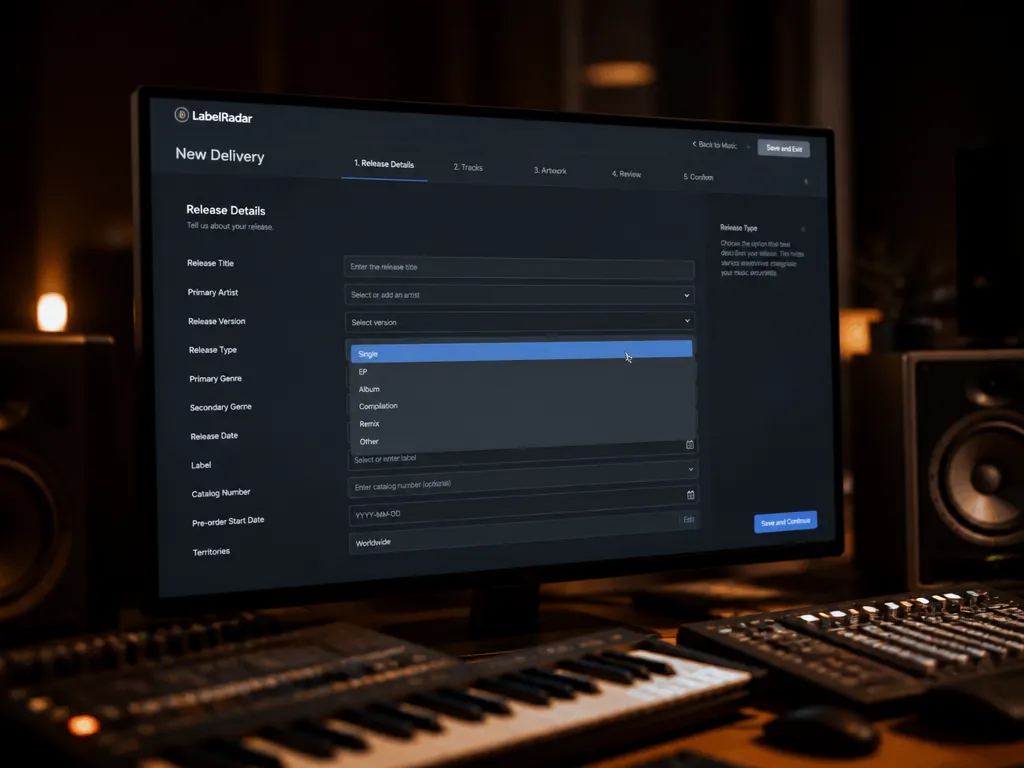
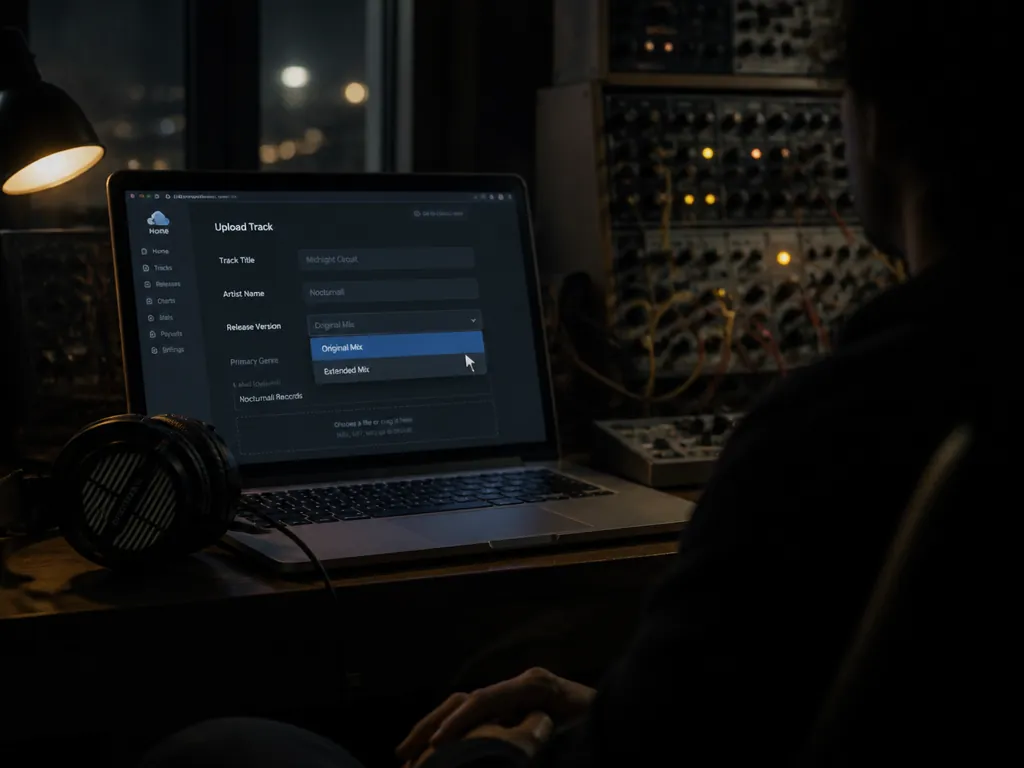
The dropdown appeared on my distributor's upload page between the ISRC field and the explicit-content toggle: Was AI used in the creation of this recording? Yes. No. The track was a 96-bar cue for a game trailer — a detuned analog bass I played badly on purpose, a drum bed I programmed, and one pad I generated from a text prompt, resampled, and ran through tape emulation until it stopped sounding like anything a model would hand you. Which button is honest?
That is the question the IFPI AI music regulations are trying to settle at industry scale, and it is the question every working producer has quietly asked themselves in the last two years. Not "is AI music art." Something narrower and much more expensive: at what point does a recording stop counting as yours — for the charts, for the royalty pool, for the label that wants to sign it?
The question underneath the dropdown
The honest version is: how much of me has to be in this file?
It matters because chart eligibility is not a vanity concern. Chart position feeds playlist consideration, sync agent attention, radio adds, and the advance a label is willing to write. A record that can't chart is a record that can't participate in most of the machinery built around records. So when the recording industry's global trade body publishes criteria for what counts as a legitimate recording, it is not issuing an aesthetic opinion. It is drawing a boundary around a payment system.
And the boundary is being drawn now because the volume forced it. Platforms are ingesting AI-generated uploads at a rate that makes manual review impossible, and acts have reached national charts and playlists before anyone downstream understood how the audio was made. Disclosure arrived after the fact, every time, and that is precisely the failure the new rules are written against.
What "substantially human made" actually means
In plain language: a recording qualifies when a human made the creative decisions that define it — the composition, the performance, the arrangement, the production choices — and an AI system assisted rather than authored. A prompt is not a performance. Selecting the fortieth render out of forty is curation, not writing. But playing, singing, programming, comping, arranging, mixing, and resampling generated material into something you shaped are all human creative acts, and they don't stop counting because a model was in the signal chain somewhere.
What the phrase does not do is give you a percentage. There is no published threshold — no "51% human" test, no bar count, no stem ratio. As of writing, the standard is qualitative and assessed case by case, which means two producers can do roughly the same amount of work and get different answers depending on how well each one can describe what they did.
That is not a loophole. It is the actual state of the rule, and pretending otherwise would be a disservice.
The three bars, read honestly
Strip the announcements down and the framework asks three things of a recording.
Human authorship. Covered above. The burden sits with the rights holder to be able to say what a person contributed.
Provenance of the tools. The framework points toward AI systems built on licensed training data rather than scraped catalogues. This is the bar most likely to catch producers by surprise, because it is not about your session at all — it is about which generator you opened. Major-label litigation against Suno and Udio, and the licensing negotiations reported alongside it, are the industry trying to convert unlicensed models into licensed ones. Until a given tool lands on the licensed side of that line, a record made with it carries a question mark that has nothing to do with your craft.
Disclosure. Declare AI involvement in metadata, accurately, at the point of delivery. That dropdown is the enforcement surface. Answering it wrong is a much worse position than answering it yes.
Running underneath all three is a rule that predates AI entirely: stream manipulation disqualifies you. Bot-farmed plays on a generated catalogue are the same offence they always were, with a cheaper cost of goods.
Where the honest answer is "it depends"
Here is the part that gets left out of the summaries. IFPI is a trade body, not a regulator. It publishes standards; national chart companies and streaming services decide what to implement, when, and in which territory. Rollout is staggered, and the criteria a chart applies in one market may not be the criteria applied in another.
More consequentially, chart eligibility and platform monetisation are separate questions. A track can fail a chart test and still stream, still earn, still sit in a playlist. Streaming services have moved on AI disclosure and spam filtering at their own pace and with their own definitions, and those definitions are not guaranteed to match the chart bodies'. If you want to know what is actually charting versus what is actually earning, those are two investigations, not one.
So: will your AI-assisted track count as a record? In most territories, if a person wrote and performed and shaped it and you can show that — yes. If you prompted it whole from an unlicensed model and uploaded the render — increasingly no, and the number of places where the answer is no is growing. Between those poles, it depends on your documentation and your territory, and anyone telling you otherwise is selling certainty they don't have.
What it does to the money
Streaming royalties are mostly pro-rata: a subscriber's payment goes into a pool, and the pool is divided by share of total plays. Every stream of every track dilutes every other track. That arithmetic is why volume is the threat, not quality. Ten million generated uploads earning fractions each still move real money out of the pool that human catalogues share.
A study commissioned by CISAC and carried out by PMP Strategy put the figure at roughly $4.6 billion of music creators' revenue at risk annually within a few years. Treat that as a projection with assumptions inside it, not a measurement — but the direction is not seriously disputed, and it explains why eligibility rules arrived when they did. Charts are the lever the industry could pull quickly. Royalty policy takes longer.
A provenance file that survives a challenge
The practical response is boring and takes about ninety seconds per project.
- Log the tool and version. Model name, version string, date generated. Screenshot the licence terms as they read that day — terms change, and "as of writing" applies to your paperwork too.
- Keep the prompt text verbatim, alongside which render you used and what you did to it afterwards.
- Keep dated project files. A session with your MIDI, your takes, and your automation is the strongest authorship evidence that exists.
- Put the AI role on the split sheet, in a sentence. Co-writers and sync agents will ask eventually.
- Answer the disclosure field accurately, and keep a copy of what you answered.
How session behaviour tends to read:
| What you did | How it reads |
|---|---|
| Prompted a full track, uploaded render #40 | Not substantially human made |
| Generated stems, comped them, played bass and keys over the top | Arguable — documentation decides it |
| One generated pad in a 40-track arrangement | A human record with an AI instrument on it |
| Trained a model on your own stems, generated from that | Human-authored, with clean provenance |
The pathway that exists
None of this closes the door on AI-assisted production, and the framing that it does is wrong. A rule requiring human authorship, licensed tools, and honest labels is a rule you can meet on a Tuesday afternoon with the workflow you already have. It penalises two specific behaviours: laundering a scraped model's output as your own, and hiding it. If neither describes your session, the compliance cost is a text file.
What it does change is tool selection. Provenance is now a feature, alongside stem export and 48kHz WAV delivery, and it is worth asking a vendor about before you build a catalogue on them.
Which is why every project folder on my drive now has a four-line PROVENANCE.txt sitting next to the session: model, version, prompt, what I played. I started it out of paranoia about a sync contract. It has since become the file I open first when a music supervisor asks where a sound came from, and the only part of my workflow that got easier to defend as the rules got stricter.
Not sure which tool to use?
Compare the top AI music and sound tools side by side — honest reviews, real pricing, no sponsorships.