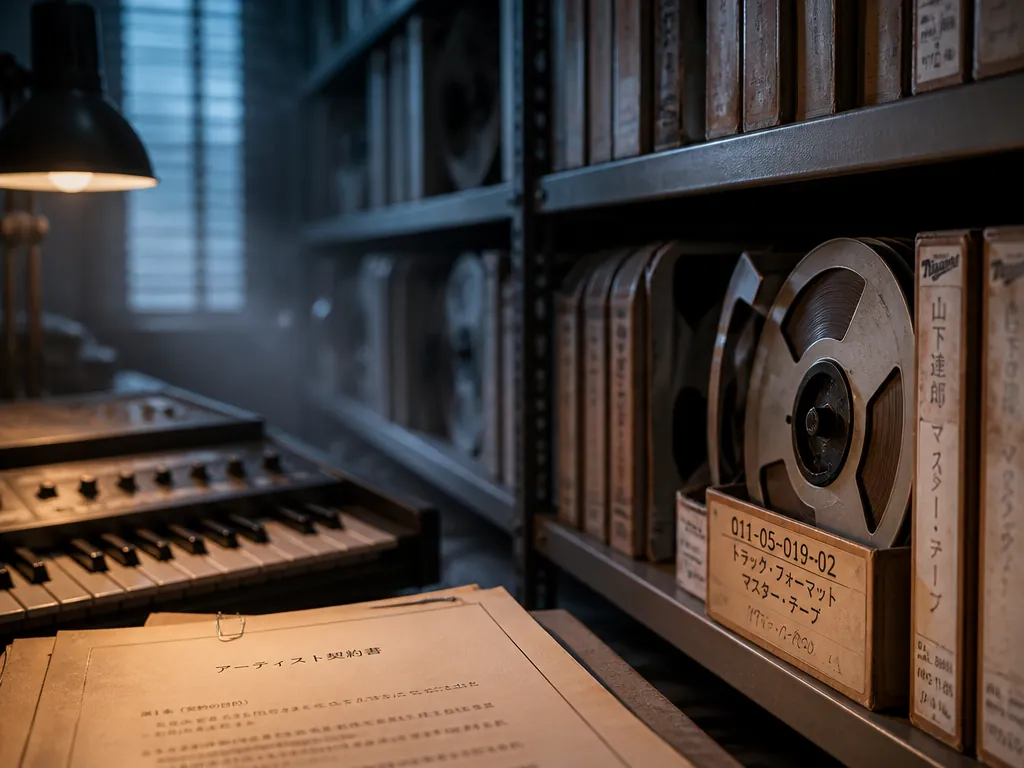
The cue is forty-odd seconds of brittle synth-piano over a pad that never resolves the way your ear expects, and close to every supervisor working in trailers has temped with it at least once. Go to clear something from Ryuichi Sakamoto's body of work today and the reply-to address on your licensing request is not the one it was three years ago. That is what a catalogue acquisition looks like from the working end of this business: not a headline, but an administrator change that lands in your inbox months after the announcement, carrying a new set of registration numbers behind it.
Sakamoto died in March 2023, at 71, leaving a body of work that is unusually awkward to value. Yellow Magic Orchestra's synth-pop sits next to the Oshima and Bertolucci scores, which sit next to a late run of ambient and installation records that move modest units and license at high rates. When those interests changed hands — publishing and masters, split across territories, with an international rights company on one side and a Japanese administrator on the other — the structure told you more than the price would have. The price, as in most of these transactions, was not disclosed.
So take the structure seriously. Here is the sequence: what happens first, what happens after, and where the money actually surfaces.
What actually gets bought when a music catalogue changes hands
A catalogue is not one asset. It is a bundle of at least four, and any given deal can include any subset of them, in any subset of territories, for any term.
- The writer's share of publishing — the composer's slice of performance and mechanical income. Estates tend to hold this longest, because it carries the most emotional weight and the least administrative burden.
- The publisher's share — the administrative half. Historically the first thing to trade, because it is the cleanest to transfer and the easiest to model.
- Master rights — ownership of specific recordings. For a film composer these are frequently entangled with studios, labels and commissioning broadcasters rather than sitting neatly with the artist.
- Neighbouring rights — performer and producer income, collected by different societies on different schedules, and routinely forgotten in first-pass valuations.
Name-and-likeness, archive tape, unreleased session material and print rights ride along or don't, depending on how the schedules were drafted. The single most useful diligence question in the room is boring and rarely asked early enough: which of those layers, in which territories, for how long, and who currently registers them.
First: someone decides the catalogue is a business, not a shrine
Nothing moves until a rightsholder decides that a body of work is better run than held. The triggers are unglamorous. An estate is illiquid and a tax bill is not. Japan's top marginal inheritance rate sits at the high end of the OECD range and it is payable in cash on a fixed clock, which turns any income-producing asset into a candidate for conversion. Heirs inherit a rights business they did not ask to operate — chasing registrations across a dozen societies, fielding sync requests in four languages, deciding whether a fragrance brand gets a theme their father wrote for a film about a prison camp.
None of this is specific to any one estate, and nobody outside the room knows which factor mattered in any given deal. But the pattern is now visible across the region: the Japanese market, long resistant to catalogue M&A that had become routine in the US and UK, has started producing sellers. Once the first credible transactions close at defensible terms, the second wave becomes a conversation between advisers rather than an argument about principle.
Then: the territorial split, and why the buyer needs a local partner
This is the step Western dealmakers underestimate. Owning a right and collecting on it are different jobs, and in Japan the second one is local.
Japan has spent decades as one of the two or three largest recorded-music markets on earth, with a revenue mix that behaves differently from anywhere else — physical media still meaningful, karaoke a real line item rather than a curiosity, broadcast and background-music licensing negotiated through relationships that took years to build. JASRAC has administered the bulk of it since before the war. NexTone, formed from a merger of smaller challengers and now publicly listed, gave Japanese rightsholders a genuine choice of administrator for the first time in most working lifetimes, particularly on interactive and streaming income.
That is why a Sakamoto-scale transaction gets structured as a partnership rather than a straight purchase. A foreign buyer brings global sync relationships, capital and catalogue-marketing muscle; a domestic partner brings society membership, registration infrastructure and the ability to get a call returned by a Tokyo broadcaster. Split the territories, co-own the layers, and each side collects where it is actually competent. The deal geography is the strategy.
Then: re-registration, and the quiet months where money goes missing
Here is where announcements stop and the work starts, and it is the least reported phase of any catalogue deal.
Every work has to be re-registered, re-claimed and re-matched: ISWCs for compositions, ISRCs for recordings, splits filed with each society, claims lodged with each DSP, conflicting claims resolved with whoever registered the work last. On a catalogue with a fifty-year tail across three continents, the error surface is enormous, and Japanese repertoire adds a layer most systems handle poorly. A single theme can exist in databases as kanji, as romaji, as an English release title with a comma and as the same English title without one. Composers who re-recorded their own themes across decades — solo piano versions, orchestral versions, trio versions, live versions — generate version-matching problems that automated systems resolve by giving up and paying nobody.
Unmatched income does not vanish; it sits in black box, gets distributed by market share, and quietly subsidises the wrong catalogues. The buyer who priced the asset off historical statements without auditing registration quality finds out during this phase whether they bought a revenue line or a cleanup project. Realistically, a large cross-border catalogue takes several distribution cycles before reported income stabilises enough to judge the deal.
Then: the catalogue gets worked
Once collection is clean, the acquirer starts doing what it bought the asset to do. Sync pitching into film, advertising, games and long-form video. Anniversary reissues and remasters. Spatial and immersive remixes of recordings that were mixed for two speakers in 1983. Print and educational licensing, which is a genuinely underrated line for a composer whose piano pieces sit on student music stands worldwide. Territory-by-territory expansion into the Asia-Pacific sync market, where budgets have grown faster than Western supervisors have noticed.
The honest counterweight: a supervisor who cannot clear the real thing inside the window they have will reach for something original and pre-cleared instead. That substitution is the demand curve generative tools — City of Punk's included — actually live on, and it is worth naming plainly rather than pretending sync budgets and clearance timelines are infinite. Catalogue owners who price and respond as though scarcity is permanent are training their customers to stop calling.
Last: the layer nobody has priced yet
Every catalogue transaction closing now contains an unpriced option, and both sides know it.
Japanese copyright law has, since 2018, included a broad exception at Article 30-4 permitting use of works for information analysis where the purpose is not enjoyment of the expression itself — one of the more permissive text-and-data-mining provisions anywhere, and the reason a good deal of model training pointed at Japan. Guidance issued by the Agency for Cultural Affairs in 2024 narrowed the comfortable reading of it, and as of writing the boundaries are still being argued rather than settled. Nobody should be quoting you a market rate for training rights on a named catalogue, because there isn't a stable one.
The structural detail that matters more, and that foreign buyers routinely miss: moral rights under Japanese law are personal to the author and cannot be transferred. You can buy every economic layer in the stack and the right of integrity still does not come with it — and after death, family members retain standing to object to treatments that would have violated it. For a catalogue built on a composer's specific, identifiable touch, that is not a footnote. It is the mechanism by which an estate keeps a veto over derivative and generative uses long after it has sold the income.
The diligence questions that move price
| Layer | What to verify before you model it | Where it bites |
|---|---|---|
| Publishing splits | Registered splits match contract schedules, society by society | Conflicting claims freeze distributions mid-cycle |
| Masters | Who actually owns the film and commissioned recordings | Score masters often sit with studios, not the composer |
| Registration quality | Title variants, transliterations, version-level ISRCs | Black box absorbs what nothing can match |
| Neighbouring rights | Which societies, which territories, claimed by whom | Frequently omitted from historical statements entirely |
| Consent rights | Moral rights, estate approvals, existing carve-outs | Determines whether AI and derivative deals are yours to do |
The number on the term sheet is a function of all five. Announcements report the first line and skip the rest, which is why press coverage of catalogue M&A consistently reads as more decisive than the transaction actually was on the day it closed.
So, tonight's rule of thumb: before you price a catalogue, price its registration — if you cannot see the works registered, matched and collecting in the territory where the money is, you are buying a story rather than an asset.
Not sure which tool to use?
Compare the top AI music and sound tools side by side — honest reviews, real pricing, no sponsorships.