The question that ends a licensing conversation is never about the music. It is four words from a music supervisor or a label's business affairs desk: who owns this cue? If the answer involves AI music generation, the follow-up lands inside a sentence — what was the model trained on, and what does your license actually say. Most people shipping generative audio right now can answer the first question with a shrug and the second by pasting a marketing page. The second one is what decides whether the cue clears.
Here is the verdict, plainly: Suno's business risk is not a single lawsuit outcome. It is a chain of custody with a contested first link, and every user downstream inherits the contest. Whether that matters to you depends entirely on what you sign after the render.
That is a mechanism, not a scandal, and mechanisms can be traced in order. What happens first, what happens next, and where somebody's money stops.
Stage one: acquisition
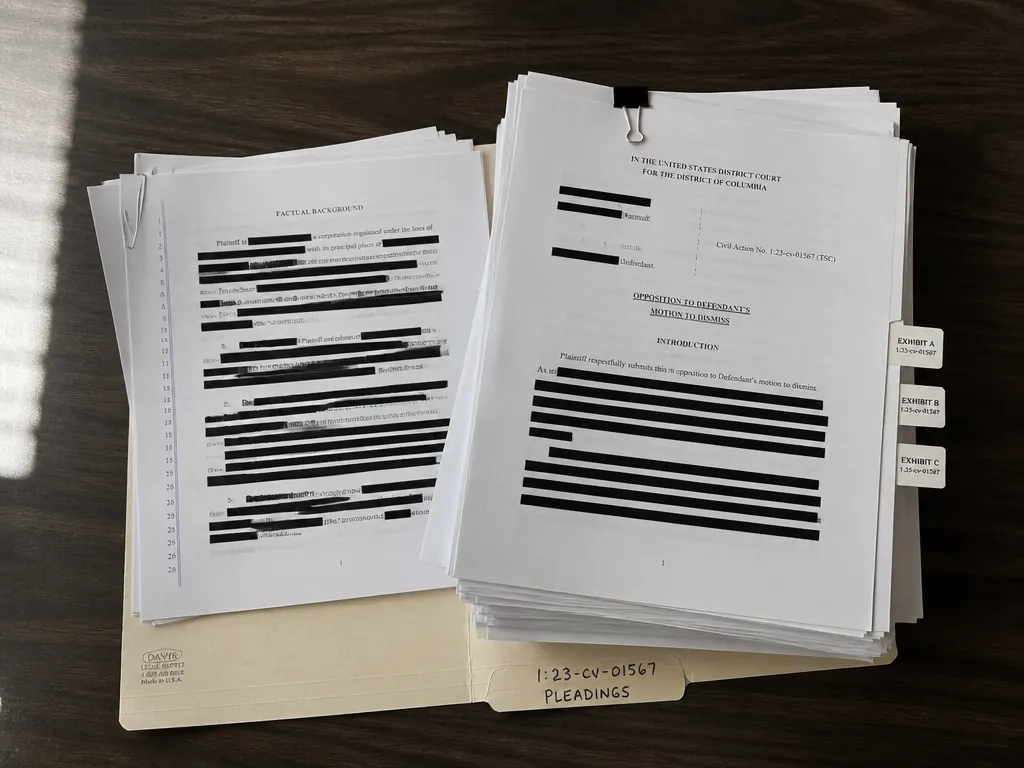
In June 2024, the major labels — Universal, Sony, and Warner, coordinated through the RIAA — filed copyright suits against Suno and against Udio in US federal court. The core allegation is simple to state and expensive to litigate: that the models were trained on copyrighted sound recordings copied at scale without licence.
Suno's public posture has been that training on widely available recordings to teach a model general musical features is transformative and protected by fair use, and that the company blocks prompts naming specific artists. The labels' position is that the copying itself is the violation, regardless of what the outputs sound like. Both of those can be argued for years, and have been.
What sharpened the picture was not a filing but a leak. In late 2025, 404 Media reported on source code and internal instructions shared by a hacker who claimed to have accessed Suno systems, allegedly describing a pipeline for harvesting audio from streaming platforms — and a clip count in the low millions. The reporting was careful, and you should be too: the material is unauthenticated, the hacker's identity is unconfirmed, Suno has not validated it, and no court has treated it as established fact. Leaked code is an allegation with a filename attached.
But it points at something structurally important that the fair-use debate tends to swallow. Stream ripping is a different legal act from training. Capturing a stream as a downloadable file can implicate the anti-circumvention provisions of the DMCA, which are not the same cause of action as reproduction, and fair use is a much poorer fit as a defence there. If a plaintiff can establish how the audio was obtained, the case stops being an abstract argument about machine learning and becomes a much more ordinary argument about access controls. That shift, more than any headline about model architecture, is what changes settlement leverage.
Stage two: the data becomes weights
Once training runs, the corpus stops being a folder and starts being a set of parameters. This is the part rights holders understood before most technologists did.
You cannot meaningfully delete a recording from a trained model. There is no takedown that reaches into the weights and removes one master. The practical options are retraining from a clean corpus — enormously expensive, and a de facto admission about the old corpus — or leaving the model alone and settling up in cash. That asymmetry pushes remedies away from injunctions and toward damages and licences.
And the damages arithmetic in US copyright is deliberately theatrical. Statutory damages run up to $150,000 per work for willful infringement. Multiply by a corpus measured in the hundreds of thousands of works, and you produce a number no company survives — which is precisely why that number rarely gets adjudicated. It is a negotiating instrument. The labels' economic interest is not a dead defendant; it is a licensed, paying, ongoing revenue line with their catalogue inside it.
So the mechanism's second stage produces a predictable output: not a verdict, but a deal. That is what happened.
Stage three: the render
Meanwhile, you are working. You type a prompt, you get audio, and the audio is genuinely useful — that is why any of this is a business problem rather than a curiosity.
What you actually receive varies by tier and by vendor: a stereo mixdown at minimum, stems on higher tiers, with sample rate and format gated the same way. Assume nothing about the deliverable until you have exported one and inspected it. A supervisor asking for 48kHz WAV stems is not going to accept a 44.1kHz MP3 bounce with a note about your subscription level.
The honest limits are still the limits. Dense arrangements smear at the transients — hats and rim clicks lose their edge when the model is asked for too many simultaneous elements. Vocals remain the hardest surface: consonants blur, and sibilance lands in a place no de-esser was designed for. Long-form generation drifts; ask for four minutes at a fixed tempo and check the grid at the end, not the beginning, because the last chorus is where the drift shows. And prompt roulette is real. The gap between take three and take thirty is not craft, it is patience, and you should price your time accordingly.
One legal point that gets conflated here and shouldn't be: whether a specific output infringes is a separate question from whether the training infringed. An output is only an infringing derivative if it is substantially similar to a particular protected work. Most renders are not. You can be entirely clear on the output side while the model you used is in litigation on the input side. Keep those two questions apart in your own head, because opposing counsel will not.
Stage four: the licence you actually hold
This is where creators get burned, and it has nothing to do with the lawsuit.
The common structure across consumer-grade AI music generation tools looks like this. Free tiers grant you no commercial rights, or grant a non-commercial licence with attribution. Paid tiers grant commercial use — and this is the part people skip — often only while your subscription is active. Cancel, and the commercial grant to tracks you already made can lapse with it. The WAV file stays on your drive. The right to keep monetising the video it sits under may not.
Read for four things in the terms, in this order:
- Ownership versus licence. Most vendors do not transfer copyright; they grant you a licence. Those are different instruments and clients' contracts often assume the first.
- Durability. Does the commercial grant survive cancellation for work created while subscribed? If the terms are silent, treat it as not surviving.
- Exclusivity. Can the vendor licence the same or a similar output to someone else? For a brand sonic identity, this question is the whole deal.
- Indemnity. Will the vendor defend you if a third party claims your output infringes? Consumer tiers almost never do. Some vendors offer indemnity on enterprise plans, usually capped at fees paid, sometimes with conditions about not modifying the output. A cap equal to twelve months of subscription fees is not meaningful protection against a national ad campaign claim, and you should say so in the procurement meeting rather than after.
None of these are fixed; they change with every terms update, and vendors update them mid-litigation. Screenshot the terms on the day you generate. Store it with the project file.
Stage five: distribution, and the claim
The render is not where risk crystallises. Distribution is.
Move a generated track into the world and it hits a series of gates, each with its own disclosure requirement. Distributors have added AI-content declarations to their delivery flows, and some refuse fully generated material outright. Streaming services have both AI-disclosure metadata standards and enforcement teams removing bulk uploads. Content ID and its equivalents create a two-sided problem: your generated track may collide with a claim you cannot rebut, and separately, you may be unable to assert a claim over it yourself. Performing rights organisations register works on human writer shares — a work with no human author has no share to register, and a work with an overstated human share is a misrepresentation to your PRO.
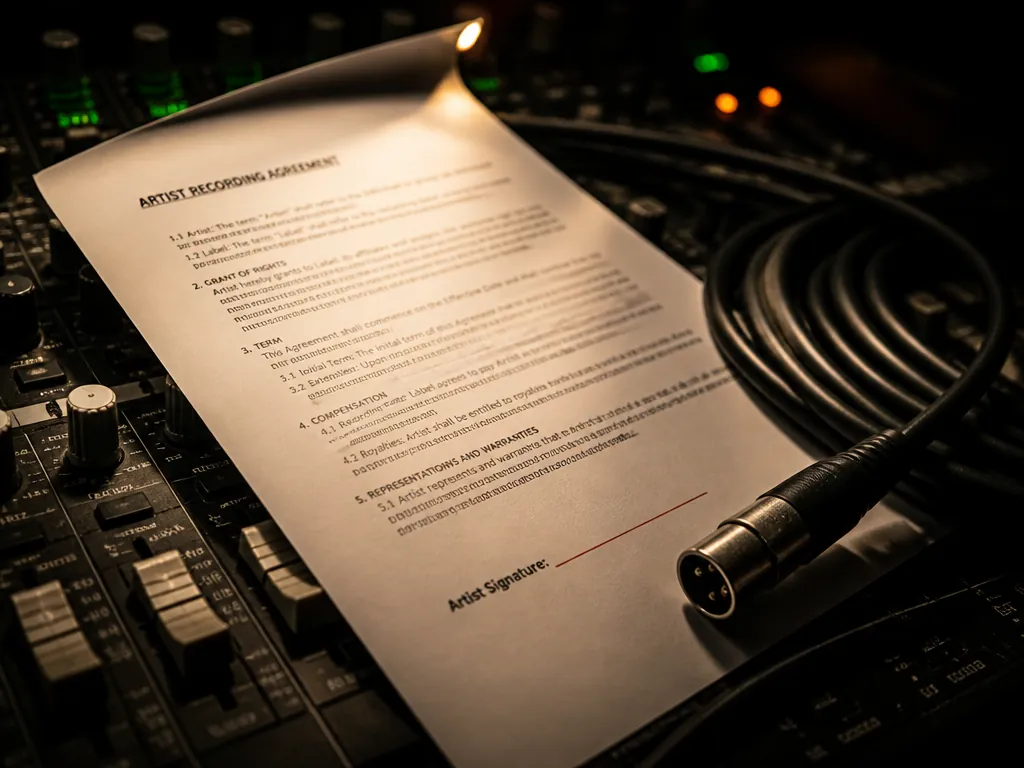
Then the sync rider arrives, and it asks you to represent and warrant that you own or control the work, that it does not infringe any third-party rights, and that you will indemnify the buyer if that turns out to be untrue.
That signature is the moment the model's training data becomes your legal problem. Not the scrape, not the lawsuit, not the render. You have contractually absorbed a risk you cannot inspect, on behalf of a counterparty with better lawyers, backed by your own balance sheet rather than the vendor's. Every stage before this one was somebody else's exposure. This one is yours.
This is the practical test I apply to any generative audio tool now: not "is it legal?" but "can I truthfully sign the warranty my client will hand me?" If the answer is no, the tool is fine for demos, temp tracks, and internal reference, and wrong for delivery.
Stage six: the licensed era, and the seam it leaves
The mechanism's last stage is the one that was always coming. Through late 2025, the litigation began converting into commerce: Warner Music Group and Suno announced a settlement and licensing arrangement, and Universal reached its own deal with Udio, with reporting at the time describing licensed, artist-opt-in platforms and — in Udio's case — download restrictions pending a rebuilt product. Details, timelines, and which catalogues are actually inside any given deal have kept moving; verify the current state before you rely on it.
What a licensed regime changes is worth stating precisely. It typically means an opt-in pool of consenting artists, per-use accounting flowing back to rights holders, and a defensible provenance story you can put in a deck. It usually also means tighter output controls, more restrictive downloads, and higher prices, because someone is now getting paid upstream.
And it leaves a seam. A licence signed in 2025 does not retroactively clear a track you generated in 2024. Deals of this kind resolve claims between the parties; they do not automatically launder every output the pre-deal model produced for third parties. If you have generated audio in commercial use, the single most valuable record you can keep is a dated log — tool, tier, terms version, generation date, project — so that when someone asks which regime a given cue was made under, you have an answer rather than a guess.
That log takes ten minutes to start and is the closest thing to insurance available at this price point.
How I'd decide
Seven criteria, in the order I weight them for commercial delivery:
- Provenance paper. Can the vendor name its training sources, or point to licensing agreements? "We use publicly available data" is not an answer.
- Licence durability. Does the commercial grant survive cancellation, in writing?
- Indemnity and its cap. Who defends you, and up to what number.
- Export reality. Stems, sample rate, format, and which tier gates them. Test before you quote a client.
- Warranty compatibility. Could you sign a standard sync rider over this output without lying.
- Twelve-month cost. Subscription times twelve, plus the regeneration time you will actually spend.
- Exit cost. If the vendor changes terms or disappears, what happens to your catalogue.
| Vendor class | Provenance posture | Honest negative |
|---|---|---|
| Suno | Fair-use defence, now partly converted to label licensing; leaked-code allegations unresolved | Commercial rights tied to an active subscription; pre-deal outputs sit in a grey zone you cannot document from the outside |
| Udio | Same litigation posture, now with a major-label arrangement | Reported download and export restrictions during the platform rebuild make it hard to plan a delivery schedule around |
| Licensed-corpus generators (e.g. Stable Audio's stated AudioSparx-licensed training) | Cleaner paper, stated licensed sources | Narrower stylistic range and materially weaker vocal capability; better for beds than for songs |
| Vendors with announced rights-holder deals (e.g. ElevenLabs' publicly stated music licensing agreements) | Deal-based, disclosed | Short track record; the deals cover specific catalogues, not everything you might prompt for |
| Traditional production libraries | Fully cleared, warranty-ready | Your competitor is using the same cue, and everyone in the edit suite can hear it |
No row on that table is risk-free. The trade is between legal certainty and sonic range, and it is currently a real trade.
Who this is for, and who should skip it
Use Suno or Udio anyway if you are making demos, temp tracks, mood references for a director, personal work, or content where you carry the risk yourself and nobody hands you a warranty to sign. The output quality per hour of effort is not matched by the licensed-corpus tools right now, and pretending otherwise helps no one.
Skip them if you deliver to broadcast, advertising, a games publisher's legal department, or any buyer with a standard rider — until you can point at a licensing arrangement that demonstrably covers the material you generated, on the date you generated it. Use a licensed-corpus generator or a cleared library, accept the blander result, and price the difference.
Rights holders and publishers should treat the leaked-code reporting as unproven and the settlement wave as the real signal: the industry is converging on licensing, and the negotiating question has shifted from whether training gets paid for to how per-use accounting works.
Tonight's rule: do not sign a warranty over a track whose licence you would lose by cancelling a subscription.
Not sure which tool to use?
Compare the top AI music and sound tools side by side — honest reviews, real pricing, no sponsorships.