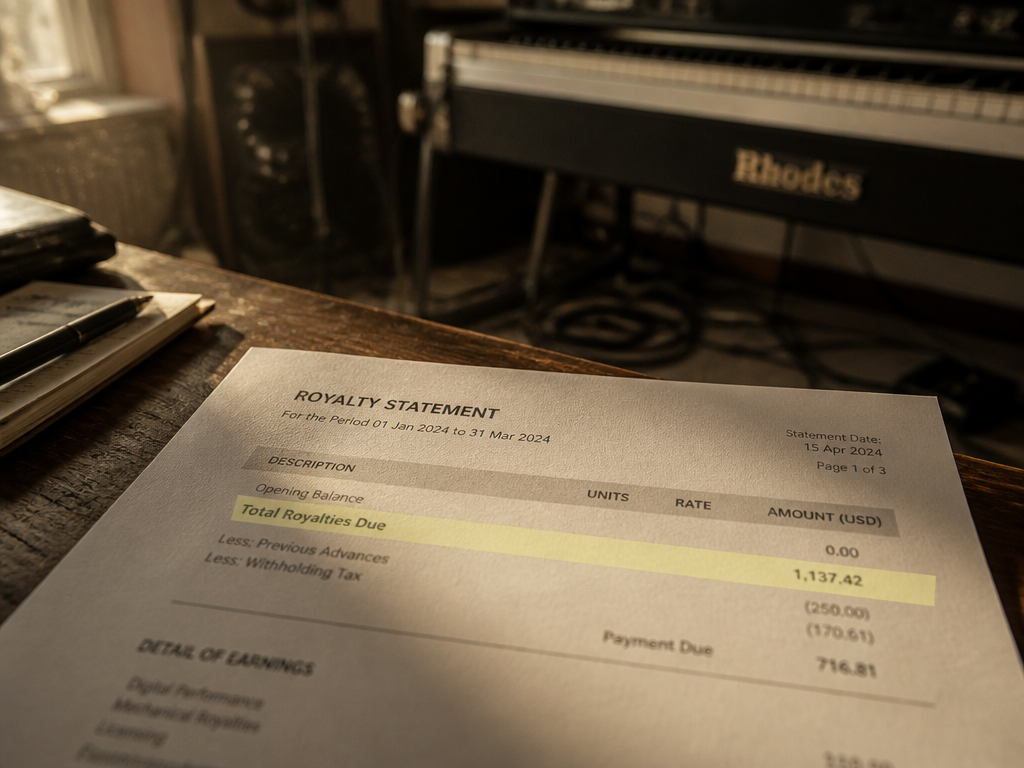
Two minutes into rendering a 96 BPM bed for a client's trailer cut, the vendor dashboard reloaded with a new logo and a fresh terms-of-service banner. Same model, same latency, new owner. My first thought was about my license grant — whether the commercial rights I'd been quoting to clients survived the transaction. My second was the thought you've probably had too: this is what an industry looks like when it starts folding into three companies. And from there it is a short walk to a much larger claim about macroeconomic policy — that transformative AI is arriving fast enough to break the frameworks central banks use, and that consolidation is the first tremor.
That walk is shorter than it should be. It's worth taking slowly.
The myth a smart reader has already heard
The version I keep hearing in conference hallways and group chats runs like this. AI is compressing decades of technical progress into a handful of years. The first industries to feel it are the ones whose output is a file — music, stock footage, voiceover, code. The collapse in those industries' cost structures shows up first as a merger wave, then as displaced labor, then as a demand shock nobody's toolkit can absorb. Central banks, the argument concludes, will be setting rates for an economy that no longer exists.
It is a coherent story, and the visible parts are real. The AI audio sector has consolidated. Distribution platforms have bought model shops, model shops have bought rights catalogs, and as of writing several major labels have moved from suing generative-audio startups to licensing them, sometimes with a commercial stake attached. Nobody consolidates a comfortable market.
The problem isn't the observation. It's the inference. A merger wave is evidence about one industry's margins and legal exposure. It is not evidence about the growth rate of the world economy. To test the larger claim you need a price set by people who lose real money for being wrong.
Will transformative AI cause an economic collapse?
The short answer, as of writing: financial markets are not pricing transformative AI at all — not the boom, and not the collapse. The cleanest place to check is the long-dated real interest rate, the yield on inflation-protected government debt at ten and thirty years. Those real yields sit in the low single digits, roughly in the band they occupied for most of the two decades before the zero-rate era. If a meaningful share of investors believed output per person was about to grow several times faster than the historical trend, that number should be far higher. It is not.
This is the argument Basil Halperin, Trevor Chow, and J. Zachary Mazlish put into circulation, and its appeal is that it doesn't depend on anyone's forecast. It reads a price.
There's a genuine tension worth naming: equity markets have repriced the compute layer aggressively. So one market appears to expect enormous sector-level rents while another appears to expect ordinary aggregate growth. Those can both be true — a few firms capturing a large share of a normally-growing economy is not the same as the economy changing regime — but I'm not sure the gap is fully explained, and anyone selling you certainty here is selling.
The Ramsey logic, without the algebra
Here is the mechanism, stripped of notation. Suppose you knew, with confidence, that you'd be five times richer in fifteen years. What would you do today? You'd borrow against it. So would everyone else. That collective rush to pull future consumption forward is what bids up the price of borrowing — the real interest rate. Rates are, among other things, an aggregation of everyone's expected income path, weighted by how much money they're willing to put behind it.
The elegant part is that the signal is robust in both directions. Run the catastrophic scenario instead: if you believed there was a substantial chance that labor income, or civilization, ended within two decades, saving for that horizon becomes less attractive, and you'd rather consume now. That also pushes real rates up. Explosive growth and existential risk push the same lever the same way, which means a calm long-dated real rate is awkward for both the utopian and the doom reading.
The honest caveats: markets can be inattentive to tail scenarios, thirty-year instruments are thinly traded relative to equities, and a repricing can happen in a week. "Not yet priced" is a statement about the present, not a forecast.
What the acquirers are actually buying
Back to the merger wave, because it has a mundane explanation that fits the evidence better.
When you read the shape of these deals rather than the headlines, the assets changing hands are rights catalogs, licensing indemnities, distribution shelf space, and multi-year compute contracts. Those are the things a competitor can't reproduce over a weekend. The model layer itself is commoditizing — which is exactly why the companies built on it are buying everything around the model. That's a margin-compression story. It's the same move a mature industry makes when its core product stops being scarce.
And on the craft side, the models still fall short of the thing that would justify a transformative reading. Vocals smear on plosives and sibilants. Dense arrangements collapse into a mid-heavy wash when you ask for six elements at once. Getting a usable 30-second loop that actually loops — matched tail, no phase artifact at the seam — is still prompt roulette, and the win rate is not what the demo reels imply. I use these tools daily and would defend them as instruments. An instrument is not a productivity discontinuity.
What would change the read
If you want to hold this position falsifiably, here's where to look.
| Signal | Where to check | What a move would mean |
|---|---|---|
| 30-year real yield | Inflation-protected sovereign debt curves | A sustained jump toward high single digits is the market pricing regime change |
| Labor share of income | National accounts, quarterly | Sharp decline is the displacement channel showing up in aggregates, not anecdotes |
| Capex-to-revenue at the model layer | Public filings of the compute buyers | Divergence without revenue follow-through is a bubble signal, not a growth signal |
| License terms after acquisition | Your own vendors' ToS diffs | Retroactive narrowing of commercial grants is the industry's actual near-term risk to you |
That last row is not macro, but it's the one that will cost you money this quarter. Re-read the grant language every time a tool you rely on changes hands, and keep the rendered files and the terms-of-service version that governed them.
What this doesn't answer
Plenty. It doesn't tell you whether markets are right — only what they currently expect, which is a different and much weaker claim. It doesn't touch distribution: a merger wave can hollow out the working middle of the composing profession while aggregate output grows fine, and the rate signal is silent on that, because it aggregates across a population where the losses of session musicians are a rounding error. It says nothing about fiscal capacity, which is where the interesting policy questions live if the labor-displacement channel does open. And it's a snapshot — the whole argument is a present-tense reading of a price that can move.
Where to look next: the Halperin–Chow–Mazlish paper on real rates and transformative AI for the formal version, quarterly labor-share series rather than layoff headlines for the displacement question, and the fiscal-response literature for the scenario this analysis deliberately brackets.
The bond market has no taste in music, but it has trillions on the line, and right now it is not betting on the end of scarcity or the end of work — so if you're going to disagree with it, disagree with a mechanism, not a mood.
Not sure which tool to use?
Compare the top AI music and sound tools side by side — honest reviews, real pricing, no sponsorships.