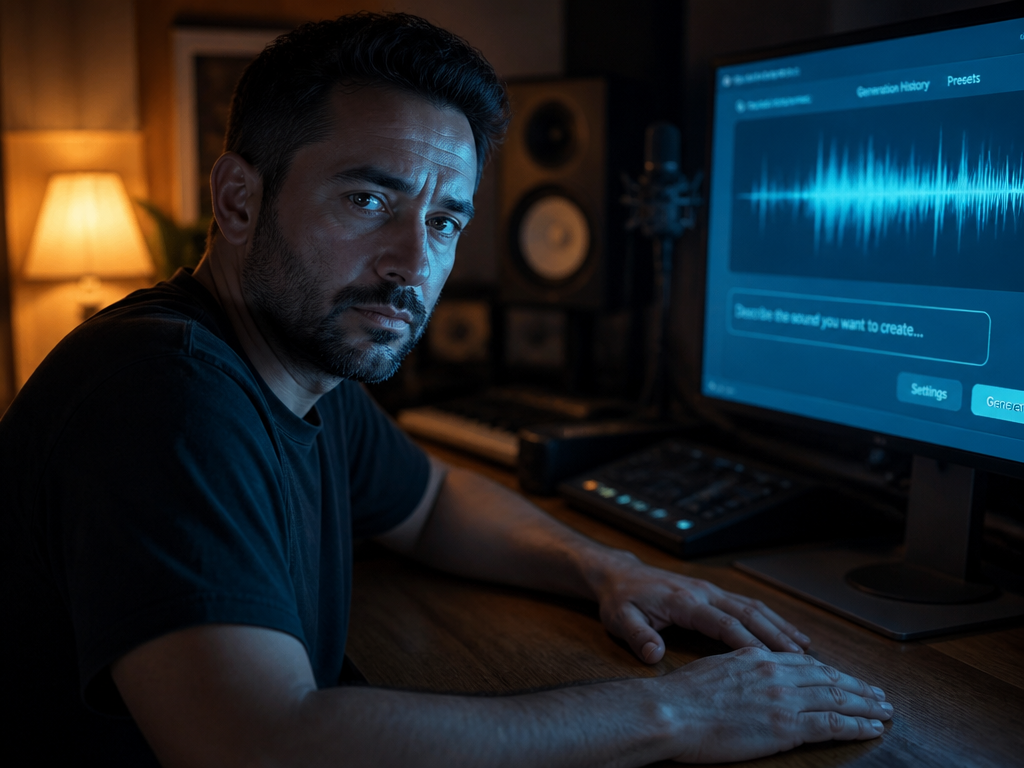
A director I work with sent me a track last spring, generated in about forty seconds from a text prompt, and asked one reasonable question: "Can we clear this for the festival cut?" Not a hard question, he thought. He'd paid for the subscription. He'd typed the words. He assumed the output was his the way a photo you shoot is yours.
The answer, once you read the actual terms, is closer to "sort of, but not the part you care about." Understanding AI copyright is now part of the job for any independent musician or producer deciding where to spend limited money — because the gap between "you can use this" and "you own this" is exactly where people get burned, usually months later, usually on the invoice or the sync deal.
The verdict, one sentence: most AI music generators grant you a license to use the output, not verifiable copyright in it, and as of writing US registration guidance treats purely prompt-generated audio as unprotectable — which means what you own is your labor on top of the render, not the render itself.
What most people do
They read the marketing page, not the terms of service. The marketing page says something like "own your creations" or "commercial use included." Both statements can be true and still leave you with nothing registrable.
Here is the mental model most people run: I paid, I prompted, I got a file, therefore I own it like I'd own a beat I made in Ableton. So they drop the render into a client project, a game build, a monetized video, and move on. No documentation. No sense of the difference between the platform's contractual grant to them and the copyright status of the work itself under federal law. Those are two separate questions, and generators are structured — deliberately — so that answering the first feels like it answers the second.
It doesn't. A platform can give you broad permission to exploit a file commercially while making no promise whatsoever that any copyright exists for you to defend. Several tools say close to that in plain language if you scroll far enough. The permission is real. The ownership is the part they go quiet on.
What the evidence suggests
Start with the primary source most creators never read: guidance from the US Copyright Office. Its position, restated across recent registration decisions, is that copyright protects human authorship, and material generated by a machine from a text prompt — where the prompt-writer doesn't control the specific expressive output — is not the author's work in a registrable sense. You can register the parts a human authored: your arrangement, your edits, your added instrumentation, your lyrics if you wrote them. The raw generated audio, on its own, sits outside that.
That's federal law about registrability. Then there's the contract layer, which is separate and where the tools differ most:
- The license grant tells you what the platform lets you do with the output (use it, sell it, sync it — often gated by whether you're on a paid tier).
- The ownership language tells you whether the platform claims rights, assigns them to you, or — most commonly — makes no representation that any copyright vests at all.
- The indemnity language tells you who eats the cost if the output turns out to infringe someone else's work. Frequently: you do.
Read those three as a set and the picture clarifies. You are often getting durable permission to use a file, sitting on top of a work that may not be copyrightable, with the training-data liability pushed downstream onto you. This isn't a bug that a future update patches. It's the shape of the product. Prompt-to-file was the quicker thing to build and the cheaper thing to defend, so that's what got built. A generator could be architected to capture and document human creative decisions in a way that supports authorship — none of this is a law of physics — but doing so is slower, and slower loses the demo.
The practical exposure looks like this. If your track is unregistrable, you can't sue someone who lifts it. If a competitor uses the same generator and lands on something close to your loop — and prompt-roulette means near-collisions happen — neither of you has a strong claim against the other. And if the output resembles copyrighted training material, the indemnity clause may leave the infringement problem on your desk, not the platform's.
What I actually do
I still use these tools. On a good day a text-to-audio generator hands me a detuned Rhodes-and-tape-hiss bed at 72 BPM in F minor that would've cost me an afternoon to build, and that's worth the subscription. But I treat every render as raw material, not a finished asset — because the raw material is the part I can't own.
Concretely, my workflow now:
- I read the ownership and indemnity clauses before the first project, not the tenth. I keep a plain-text note per tool: what the license permits, whether they disclaim copyright, who carries infringement risk.
- I never deliver a naked render. I pull generated audio into the DAW and do human work on it — re-arrange sections, replace the drums with my own kit, re-key or re-time, layer a real bassline, resample and process. That layer is authored by me, and it's the layer I can point to if a client's legal team asks.
- I document the human decisions in a short session log: what I generated, what I changed, what I added. If registration ever matters, that log is the argument for the protectable portion.
- I keep AI-generated stems out of anything where clean, defensible ownership is the whole point — a client's trademarkable sonic logo, a release I'd want to enforce against sampling.
Who this is for: producers scoring video, games, and content where a robust commercial-use license covers the actual risk, and where speed beats enforceability. Who should skip the prompt-only approach: anyone whose business depends on owning and defending a master — sync catalogs, artist releases you'd fight over, brand audio you're licensing exclusively.
The line I'd underline: last week I generated a warm synth pad, threw away everything but its texture, and rebuilt the track around a bassline I played badly by hand — because the badly-played part is the only part I can prove is mine.
Not sure which tool to use?
Compare the top AI music and sound tools side by side — honest reviews, real pricing, no sponsorships.