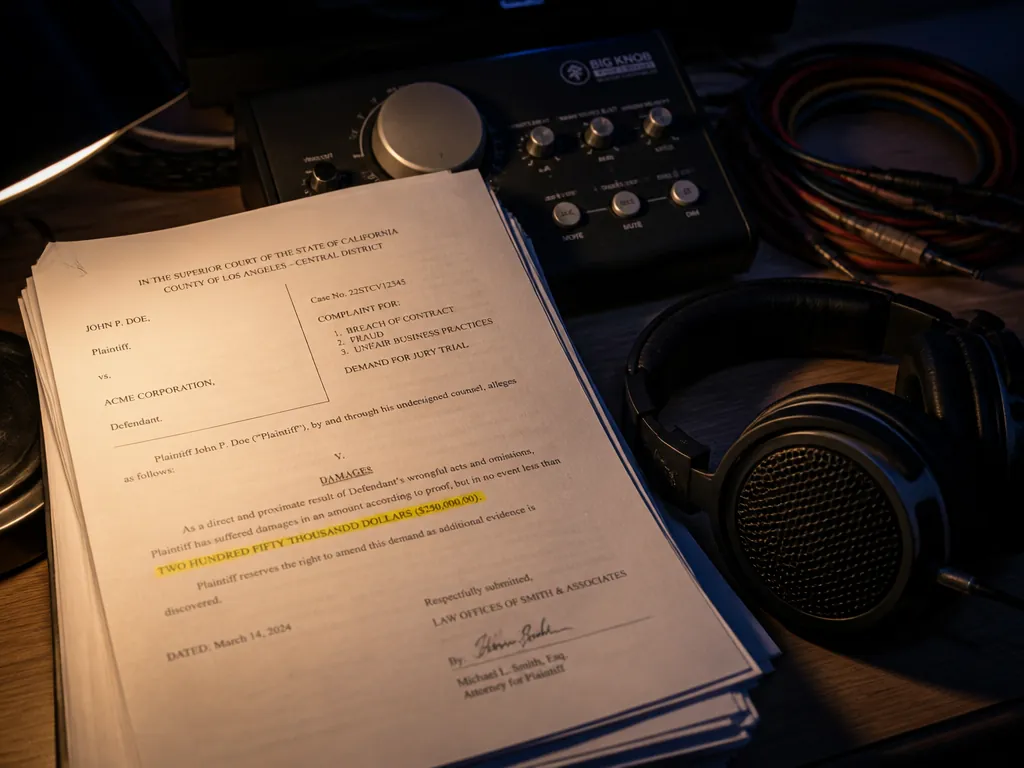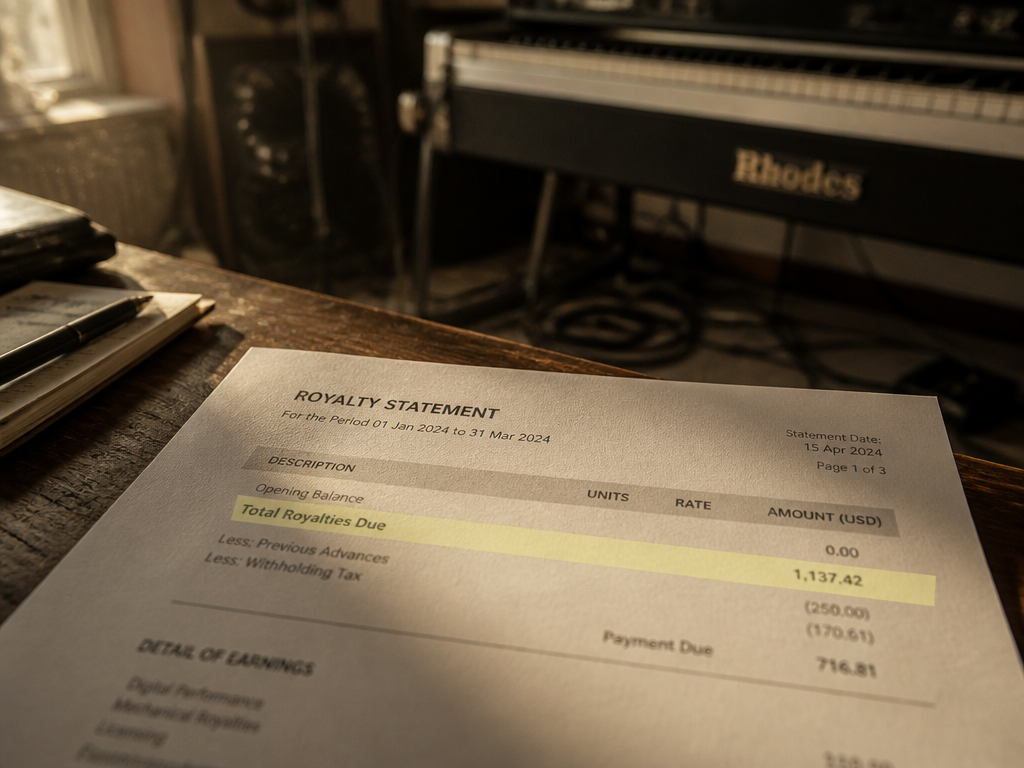
A friend who runs a small commercial studio sent me two numbers last month. The first was an invoice: $4,200 for a three-day session to cut a 90-second cue for a regional ad. That covered a tracking room, an engineer, two session players, a mix pass, and a buyout license negotiated by a music supervisor who took her cut. The second number came from a panel transcript, where a platform executive described the cost of training a music model in terms of "compute and infrastructure investment." No dollar figure. Just the shape of an argument.
That gap between the two numbers is where the AI copyright regulation fight actually lives, and most of the public debate skates right over it. The legal arguments get the headlines — fair use, transformative purpose, training versus output. But underneath the legal language is a cost story, and the cost story is the one a rights manager can win, because it's the one tech lobbying works hardest to keep vague. If you advocate for creators in front of policymakers, this is the comparison worth carrying into the room.
What does it actually cost to make a track each way?
The short answer: making music the traditional way spends most of its money on people and permission, in that order, and almost all of it is traceable. Training a model spends most of its money on compute and ingestion, and the permission line is frequently $0 — not because permission is free, but because it was skipped. The two cost structures aren't smaller and larger versions of the same thing. They're different shapes, and the regulatory argument turns on pretending they're the same shape.
Let me walk the mechanism in order, because the order is the whole point.
First: where the money lands in a studio
Trace a single commissioned track from commission to delivery and the cash moves through a predictable chain.
A client pays a budget. Out of that budget, in rough sequence: the songwriter or composer is paid (or advanced against royalties), session players are paid scale or a negotiated rate, the studio is paid for room time, the engineer and mixer are paid, and — critically — anyone whose existing work gets used is paid for that use. A sample gets cleared. An interpolation gets licensed. A music supervisor exists as a job category precisely because clearing rights is expensive and slow enough to need a specialist.
Every one of those payments is a permission event. Money changes hands because someone holds a right and grants it. The cost of the track is, in large part, the cost of the permissions baked into it. That's not a bug in the old model. It's the load-bearing wall.
Next: where the money lands in a model
Now trace a model from dataset to deployment.
Money moves through compute clusters, storage, the engineers who build the pipeline, the people who clean and label data, and the inference cost of actually running the thing once it ships. Real costs, large costs. But notice what's typically missing from that chain: a payment that fires because someone held a right to a training example and granted permission to use it.
When the work used in training was scraped or licensed in bulk at terms the original creators never saw, the permission event — the thing that ate most of the studio budget — has been engineered out of the cost structure entirely. The compute is real. The licensing line is the one that went quiet.
This is why "we made enormous infrastructure investments" is offered up so readily in policy settings. It's true. It's also a substitution. The argument trades a cost the industry can document (compute) for the cost it would rather not discuss (the unpaid permissions), and invites you to nod along because the first number is genuinely big.
The swap, in their own framing
Watch for the move in how the position gets phrased. The framing usually runs something like: training is a costly, good-faith engineering effort, and any obligation to pay for individual works would make that effort "unsustainable at scale."

Read it again. The cost being defended is the engineering cost. The cost being waved off as unworkable is the licensing cost. The sentence quietly assumes that the second cost is optional overhead rather than the same load-bearing wall the studio model was built on. A composer doesn't get to call session musicians "unsustainable at scale" and record them anyway. The scale objection only works if you've already decided the permission was never owed.
That's the seam. The argument isn't "we paid." It's "we paid for the part we chose to pay for, and the part we skipped should be reclassified as friction."
Where the cost argument is genuinely weak for rights holders
I said I'd hold judgment until the evidence lands, so here's the uncomfortable half.
The per-work licensing math is genuinely hard, and pretending otherwise hands the other side an easy rebuttal. A model might be trained on tens of millions of recordings. If every one of those carries a clearance negotiation like the one in my friend's studio invoice — a supervisor, a back-and-forth, a signed grant — the transaction cost alone could exceed the value of any single track by orders of magnitude. The studio model's permission economics, the thing rights holders want to defend, does not obviously survive being multiplied by ten million.
So the strong version of the tech position isn't "permission doesn't matter." It's "the per-unit clearance machinery you built for human-scale music doesn't physically run at training scale, so something else has to replace it." That's a real problem. A blanket-license or collective-rights structure might answer it. A pure individual-clearance demand probably can't. If your counter-argument depends on individual clearance scaling cleanly, you'll lose on the math, and you should know that before you walk in.
The scale problem cuts the other way too
Here's the part that flips back in the rights holder's favor, and it's where the cost comparison stops being abstract.
In the studio model, output is bounded by input cost. Another track costs another budget — more room time, more players, more clearances. Cost and output rise together. That coupling is what made the permission economics stable for a century. You couldn't flood the market faster than you could pay to fill it.
A deployed model breaks the coupling. The training cost is paid once. After that, generating the ten-thousandth track costs roughly what the first one did — inference, fractions of a cent. Output detaches from input cost completely. Platforms have described daily upload volumes in the tens of thousands of newly generated tracks, and the number keeps climbing because nothing on the cost side restrains it.
That detachment is what makes "report-and-takedown" proposals collapse as a remedy. Takedown was designed for a world where infringing copies were expensive enough to be rare. When generation is nearly free and continuous, asking rights holders to police the output stream one track at a time is asking them to bail with a teaspoon. The volume doesn't just strain the system. It's the wrong unit of analysis entirely — which is the same lesson the per-work clearance problem teaches, pointed the opposite direction.
What to actually price into the counter-argument
If you're building a position for a policymaker, the durable move is to refuse the substitution and put both costs on the table at once.
- Name the missing line. Compute cost is real and large. It is also not the permission cost, and the two are not interchangeable. Make them say which one they're defending.
- Concede the clearance-scale problem out loud. It buys credibility, and it forces the conversation toward collective or blanket structures instead of a fantasy of frictionless free use.
- Lead with the output-side economics, not the training-side. Training cost is their strongest ground. The detachment of output volume from output cost is yours.
- Treat takedown as a unit-mismatch, not a workload complaint. The point isn't that takedown is tiring. It's that it measures the wrong thing in a world where copies are free.
Lobbying gets answered by matching it — better numbers, tighter framing, fewer concessions handed over by accident. The cost comparison is a place where the documentable facts favor the people doing the documenting, if they insist on showing both columns.
What stays genuinely unsettled is the accounting itself. If output detaches from input cost, what does a fair per-output royalty even mean when no single training example can be traced to any single generated track — and is that a number anyone can actually compute, or only one we can agree to negotiate?
Not sure which tool to use?
Compare the top AI music and sound tools side by side — honest reviews, real pricing, no sponsorships.