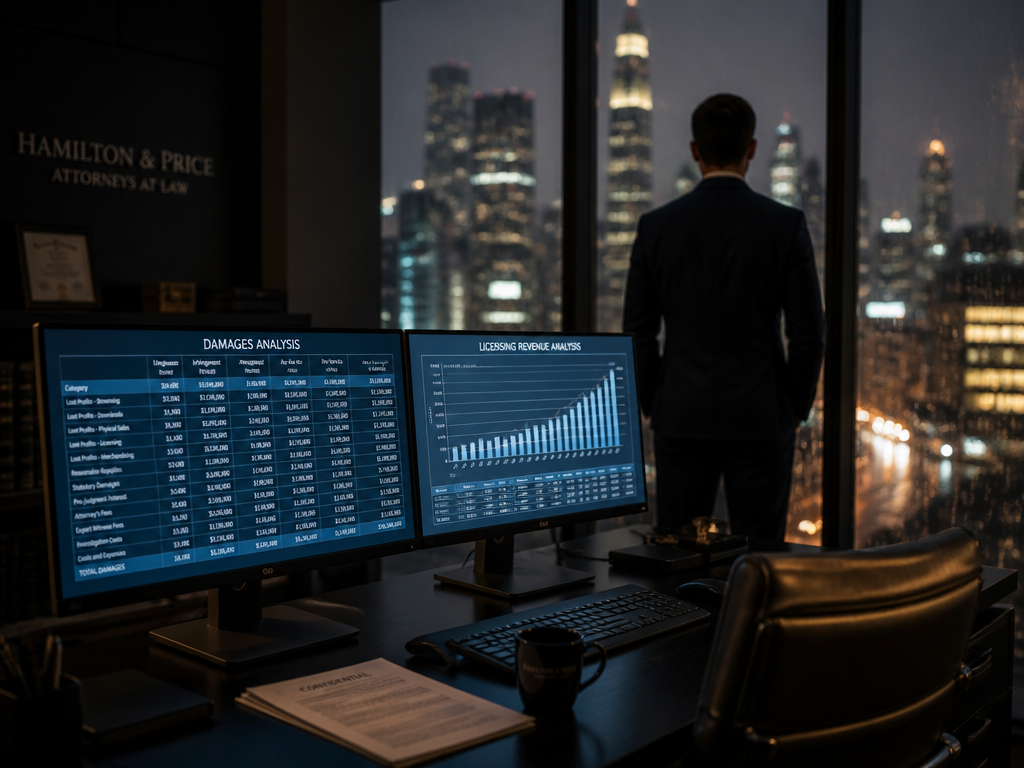
There is a moment in every one of these matters where the numbers stop mattering. You have the statutory-damages math on one screen and the projected bilateral licensing revenue on the other, and the two are close enough that the spreadsheet abstains. That is the moment your client actually decides something — and it is almost never about the money on those screens. It is about precedent.
If you advise on AI music generation copyright law right now, you are not really weighing a settlement figure against a damages exposure. You are weighing whether to buy a rule. That is the fork worth thinking clearly about, and it looks different depending on which courtroom you are standing in.
Consider three tools of analysis, applied across two legal systems: the evidentiary floor (what is even still in dispute), the fair use / lawful-use test in each jurisdiction, and the strategic calculus of settling bilaterally versus litigating for a systemic ruling. Run a music-training case through all three and a verdict tends to emerge on its own.
Criterion one: what is still actually contested
Start with the record, because it constrains everything downstream. In the training-data disputes now visible in both U.S. and German dockets, the pattern is consistent: the factual question of what was ingested is largely conceded or forensically demonstrable, and the fight has migrated entirely onto the legal question of whether that ingestion was permitted.
That migration is the single most important thing to internalize. Audio fingerprinting — the same match technology that content-ID systems use — does not leave much room for a "we don't know what was in the corpus" defense. When a rights-holder can put specific, identifiable master recordings on the board and the defendant's own filings concede that copyrighted works were used in training, you no longer have a factual trial. You have a legal one. That is a very different animal to litigate, and a much harder one to settle cheaply, because there is no evidentiary uncertainty for the defendant to trade on.
Treat this as your baseline: assume the copying is provable. Everything useful happens after that assumption.
Criterion two: fair use, and the transfer problem
In the United States, the defense lives or dies on fair use, and increasingly on the fourth factor — the effect of the use on the market for the original.
Defendants borrow optimism here from the recent wave of text-training rulings. The argument runs: courts have found that training a large language model on copyrighted text can be transformative, that the model learns statistical relationships rather than storing the works, and that this analytical use is defensible even where acquisition of the training corpus was messy. Campbell v. Acuff-Rose supplies the transformativeness vocabulary; the recent LLM cases supply the applied comfort.
The transfer does not hold, and counsel should be candid with a client about why. Text-training fair use survived in part because the market effect was diffuse — a summarizing model does not obviously substitute for the books it read. Music training does not have that luxury. A model that generates on-demand instrumental beds, pop pastiche, and mood cues competes directly in the licensing and sync markets that the training recordings themselves serve. Factor four asks whether the use harms the market for the original and its derivatives, including licensing.
Here is the trap that a functioning licensing market sets for the defense: once rights-holders have begun striking deals to license catalogs specifically for AI training, the existence of those deals is itself evidence that a market for the use exists — and that the unlicensed defendant has appropriated something others are paying for. A transformativeness argument that might have been genuinely contestable becomes structurally weaker the moment the plaintiff can point to a signed comparable. The defense's own industry validated the market it is accused of raiding.

Criterion three: the German frame is not a milder version of the same test
Counsel who treat the European exposure as a softer copy of the U.S. case are making a category error. German law does not run a four-factor balancing test at all. It asks two narrower, more mechanical questions.
Section 16 of the German Copyright Act governs the right of reproduction — did the act of ingesting and encoding the works constitute reproduction? Section 19a governs the right of public disclosure / making available — does the model's output or deployment make protected works available to the public? These are not "vibes and balancing" provisions. They are closer to yes/no gates.
The defense's escape hatch in Germany is the text-and-data-mining exception, which permits certain analytical reproductions. But the exception has an edge the U.S. framework lacks a clean analogue for: the line between analysis and memorization. Reproduction for the purpose of extracting patterns can fall within the exception; a model that can be induced to reproduce a recognizable portion of a protected work has arguably stored rather than analyzed it, and steps back outside the exception into plain Section 16 infringement. The relevant question German courts are pressing is not "was this transformative" but "did the system merely analyze, or did it retain?"
That is a worse question for a music generator than for a text model, because audible reconstruction of a melody, a hook, or a vocal timbre is far easier to demonstrate to a judge than paraphrase leakage from a language model. You can play it in the courtroom.
Where the verdict lands, and what it implies for strategy
Run all three criteria and the same conclusion arrives from opposite directions. The provable-copying baseline removes the factual defense. U.S. factor four is undermined by the very licensing market the industry is building. German Sections 16 and 19a offer a narrower, more binary path to liability that the memorization question makes harder to escape. The legal ground is not neutral, and it is not tilting toward the model.
Which reframes the settle-versus-fight decision:
- A rights-holder plaintiff with catalog depth and patience has a rational reason to refuse bilateral settlement even when the offered check exceeds projected licensing revenue. A settlement buys revenue once. A favorable ruling on factor four, or on the German memorization line, prices every future negotiation across the whole sector. That is why a well-capitalized plaintiff litigates past its own cost-benefit line — it is buying an asset, not collecting a debt.
- A defendant AI company faces asymmetric forum risk. It may want to settle the U.S. matter to deny the plaintiff a factor-four precedent, while fighting in Germany hoping the TDM exception holds — or the reverse, depending on which forum threatens the more portable rule. The worst outcome is a bilateral settlement that leaves the systemic question open for a better-funded adversary to win later.
Who should settle: a defendant whose training corpus is provably unlicensed and whose outputs demonstrably occupy a licensable market. You are not litigating a close question; you are funding your opponent's precedent.
Who should fight: a plaintiff with the balance sheet to outlast, or a defendant with a genuinely defensible corpus and outputs that do not substitute — a rarer profile than most decks claim.
The unsettled question is the one no court has yet answered cleanly: if a music model can be shown to analyze without ever reproducing a recognizable fragment of any training recording — no memorization, no audible substitution, output that competes only in the abstract — does factor four still weigh against it, and does Section 16 still bite? Nobody knows yet. Everything above assumes the models leak. What happens when one demonstrably does not?
Not sure which tool to use?
Compare the top AI music and sound tools side by side — honest reviews, real pricing, no sponsorships.