You have probably asked yourself some version of this question in a conference room with the general counsel and two outside firms billing by the six-minute increment: if an AI music company is on the hook for training on our catalog, do we take the bilateral check and move on, or do we spend two years and seven figures chasing a precedent that binds the whole market? And does that answer flip when the venue is Munich instead of Boston?
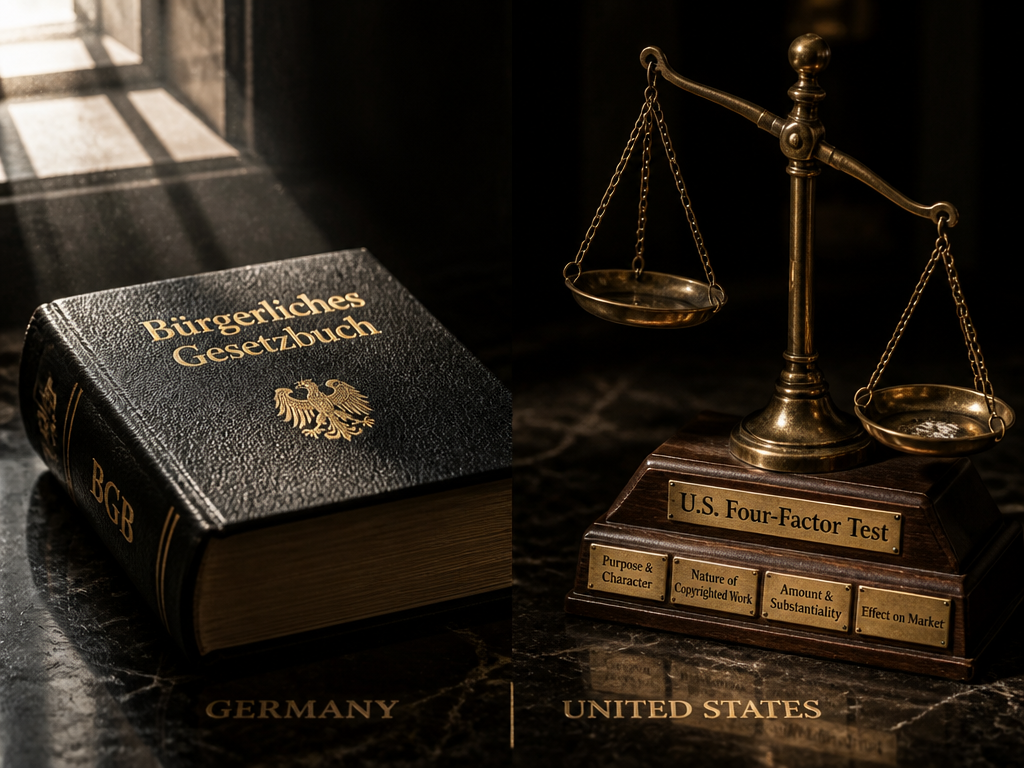
Here is the short version, stated the way a featured snippet would want it: under AI music generation copyright law, the German framework built on Section 16 and Section 19a of the Urheberrechtsgesetz is structurally harder for an AI defendant to escape than the U.S. fair use doctrine, because it converts the fight from a squishy four-factor balancing test into a pair of enumerated exclusive rights the defendant has to affirmatively find an exception for. That asymmetry is the whole strategy. Everything below is the work behind that sentence.
The question, restated for a rights team
Strip away the headline damages figures and the case is about two acts: the copying that happens when a model ingests a catalog, and the distribution that happens when it emits something recognizably derived. In the United States those acts collapse into one contested inquiry — was the use fair? In Germany they stay separate, and each has its own name. That is not a cosmetic difference. It changes what you have to prove, who bears the burden, and therefore what your settlement leverage is worth.
Why U.S. fair use is a fight you might survive
American AI training copyright analysis has, so far, been friendlier to defendants than rights-holders would like — but the friendliness is confined to a specific fact pattern. The text-training cases established a defensible transformativeness argument: ingesting works to learn statistical relationships, then producing something that does not substitute for the originals in their market, reads as transformative under the logic running from Campbell v. Acuff-Rose forward.
The trouble for an audio defendant is the fourth factor — market effect — and it is a different animal for music than for text. When a model trains on a catalog and then generates songs that land in the same playlists, sync libraries, and streaming queues those recordings compete in, the output is not orthogonal to the input's market. It is aimed at it. And once a licensing market for AI training data demonstrably exists — once a major has actually signed a deal to license catalog for exactly this purpose — the defendant can no longer argue that no market was harmed. The market it harmed is the one it declined to pay into.
So the U.S. answer is genuinely "it depends." A defendant with clean, licensed training data and outputs that don't compete has a real fair use argument. A defendant with unlicensed ingestion and market-substituting outputs is relying on transformativeness to carry weight that Factor Four keeps pulling back down. Survivable, but not comfortable.
Why German law is a different animal
Now move the venue. German copyright law does not run a balancing test at all. It grants enumerated exclusive rights and then lists narrow statutory exceptions. Two rights matter here.
Section 16 — the right of reproduction (Vervielfältigungsrecht). This covers the copying inherent in ingesting protected recordings into a training corpus. If protected works were reproduced without authorization, the right is implicated at the moment of ingestion, full stop. There is no transformativeness escape hatch built into the right itself.

Section 19a — the right of making available to the public (Recht der öffentlichen Zugänglichmachung). This covers on-demand distribution — the model serving up outputs to users on request. Where a generated output is found to reproduce protected elements of a specific recording, this is the right that the delivery of that output implicates.
The defendant's route out is not "fair use." It is the text-and-data-mining exception transposed from the EU framework into German law. And that exception has a seam that the German OpenAI-adjacent reasoning has been pressing on: it protects analysis, not retention. A system that extracts statistical patterns and discards the works may sit inside the TDM exception. A system that memorizes protected expression well enough to reproduce it on demand has done something the exception was never written to cover. The line between analysis and memorization is where the entire German defense lives or dies — and it is a factual line, provable with the same fingerprinting evidence that shows up in discovery elsewhere. Name a specific work in the hearing — a recognizable eighties synth-pop anthem, a disco-era chart single — play the output next to the master, and you are no longer arguing law. You are arguing acoustics.
That is why the German posture is worse for a defendant. In the U.S. the defendant argues one contested question and might win it. In Germany the defendant has to (1) locate an exception for the Section 16 reproduction, (2) stay inside the analysis-not-memorization boundary, and (3) do the same again for any Section 19a output that fingerprints against a real recording. Three affirmative burdens, not one favorable balance.
The strategic fork
This is where the settle-or-fight question actually resolves, and it resolves differently depending on which chair you're in.
If you are the rights-holder, a bilateral settlement is revenue today; a precedent is leverage over every AI company forever. You fight for precedent when your evidentiary record is clean — documented unlicensed ingestion, fingerprint matches to named masters — and when the venue's law does the work for you. A German forum applying Section 16 and 19a does more of that work than a U.S. court weighing four factors. Precedent-hunting is more rational where the statute is more rigid.
If you are the AI company, the calculus inverts. Settle bilaterally where the law is harshest and your factual record is dirtiest — buy your way out of Germany quietly rather than generate a binding continental precedent against yourself. Fight for precedent only where you have the stronger structural argument, which is the U.S. transformativeness terrain, and only if your training data is defensible enough to survive Factor Four.
Who should settle, who should fight
- Settle if your training corpus was unlicensed and your outputs demonstrably compete in the licensed catalog's market — that fact pattern loses in Germany and strains in the U.S.
- Fight for precedent if you're a rights-holder with fingerprint evidence and a German forum, because the enumerated-rights structure minimizes the discretion a judge can use to save the defendant.
- It genuinely depends if the corpus was partly licensed, the outputs are non-substitutional, and the venue is American — that's the one configuration where a defense is worth its cost.
I keep a folder of AI renders I've made from prompts describing tracks I own outright, and a second folder from prompts that named other people's songs. I never ship from the second folder, and not because a court told me to — because I can hear, in the memorized phrasing, the exact thing Section 16 was written to name.
Not sure which tool to use?
Compare the top AI music and sound tools side by side — honest reviews, real pricing, no sponsorships.