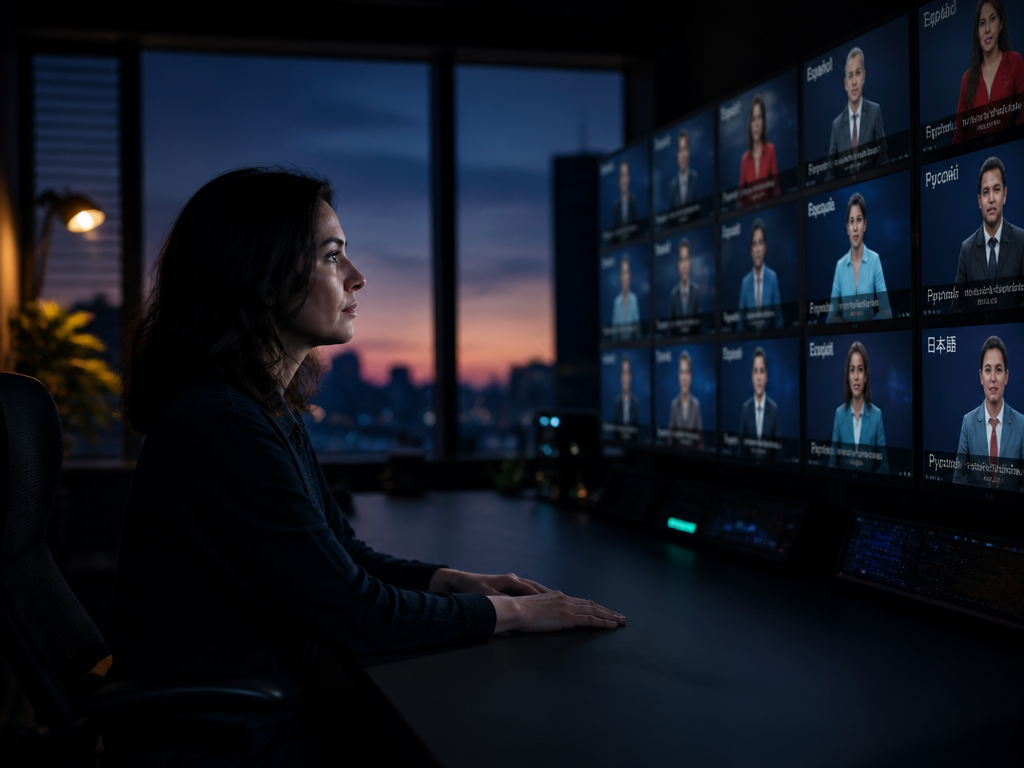
A localization vendor once handed me a batch of 14 product videos two days before a multi-market launch. The English master looked clean. Then I opened the Castilian Spanish cut and the presenter's mouth was finishing a sentence her voice had abandoned half a second earlier. The audio had been regenerated; the lip-sync had not. Multiply that by 14 languages, three reviewers per language, and a hard launch date, and you have the actual problem AI video generation is supposed to solve — not "can a machine make a talking head," but can it make 200 of them, in a dozen tongues, without one of them quietly breaking on a Friday.
That is the question an enterprise content lead is really asking when a unified platform like Infinite Reality shows up promising script-to-screen in one pipe. So let me state the disclosure up front: City of Punk builds neural audio tools, which puts us adjacent to the voice layer of every product discussed here. I am going to compare these approaches on criteria that have burned me on real jobs, and where a competitor does something better than what I'd build, I'll say so.
The shift worth examining, and the one that's hype
The genuine change is not the avatar. Convincing synthetic presenters have existed in the enterprise category for years. The change is consolidation: voice synthesis, lip-sync, render, and localization collapsing into a single platform with one API and one billing relationship, instead of four vendors who each blame the other when the Spanish cut desyncs.
That consolidation is real and it matters. What's overstated is the implication that consolidation alone solves your problem. It moves the problem. You trade integration risk for lock-in risk, and you trade per-tool licensing confusion for a single governance surface that is now large enough to stop a launch on its own. Whether that trade is worth it depends entirely on volume, language count, and how much your legal team already knows about avatar consent law. So instead of ranking products, I'm going to evaluate three approaches against criteria, and let the verdict fall out.
The three contenders:
- The unified stack — an all-in-one platform of the Infinite Reality type, where voice, avatar, lip-sync, and localization live under one roof.
- The avatar specialist — a Synthesia-class tool built specifically for stock-and-custom presenter video, deep on the avatar layer but historically lighter on the rest of the pipeline.
- The fragmented best-of-breed setup — a dedicated voice tool, a separate video/avatar tool, and a separate localization workflow, stitched together by your team.
How I'd evaluate any of them
These are the criteria that decide whether a tool survives contact with a real content operation. Vague superlatives don't ship campaigns; these do.
Output quality
The avatar specialists still hold the edge on presenter fidelity for one reason: they've spent years capturing actor data under controlled conditions. A custom avatar trained from a proper studio shoot, driven by a clean script, reads as broadcast-adjacent. The failure mode is the same one it's always been — micro-expressions during pauses, and the eyes. Synthetic presenters tend to look attentive in a way humans aren't; they don't glance away, they don't blink off-rhythm. On a 30-second product explainer, nobody notices. On a two-minute executive address, the uncanny tax compounds.
Unified platforms are catching the avatar layer up, but their real quality differentiator is upstream, in the voice. If the voice synthesis and the lip-sync are trained together, the phoneme timing aligns natively instead of being conformed after the fact. That's the technical reason the unified approach kills the desync problem I opened with: the mouth shape is generated from the same model state as the audio, not bolted on. Where unified renders still go mushy is emotional range — a voice carrying genuine enthusiasm or measured gravity across a long read tends to flatten toward a pleasant, even middle. Fine for a knowledge-base walkthrough. Thin for a brand manifesto.
Localization at scale
This is where the fragmented setup falls apart and the unified stack earns its keep. In a stitched pipeline, every language is a fresh opportunity for the audio and the visuals to drift, because they're produced by different systems on different timelines. You localize the script, regenerate the voice, and then someone has to re-conform the lip-sync — which is exactly the step that got skipped in my 14-market story.
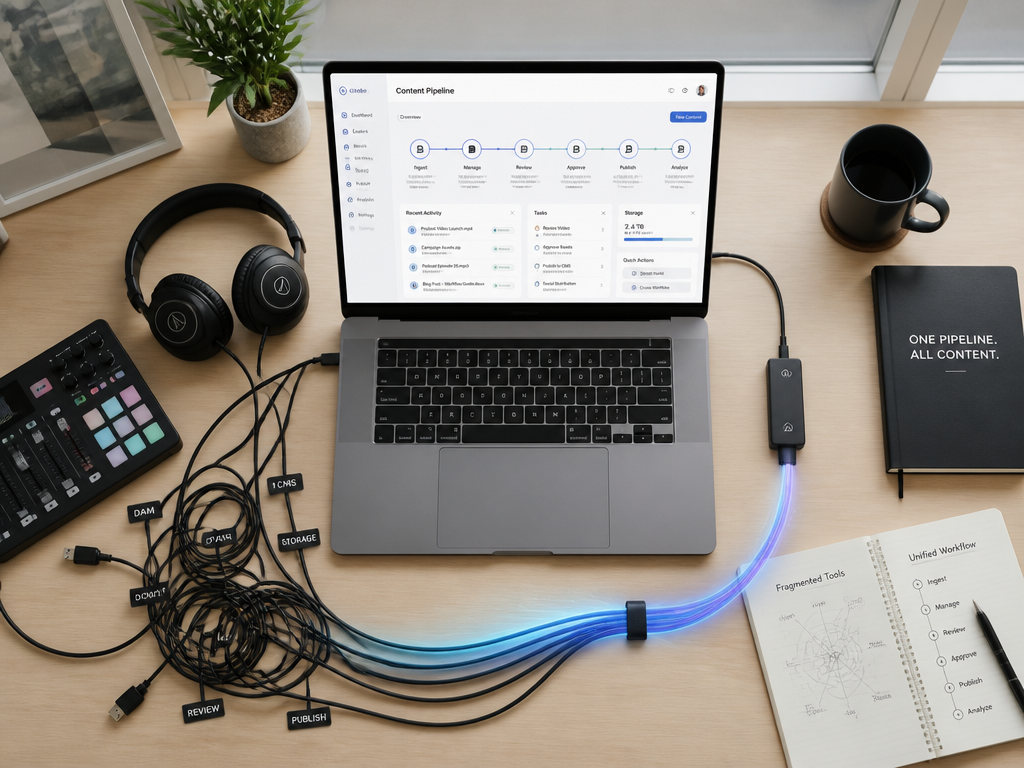
A unified platform treats a new language as a parameter, not a new project. Swap the target locale, the voice re-renders in that language, and the lip-sync regenerates against the new phonemes in the same pass. For a marketing ops manager pushing the same campaign into a dozen markets, this is the single largest throughput gain on offer. The honest limit: language coverage and quality are wildly uneven across vendors and across languages within a vendor. Tier-one European and East Asian languages tend to be strong. Right-to-left scripts, tonal languages, and regional dialects are where you'll find the rough edges, and a render that's grammatically correct can still land as tone-deaf to a native reviewer. Never ship a localized cut your team can't have reviewed by someone who actually speaks it.
Licensing and avatar governance
Read this section twice, because it's where the money and the risk both hide. The three approaches differ less on price than on what you're actually allowed to do with the output and whose face you're allowed to use.
For stock avatars — the platform's library presenters — the usual model grants commercial use while you're subscribed, often with carve-outs: no political content, no implying the avatar endorses you personally, sometimes restrictions on regulated industries. For custom avatars built from your own talent, the governance burden moves onto you: you need documented, time-bounded consent from the person whose likeness you've cloned, and you need a plan for what happens to that clone when they leave the company or revoke consent. Several platforms now require explicit consent capture before they'll train a custom avatar. Treat that as a feature, not friction.
The trap in the fragmented setup is that each vendor's commercial terms differ, and the place they differ most is whether output rights persist after you cancel. A voice you generated under an active subscription may not be licensed for use once you stop paying — and that footnote is exactly where stock-media subscriptions have burned people for a decade. Audit cancellation terms before you build a campaign on any of these.
Export formats and pipeline fit
Ask three boring questions before you commit:
- Can you get the audio out separately? A combined MP4 is useless if your editor needs to remix the voice against a music bed. You want at least a discrete audio export, ideally 48kHz WAV to match video post standards.
- Is there an alpha channel? Avatars composited over your own backgrounds need transparency (ProRes 4444 or equivalent). Platforms that only output flattened 1080p MP4 force you into their template world.
- Is there a real API? For high-volume operations, the difference between a tool and an operation is whether you can trigger renders from your CMS or a script. Manual seat-based UIs cap out fast at scale.
The avatar specialists are generally strong on the studio-finish exports and weaker on raw component access. The unified platforms vary; the good ones expose the stems because they know enterprise post teams demand them. The fragmented setup gives you the most control over formats and the most labor assembling them.
Twelve-month cost reality
Pricing models matter more than headline numbers, and they fall into three shapes: per-seat (you pay for editors), per-minute of rendered output, and render credits that bundle the two. Costs and tiers shift constantly, so I won't quote figures that'll be stale by the time you read this — but the structure tells you who each model punishes.
Per-minute pricing punishes high volume; it's friendly for a team making a few polished videos a month and brutal for one pumping out hundreds of localized variants. Per-seat punishes large teams with light individual usage. The fragmented setup carries a hidden cost that rarely shows up in the spreadsheet: the labor of integration and the re-work when one tool's output doesn't conform to another's. Price that engineering and QA time honestly and the "cheaper" stitched stack often isn't.
The comparison, side by side
| Criterion | Unified stack (Infinite Reality-type) | Avatar specialist (Synthesia-class) | Fragmented best-of-breed |
|---|---|---|---|
| Lip-sync / voice alignment | Native; generated together | Strong avatars, conformed audio | Most likely to desync |
| Presenter fidelity | Improving, varies | Highest, studio-trained | Depends on chosen tools |
| Localization throughput | Highest; locale as a parameter | Good within supported set | Slowest; manual re-conform |
| Voice emotional range | Flattens on long reads | Tied to voice partner | Best if you pick a strong VO tool |
| Export control (stems, alpha, API) | Varies; good ones expose stems | Studio-finish, less raw access | Most control, most labor |
| Governance surface | Single, large, must-manage | Mature consent tooling | Spread across vendors |
| Cost risk at high volume | Lock-in; check render pricing | Per-minute can sting | Hidden integration labor |
| Best fit | High-volume multilingual | Polished presenter content | Low volume, bespoke needs |
No single column wins outright, which is the point. The right answer is a function of your volume and your tolerance for governance overhead.
Governance is the part that decides whether you ship
Here's the strategic concern an executive should actually lose sleep over, and it's not render quality. It's that synthetic presenters now sit inside a tightening regulatory frame, and the obligations land on you, the deployer, not only on the vendor.
Transparency requirements are moving from optional to mandatory in major markets. Regulation of AI-generated likenesses — most prominently the EU's framework — pushes toward disclosure that content is synthetic and toward provenance you can prove. Content provenance standards like C2PA exist specifically so a downstream platform or auditor can verify how an asset was made. The practical questions for your stack:
- Does the platform embed provenance metadata or a watermark, and does it survive your post-production?
- Can you produce, on demand, the consent record for every avatar likeness in a campaign?
- When a piece of talent revokes consent, can you find and pull every asset their clone appears in — across markets and channels?
The fragmented setup makes that last question nearly impossible to answer cleanly, because no single system holds the full record. A unified platform at least centralizes the governance surface — which is also why it becomes a single point of risk. The avatar specialists have, in many cases, the most mature consent capture, because regulators came for the talking-head category first.
Whichever approach you pick, the governance work doesn't disappear into the product. The vendor gives you the controls; building the policy around them is your job, and it's the job most enterprises are still pretending they can defer.
Who it's for, who should skip it
The unified stack is for you if your operation looks like high-volume, multi-language campaign production — the same message into ten or more markets, refreshed often, where throughput and lip-sync consistency are the bottleneck. The consolidation pays for itself in re-work avoided, and the centralized governance surface is an asset once you staff it.
The avatar specialist is for you if your output is a smaller volume of polished presenter content — training, internal comms, executive-fronted explainers — where fidelity matters more than scale and you value mature consent tooling over a one-pipe localization story.
The fragmented best-of-breed setup is for you if your volume is genuinely low, your brand demands hand-crafted hero content, or you already own a voice and video pipeline you trust and only need to swap one component. It is the wrong choice the moment your language count climbs, because that's exactly when the conform-the-lip-sync step gets skipped and breaks on a Friday.
Skip synthetic presenters entirely if your most important content is the kind that carries genuine emotional weight — the brand film, the founder's apology, the moment that needs a real person being imperfect on camera. AI video generation is an instrument for scale and consistency, not for the one piece that has to feel human. Use it where the math demands volume; use a camera where the message demands a soul.
The verdict, and what it doesn't settle
For the specific reader this is written for — the content lead drowning in multi-language campaign volume — the unified stack wins on the criterion that's costing you the most: throughput without desync. You'll pay for it in lock-in and in governance work you can't outsource to the vendor. That's a defensible trade at high volume and a bad one at low.
What this comparison can't settle for you is the economics at your scale. The per-minute math at 10,000 assets a year looks nothing like the demo, and only a paid pilot against your real catalog will tell you whether the unified stack's pricing model rewards or punishes your volume. Nor can I tell you how an avatar likeness contract survives a vendor being acquired — whose obligation the consent record becomes when the company that holds your talent's face changes hands. That clause is in nobody's marketing deck, and it's the one I'd put in front of legal before I signed.
Run the pilot on your worst job, not your best one. The tool that holds together on a 14-market launch the week it's due is the only one whose demo was telling the truth.
Not sure which tool to use?
Compare the top AI music and sound tools side by side — honest reviews, real pricing, no sponsorships.