First Snap, then Spotify. Within the same stretch of earnings-season optimism, two platforms that sell attention by the second started pitching the same idea to advertisers: describe your product, pick a tone, and let the system write the script, read it in a synthetic voice, and drop it into the feed. The pitch decks lead with AI voice generation as the headline feature, and they come with the kind of numbers that travel well — thousands of brands trying it, tens of thousands of creatives generated.
Those numbers are real. What they measure is the question. "Creatives generated" is not "creatives that ran," which is not "creatives that performed," which is not "advertisers who renewed because of them." Between the announcement and the impact sits a gap most coverage skips over, and that gap is where the actual story lives.
I score audio for a living, and I've spent the last few years watching generative tools move from novelty to part of the pipeline. So let me set up the thing a smart reader has almost certainly heard — in a vendor meeting, on a panel, in a Slack thread from someone who saw the demo — and then take it apart.
The myth, stated plainly
Here is the version of events that's circulating, and it's persuasive because it's half true:
Platforms like Spotify are about to drive the cost of an audio ad to near zero. The voice becomes a dropdown. The script becomes a prompt. The whole production chain — writers, voice talent, audio shops, the mix — collapses into a slider you drag. Brands self-serve the entire spot, audio professionals get disintermediated, and the only competitive moat left is who has the best generation model.
A smart marketing reader hears that and does the math: if audio creative is suddenly free and infinite, then the platform that owns the generation layer owns the category. That's a real competitive thesis, and it's worth evaluating seriously. It's also wrong in the specific way that matters for how you allocate budget and headcount this year.
The evidence doesn't say what the deck says
Start with what's actually shipping. The platform tools in this wave are, mechanically, three things bolted together: a copy generator (a language model that turns a brief into a script), a text-to-speech engine that reads the script in one of a fixed menu of voices, and a dynamic-insertion system that drops the result into ad slots. That's a genuine production efficiency. It is not the same as "infinite free creative that converts."
The tell is in the metric everyone quotes. When a platform says it generated 20,000 creatives, that's a usage number — it counts renders, not results. It's the audio-ad equivalent of "documents created in our editor." The numbers that would actually support the disintermediation thesis are the ones nobody publishes yet:
- How many of those generated spots cleared internal brand review and went live?
- Of the ones that ran, how did completion rate and recall compare to the brand's human-produced control?
- How many advertisers renewed the AI workflow versus trying it once and going back?
Until those exist, the announcement is a momentum signal, not an impact finding. Treat it the way you'd treat any top-of-funnel vanity metric from a platform that has a quarter to make.
Where synthetic audio already earns its keep
None of this means the tools are vaporware. They work — in a specific lane. Synthetic voice is genuinely good now at high-volume, low-personality, functional copy. Think:
- Direct-response radio and audio where the copy is information ("0% APR through Sunday at participating dealers") and the voice is a delivery mechanism, not a brand asset.
- Programmatic localization — the same 15-second spot needing to run in nine markets in seven languages, where hiring nine voice actors and booking nine sessions is the bottleneck.
- Dynamic personalization — inserting a city name, a price, a daypart greeting into an otherwise-fixed spot, at a scale no human session can match.
In those cases the synthetic voice isn't competing with a great read. It's competing with no localized version at all, or with a robotic concatenation system that already sounded worse. That's the honest opportunity, and it's substantial.
Where it still falls apart
The same tools get exposed the moment the copy needs a person in it. As of writing, generated voice still struggles with:
- Emotional range across a sentence. TTS reads "We know losing a parent is hard" with the same metabolic calm as a weather report. The prosody is plausible word to word and wrong across the arc.
- Specific regional identity. A model's idea of an "Australian voice" or a "Southern US" read tends toward a flattened average — fine for a generic spot, instantly fake to anyone from that market.
- Comic timing and intentional imperfection. The breath before a punchline, the deliberate stumble that signals authenticity. Generation smooths exactly the texture a good read uses on purpose.
- A signature voice. If your brand is the voice — a recognizable spokesperson, a personality-led campaign — synthetic doesn't get you close, and cloning a real person opens a rights question we'll get to.
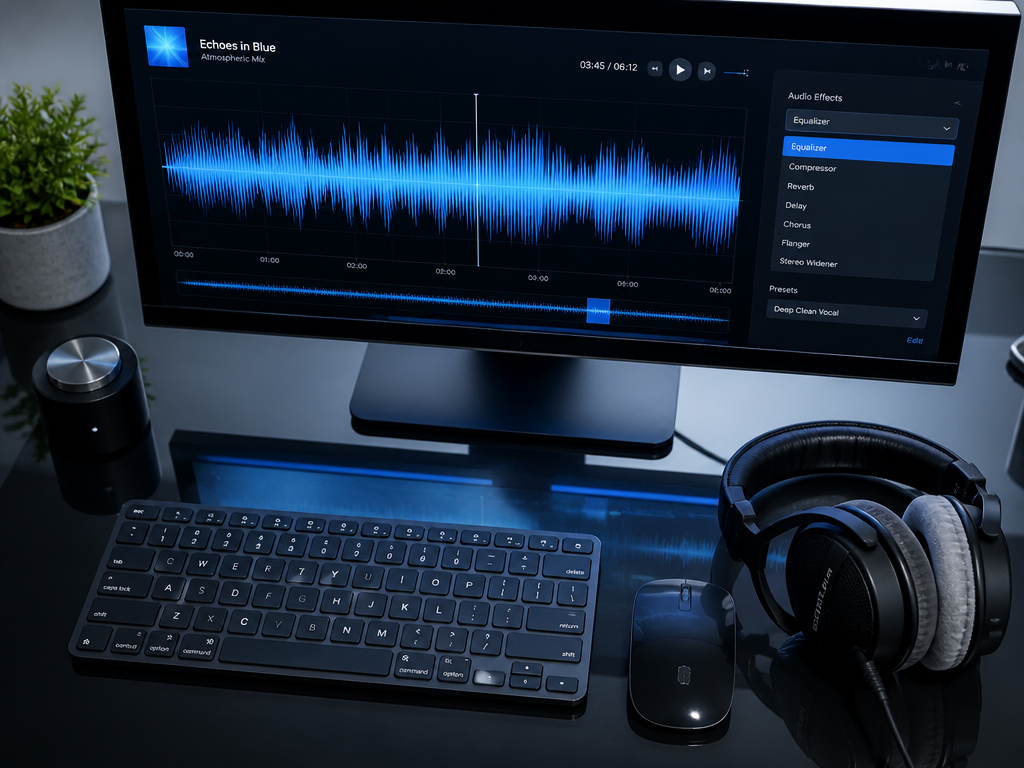
So the evidence points somewhere more interesting than the myth. Synthetic voice automates the floor of audio advertising — the volume, the localization, the functional reads. It does not automate the ceiling, and it makes the ceiling more valuable by contrast.
How the automation actually works
If you're evaluating one of these platforms, it helps to know what's behind the single word "AI" in the slide. There are three distinct technologies, and vendors blur them on purpose because the blur is flattering.
Text-to-speech (TTS). A model trained to convert written text into a synthetic read, using a library of pre-built voices. This is the workhorse of platform ad tools. You don't supply a voice; you pick from a menu. The licensing is usually clean because the platform owns or has licensed the voice models. The quality ceiling is "competent stock read."
Voice cloning. A model that reproduces a specific person's voice from a sample, so you can generate new lines in, say, a celebrity's or a staff member's voice. This is where the rights questions get sharp — you need explicit, documented permission from the voice owner, and the terms around synthetic likeness are still being written into contracts and, in some jurisdictions, law. Most platform self-serve tools avoid offering this for exactly that reason.
Generative audio (music and sound). A separate category — models that produce the music bed, the sting, the texture under the voice, rather than the voice itself. Different licensing story, different failure modes (more on this below).
What the platforms call "automation" is mostly templating plus TTS plus dynamic insertion. The script generator drafts copy from your brief; TTS reads it; the ad server inserts it. The human stays in the loop in places the demo skips over:
- Casting the voice. Picking which synthetic voice fits the brand from the available menu is a creative-direction decision, and the menu is finite.
- Editing the copy. The generated script is a first draft. Someone with brand judgment trims it, fixes the claim that legal won't allow, and rewrites the line that scans wrong.
- The mix. Voice level against music bed, compression, loudness normalization to the platform spec. Automated tools do a default pass; the default is rarely the final.
- The music bed and its clearance. This is the part that quietly becomes your problem.
The licensing trap nobody puts in the press release
Here's the thing that doesn't make the announcement. A finished audio ad is usually voice plus a music bed plus maybe a sound effect or sting. The platform's AI handles the voice and its rights. The music underneath is a separate clearance question, and "the AI made the whole spot" can quietly leave you holding the licensing risk on the bed.
If the platform's tool pulls a music bed from a library, read what license actually attaches to your use of the rendered ad — territory, term, exclusivity, and whether it covers paid distribution at the scale you're planning. If you bring your own track, you own that clearance entirely. And if any part of the audio was generated by a third-party model, the question of who owns the render and on what terms is one to get in writing, not assume.
This is the unglamorous reason a lot of teams handle the voice and the music as two separate decisions. For the bed specifically, generated, commercially-cleared audio — the lane City of Punk works in — tends to be a simpler clearance story than a sample-based track, because there's no underlying recording to chase rights on. That's a narrow point, not a pitch: the broader principle is that "AI did it" is never a substitute for knowing what license covers the file you're about to push to millions of impressions.
So who does this actually hit?
The displacement story gets told as a clean line: machines replace people, full stop. The reality is shaped like a squeeze, and where you sit on the curve determines whether this wave is a threat or a tailwind.
The volume floor gets automated. The per-market localization read, the DR radio spot, the price-and-date functional ad, the daypart variant — that work was already low-margin and high-volume, and it's the first to move to synthetic. The voice professionals who lived primarily on that work feel it first and hardest. That's the real labor implication, and it's worth naming without dressing it up: the floor is rising under the machines.

The ceiling gets more valuable. When competent functional reads are infinite and cheap, the things that can't be generated — a distinctive brand voice, a performance with intent, a campaign built around a real personality — stand out more, not less. Scarcity reasserts itself at the top. Talent that operates there isn't competing with the platform tool; it's now the differentiator the platform tool can't supply.
The middle is where it's brutal. The mid-tier production shop that did fine, professional, unremarkable audio — neither high-volume-cheap nor distinctive-premium — is squeezed from both sides. The floor work goes to the platform; the ceiling work goes to specialists. That middle is where the disruption actually concentrates, and it's the part the "everything is automated" narrative gets too lazy to locate.
For an ad-tech watcher, this reframes the competitive question. The moat isn't "who has the best voice model" — those will commoditize fast, the way every other model layer has. The moat is who owns the demand-side relationship and the inventory: the platform that already has the brands, the audience, and the ad server. AI voice generation is a feature that makes self-serve audio sticky on a platform that already had the advertisers. It's a retention and onboarding play dressed as a creative one.
An evaluator's checklist
If you're assessing a platform's AI audio claims — as a buyer, a competitor, or an analyst — these are the questions that separate the announcement from the substance.
- What's the renewal rate, not the generation count? Ask how many advertisers used the AI workflow more than once. Usage is vanity; repeat usage is signal.
- What's the human-control benchmark? Did the platform A/B the synthetic spot against the brand's own human-produced version? On what metric — completion, recall, conversion? If they didn't run the test, that's the answer.
- Which voice technology is under the hood — TTS, cloning, or both? If they offer cloning, ask exactly how voice-owner consent is captured and documented.
- Who clears the music bed, and what does that license cover? Territory, term, paid distribution at scale. Get the actual terms, not "it's all licensed."
- Who owns the rendered file? Confirm in writing that you can run the output where and as long as you need to.
- What's the voice menu, and how big is it really? "Hundreds of voices" often means a few dozen with accent variants. Listen to the ones in your target market before you believe the count.
- Where does it break for your category? Bring your hardest 15 seconds of emotional or comic copy to the demo. Generic copy always sounds fine; your copy is the test.
Where synthetic audio holds up — and where it doesn't
| Use case | Synthetic voice today |
|---|---|
| Functional DR copy (price, date, terms) | Holds up — competes with no-localization, wins |
| Multi-market localization at volume | Holds up — clears the human-session bottleneck |
| Dynamic insertion (city, daypart, price) | Holds up — scale humans can't match |
| Emotional or sensitive copy | Breaks — prosody flattens across the arc |
| Strong regional/cultural identity | Breaks — reads as an averaged accent |
| Comic timing, intentional imperfection | Breaks — smooths the texture that does the work |
| Signature brand voice / personality | Breaks — and cloning a real one is a rights question |
The honest takeaway
The momentum is real and the tools are useful, so the temptation is to round up to the myth — that the audio ad is becoming a free, infinite, fully automated artifact and the platform that owns generation owns the category. It's cleaner to say that, and clean stories travel.
But the measurable shift isn't at the glamorous end. It's in the middle of the funnel and the bottom of the rate card — the localization, the functional reads, the volume work that was already commoditizing and now commoditizes faster. The platforms are competing on advertiser relationships and inventory, and AI voice is the feature that keeps self-serve buyers from leaving. The voice professionals who'll feel it are the ones in that squeezed middle, and that's worth saying without either panic or cheerleading. Meanwhile the work that needs a person in it gets, if anything, scarcer and more valuable.
So evaluate the platforms on the renewal curve, not the render count. Ask who clears the music and who owns the file. And keep the human where the human still wins — the script that lands, the read with intent, the spot that sounds like someone meant it.
The myth says AI voice generation is about to make the audio ad free, infinite, and human-free. The more accurate version: it makes the cheap, functional, high-volume part of audio nearly free — and quietly makes everything a machine can't fake worth more than it was last year.
Not sure which tool to use?
Compare the top AI music and sound tools side by side — honest reviews, real pricing, no sponsorships.