A mid-size publisher I talked to last winter had 240 backlist titles sitting in a spreadsheet, every one of them text-only, every one of them a candidate for an audio edition that would never get made. The math was the wall. At the rates a union narrator commands — figure a per-finished-hour fee, plus studio, plus a director, plus a proofer-against-text pass — a single 10-hour title runs into the thousands before anyone considers a cover. Times 240. The audio program died in committee, not because nobody wanted it, but because the production model only worked for the front-list lead titles.
AI voice generation is the thing that changed that arithmetic, and the question on every acquisitions and production desk right now is not whether it works but where it works without burning you. The honest answer is that it depends entirely on what's in your catalog — and on a licensing question most vendors would rather you not read closely.
Disclosure up front: City of Punk builds neural audio tools, including generated music and sound textures that compete in part of this space. I score games and short films for a living and I have shipped projects on all three of the production paths below. I'll show my reasoning so you can check it.
The three paths on the table
When a publisher asks "should we use AI for audio," they're usually conflating three different production models that fail in different places:
- Full human narration — the baseline. A booked narrator, a studio, a QC pass.
- Hybrid — a human lead voice for the words, AI tools for everything around it: scoring, ambience, pickup lines, pronunciation fixes, mastering.
- Full synthetic narration — the words themselves rendered by AI voice generation, human-directed and reviewed.
I judged each on five criteria that actually decide budgets: output quality, licensing clarity, stems and export formats, cost over a publishing season, and who it's flatly wrong for.
Path 1: full human narration
This is still the quality ceiling for anything that lives on performance. A skilled narrator does things a model does not reliably do yet — landing a joke's timing, holding a 40-hour register consistent, making a villain and a child distinct without sounding like a cartoon.
Output quality: highest, for narrative-driven and literary fiction. Licensing: clean and well-understood. Contracts, royalty splits, and rights reversion are a known quantity your legal team already handles. Export: you get what you commission — typically 44.1kHz or 48kHz, mastered to ACX-style specs, delivered as per-chapter files. Cost over a season: the highest by a wide margin, and it does not bend. A bigger catalog costs proportionally more. Wrong for: deep backlist, technical manuals, reference, and anything where the listener wants information over performance.
Path 2: hybrid
This is the one most working studios have quietly settled into, and the one I reach for most. Keep the human read — that's the part the audience emotionally tracks — and let AI tools carry the production weight around it: a low, detuned drone under a tense chapter, an ambient room tone, a generated intro sting at the title card, and AI cleanup for the three lines the narrator flubbed after the studio was already torn down.
Output quality: very high, because the performance is human and the machine handles texture, where it's strong. Licensing: this is where it gets sharp. The narration license is clean. The generated music and ambience may not be — read the next section before you ship. Export: best of the three for editors. Generated beds often come as stems, so you can duck the music under dialogue at the mix without a re-render. Cost over a season: materially lower than full human, mostly by killing the composer fee and the second studio day. Wrong for: projects with no budget for any human talent at all.
Path 3: full synthetic narration
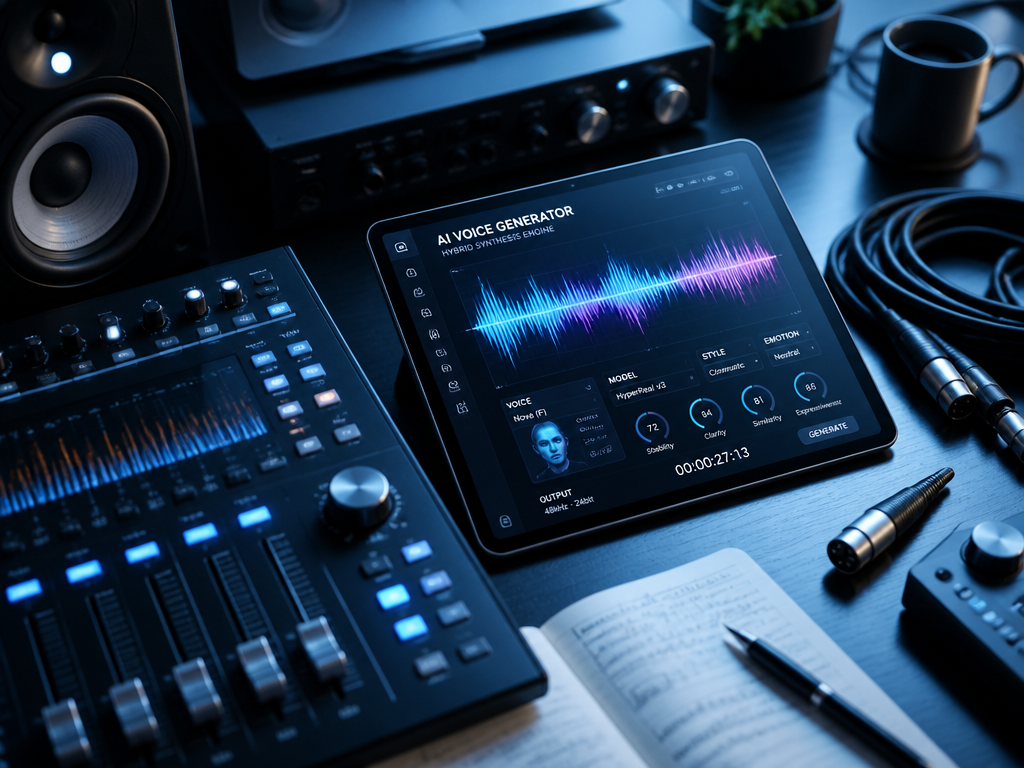
This is the path the headlines mean when a celebrity voice "narrates" a classic without entering a booth. The model speaks the whole book in a licensed voice, a human directs and reviews, and a 10-hour title can finish in days instead of weeks.
Output quality: good and improving, genuinely strong for non-fiction, self-help, business, and reference. It still slips on long-form fiction — emotional pacing flattens over hours, multi-character dialogue blurs, and prompt-roulette is real: you'll re-render passages that come out mushy, clipped, or oddly emphatic on the wrong word. Licensing: the entire ballgame, covered below. Export: typically clean WAV per chapter; fewer vendors give you the underlying performance as anything editable. Cost over a season: lowest, and the only model that makes a 240-title backlist conversion pencil out. Wrong for: literary fiction, poetry, anything sold on the strength of a name performer's reading.
| Criterion | Full human | Hybrid | Full synthetic |
|---|---|---|---|
| Quality (fiction) | Highest | High | Inconsistent over long form |
| Quality (non-fiction) | High | High | Strong |
| Licensing clarity | Clean | Mixed | Read every clause |
| Stems/editable export | As commissioned | Best | Limited |
| Cost over a season | Highest | Lower | Lowest |
| Speed per title | Weeks | Weeks | Days |
The licensing trap nobody footnotes
Here is where decision-makers get burned. With synthetic narration, the voice itself needs a real chain of consent and compensation — the voice actor or estate agreed, in writing, to this use, and gets paid on terms you can audit. The reputable vendors build this in. The cheaper ones are vaguer, and a voice trained without clear consent is a lawsuit wearing a release schedule.
But the subtler trap is the music and ambience in the hybrid path. A generated score that's "royalty-free" on a consumer tier may carry usage caps, attribution requirements, or a commercial-use term that quietly excludes "audiobooks sold for profit." This varies by vendor and changes often, so the durable rule is: before you commit a catalog, get the commercial-use grant in writing, confirm it covers paid distribution, and confirm whether the voice's consent chain is documented. The tools differ most exactly where the marketing pages are quietest.
Who this is for, who should skip it
If your catalog is non-fiction, reference, education, or deep backlist that will otherwise never get an audio edition, full synthetic narration is the path that turns a dead spreadsheet into a shipping program — provided the consent and commercial-use terms hold up.
If you publish literary fiction, memoir, or anything where a named voice is part of the product, stay human on the read and use the hybrid model to cut your scoring and pickup costs. The audience is buying the performance, and a model can't fake forty hours of it yet.
If you're tempted to go full synthetic on a flagship literary title to save money, skip it. You'll spend the savings on re-renders and lose the thing readers came for.
The myth is that a quality audiobook program requires a booth, a booked narrator, and a budget that only the front list can justify. The more accurate version is that the booth was never the cost barrier — the licensing fine print is, and that's true whether the voice is human or generated.
Not sure which tool to use?
Compare the top AI music and sound tools side by side — honest reviews, real pricing, no sponsorships.