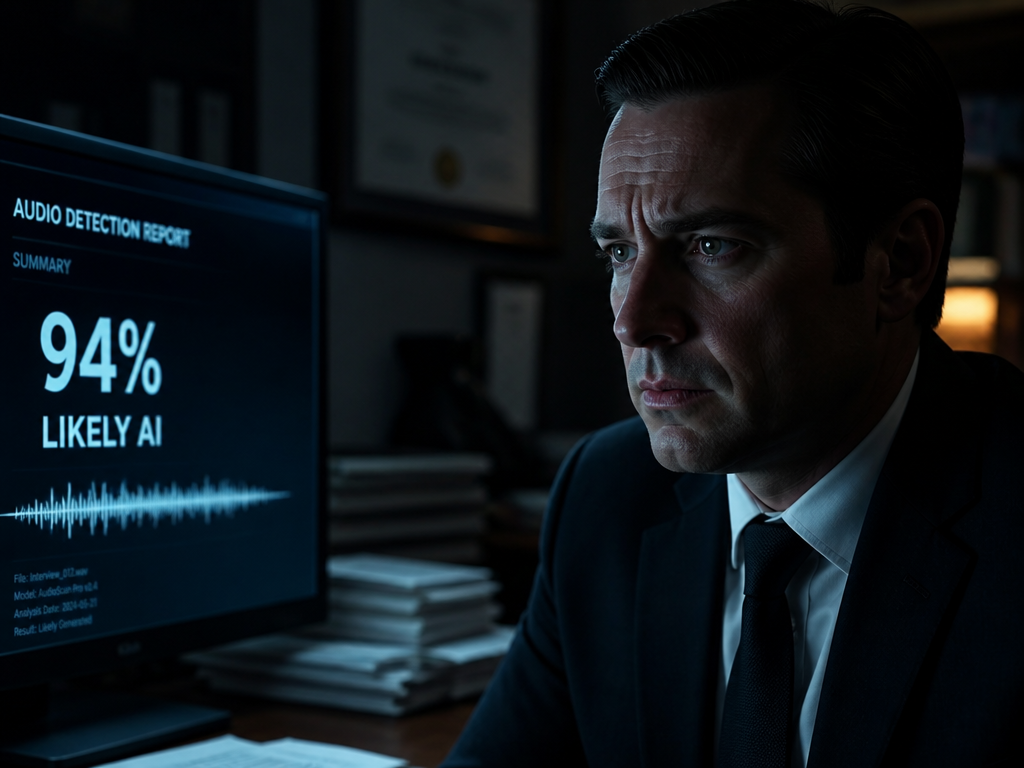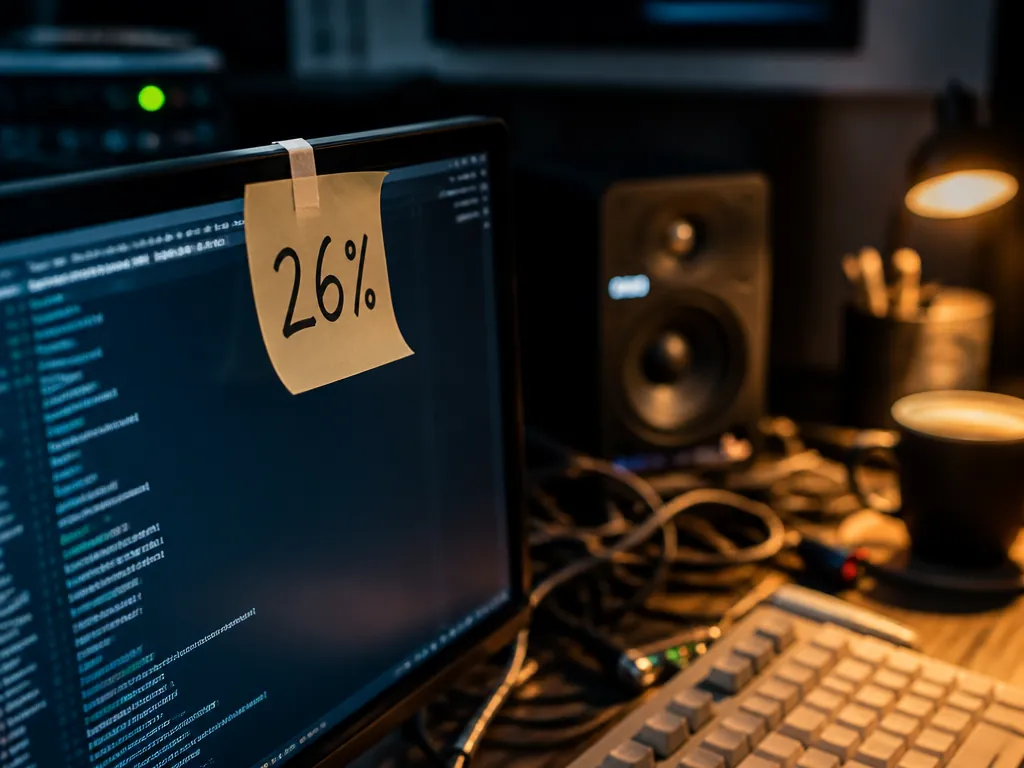
In July 2023, OpenAI quietly retired its own AI text detector. The classifier it had launched six months earlier correctly flagged about 26% of AI-written text as "likely AI-written," and it mislabeled genuinely human writing as machine-made roughly 9% of the time. The company that trained the model also built the tool to catch it, looked at the hit rate, and shut it down. If you are a developer building AI agents and autonomy into a real pipeline — an agent that screens uploads, tags a library, or gates a release — 26% is the number to tape above your monitor.
I write about AI music for a living, and I ship a lot of AI-assisted sound: adaptive game loops, transition beds, the ninety-second cue a video editor needs by Friday. The question I get most from developers isn't "is this any good." It's "can I detect it" — can they stand up something autonomous that sorts human from machine at the door and acts on the answer. The honest reply starts with that 26%.
What the 26% actually measured
A detection score is a measurement, and every measurement has an apparatus. OpenAI's number came from running its classifier against a specific test set: particular text, particular lengths, particular models generating the "AI" side. Inside that frame, 26% is real. It tells you how one classifier performed against one slice of the world on one afternoon, under conditions its makers chose.
That's the trap baked into every accuracy figure a detector advertises, whether it's an embarrassing 26% or the 98% you'll see on a music-detection landing page. The number is almost always an in-distribution score — the tool tested against the exact kind of content it was trained to catch. It's a closed-book exam where the detector wrote the questions and graded itself. Useful as a floor. Close to meaningless as a promise about the messy audio that will actually hit your endpoint.
What the number doesn't measure
Here is what 26% — or 98% — can't tell you.
It can't measure the model that shipped last week. Detectors are trained on the outputs of generators that existed when the training set was frozen. Point one at a tool released a month later and you are testing on a species it has never seen. Accuracy on unfamiliar generators routinely slides toward a coin flip, and nobody prints that second number on the box.
It can't measure hybrids, which is most real work. The track a producer actually ships was maybe generated, then pitched down, re-EQ'd, layered under a live bass take, and run through a mastering chain. Every one of those steps smears the statistical fingerprint the detector is hunting for. By the time a 48kHz WAV lands in your bucket, the "AI-ness" the classifier keys on may be buried under three rounds of human decisions.
It can't measure the adversary who reads the same documentation you do. Anyone motivated to beat a detector can paraphrase, re-render, add noise, transcode down and back up. Detection is one side of an arms race, and it's the side that has to be right every single time while the other side only has to win once.
Why audio is a harder problem than text
If text detection washed out at 26%, audio starts from further back. The research is younger, the labeled data is thinner, and the transformations that break detectors — resampling, compression, limiting, stem separation — are the normal steps of music production, not exotic attacks you have to go looking for.
Last month I ran a track I had built entirely by hand — a detuned analog bassline at 92 BPM in F minor, no model anywhere in the chain — through three tools that market themselves as AI-music detectors. Two called it human. One called it 87% AI. Same file, same afternoon, three verdicts. That spread isn't a bug in one product; it's the honest state of the field.
A classifier trained on one vocal-synthesis engine's artifacts learns that engine's tells: a certain smearing in the sibilance, a particular way the stereo image behaves in the high end. Feed it a track from a different tool, or the same tool two versions later, and the tells move. This is why I don't trust any AI-music detector that won't tell me which generators, and which versions, it was tested against. Without that context, the accuracy number is a decoration.
None of this means the tools are frauds. A detector can be a genuinely useful smoke alarm — a cheap first-pass signal that says "look closer here." The failure mode is treating a smoke alarm as a verdict, and that is exactly the failure mode autonomy invites.
The autonomy trap
Here is where it bites developers specifically. The whole appeal of AI agents and autonomy is that the agent acts without you standing over it. It reads a signal and takes an action — approves, rejects, tags, files a claim. That's the point of the design. It's also the hazard, because an autonomous agent will treat a 60%-confidence guess with exactly the same conviction it gives a hard fact, and then do something irreversible with it.
Wire a detector's boolean straight into an agent that auto-rejects submissions and you have built a confident machine on a coin-flip input. At a 9% false-positive rate, roughly one in eleven human creators gets wrongly flagged by your pipeline — and the agent that flagged them cannot feel the wrongness, cannot hesitate, cannot be embarrassed later. Agent autonomy doesn't dissolve the 26% problem. It just removes the human who used to catch it before it went out the door.
Provenance is a receipt you keep; detection is a guess you buy
The way out isn't a better detector. It's to stop asking "can I detect how this was made" and start asking "can I keep a record of how this was made."
That distinction lands hardest for exactly the reader who wants agents that understand a whole workflow without shipping every asset to a surveillance-flavored cloud. Detection is inherently third-party and after the fact — usually someone else's API, staring at a finished file, inferring backward. Provenance is a record you generate at the moment of creation and hold yourself: the session file, the render log, the generation parameters, the content credentials embedded at export.
| Detection | Provenance | |
|---|---|---|
| When it runs | After the fact, on the finished file | At creation, as you work |
| Who holds it | A third party's model | You |
| What it produces | A probability | A signed record |
| Fails when | The generator is new or the file was edited | You never captured it |
| Cloud dependency | Usually required | Local by default |
Standards like C2PA content credentials point this way: cryptographically signed metadata that travels with the file and states what tool touched it and when. It isn't magic — credentials can be stripped, and the absence of one proves nothing about how a track was made. But it flips the architecture. Instead of an agent guessing at the truth from the outside, the truth rides along inside the asset, in a record you control on hardware you own.
That's the local-first move, and it's the one we keep landing on at City of Punk when we test these tools: the workflow you can trust is the one whose receipts you hold, not the one whose verdict you rent by the month.
What to build instead
If you're putting autonomous agents anywhere near AI-detection signals, a few durable rules:
- Treat detection as a flag, never a verdict. Let an agent escalate on a low-confidence signal; don't let it execute an irreversible action — a ban, a takedown, a claim — on one.
- Log the generator and version you tested against. An accuracy number without that context is marketing, not measurement.
- Prefer provenance you capture over detection you outsource. A render log you wrote beats a cloud probability you bought.
- Keep a human on the false-positive path. That 9% is someone's real work. Somebody who can feel that should see it before the agent moves.
- Re-test on every new model release. Detector accuracy has a half-life now measured in weeks.
The reason OpenAI pulled its detector is the most honest thing anyone in this space has done: they had the number, the number said the tool wasn't good enough to trust, and they acted on it. Most vendors have that number too. Far fewer will show it to you.
Build your agents to act on what you can prove, not on what a model guesses. A detector tells you what something might be. Only provenance tells you what it is.
Not sure which tool to use?
Compare the top AI music and sound tools side by side — honest reviews, real pricing, no sponsorships.