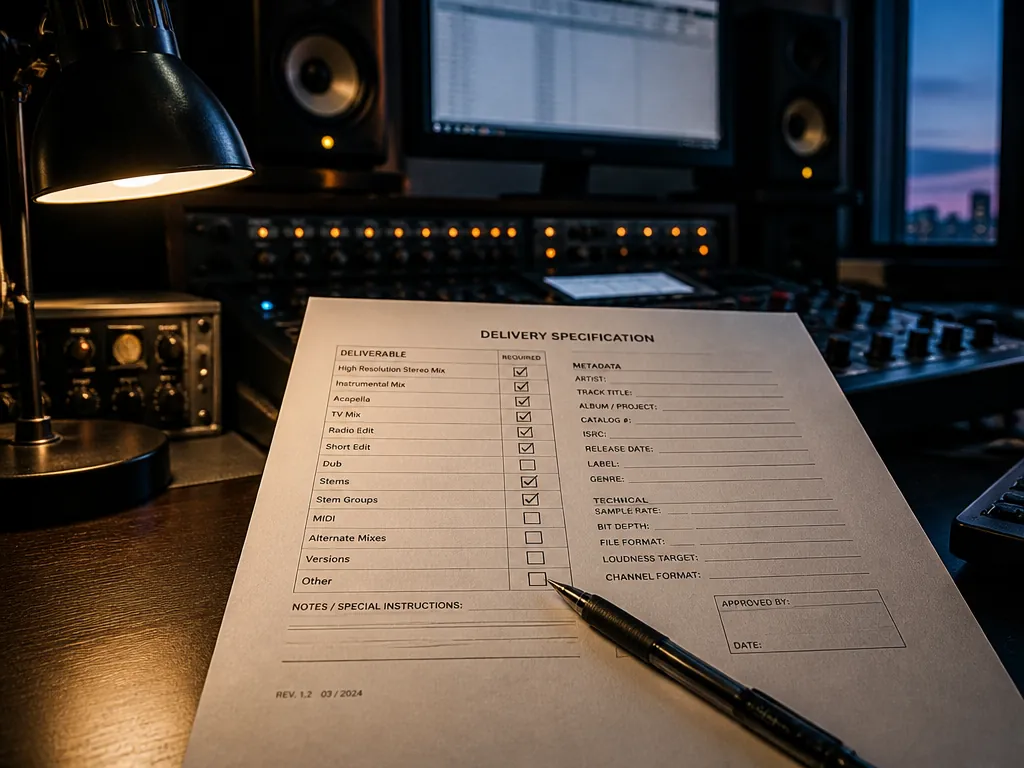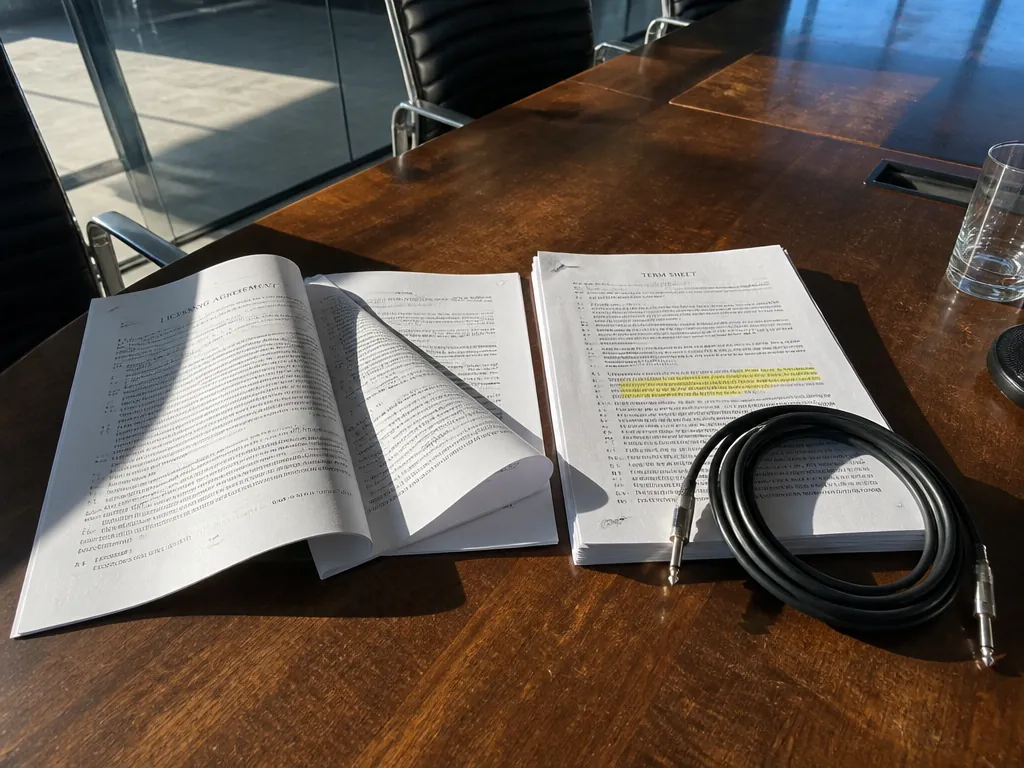
The question that stalls an AI-music delivery is almost never about the audio. It arrives as a one-line email from someone in your client's legal or finance chain: send us the license for the music. Not the render. Not the stems. The paperwork.
I have watched that email land on a game studio's Friday and turn a finished cue into a two-week problem. It is also why the Lyria 3.5 product update is being read the way it is — as a legal answer dressed up as a feature release. Google's positioning for Lyria has leaned on licensed training material and SynthID watermarking since well before this version, and the new release goes after the thing creators complain about most: vocals and lyrics.
That combination is genuinely useful. It is also the seed of a bad assumption that is spreading fast.
The myth: if the model was trained on licensed data, your track is cleared
You have heard this one in a Slack thread or read it in a procurement deck. It goes like this: Suno and Udio have spent the last stretch of the AI-music era in and around copyright court, Google licensed its training material, therefore music from a Google model is safe to ship and music from the others is a liability.
It is a tidy story, and it is wrong at the joint. Training-data provenance and output clearance are two different contracts, negotiated by different parties, protecting different people. Conflating them is how a team ends up with a beautiful 48 kHz WAV, a client who wants a document, and nothing to send.
What the update actually ships
Strip the announcement down and this is a quality release aimed at the format's weakest link. Vocals have been the honest gap in every AI music tool I have put through a session: pitch-correct and phrasing-dumb. The model hits the note and misses the breath. You notice it in the back half of a chorus, where a human singer would lean early, crack a consonant, or leave a bar alone — and the render instead delivers every syllable with the same confident, sanded-down attack.
Lyric generation has the parallel failure. Lines that scan correctly and mean nothing. That is worse than clumsy writing, because it survives the first listen and becomes unbearable by the twentieth, which is exactly how many times a picture editor will hear the cue before lock.
So an update targeting delivery and lyric coherence is not cosmetic. It is the difference between a take you can drop under a trailer and one you have to re-cut the edit around.
Competitive honesty, since it bears on the decision: as of writing, Suno holds the consumer mindshare and the top of the community leaderboards, and Udio carries a reputation for stronger vocal character in electronic, hip-hop and pop. Lyria's structural advantage was never that it sounded best. It was distribution — the model turning up inside creative surfaces teams already pay for, rather than as one more standalone subscription — paired with a training-data story built to survive discovery. This release is Google pushing on quality from a position of legal comfort rather than the reverse. Whether the gap has closed is a question for your ears, on your material, at your tempo. Not for a chart.
Can you use Lyria-generated music commercially?
Usually yes, and the terms that govern it attach to the product surface and account tier you generated in, not to the model name. The same underlying system can ship with meaningfully different output rights in a consumer app, a paid creative tool, and an enterprise cloud agreement. Commercial use, ownership language, attribution requirements, and any indemnity live in the terms for that specific surface, and they can change between the day you render and the day you ship. Read them on render day and keep a copy. "It was trained on licensed data" is not something you can forward to a client's counsel. The terms page for the product you actually used is.
The four layers between a render and a clearance
| Layer | What it governs | Who it protects first |
|---|---|---|
| Training-data licensing | How the model was built | The company that built it |
| Your output terms (surface + tier) | What you may do with the file | You, if you can produce them |
| Distributor and platform AI policy | Whether it can be uploaded, monetized, registered | Your release |
| Similarity to an existing work | Whether this specific render resembles something | Nobody, automatically |
The first layer is the one that gets the press, and it does matter — a model trained on cleared material is less likely to have its output supply interrupted by an injunction, and less likely to have its terms rewritten mid-project. That is a real procurement consideration, especially if you are scoring a live-service game and need the same sonic palette available in eighteen months.
But it is upstream of you. Your exposure sits in layers two through four, and those you have to handle yourself. A distributor can refuse AI-assisted uploads or require disclosure regardless of how the model was trained. A performing-rights organization can have its own registration rules. And no training-data license prevents a particular render from landing uncomfortably close to a song someone already wrote — prompt a model hard enough toward a reference and it will oblige. That last one is on your taste and your review process, and it always was.
What SynthID actually does for you
SynthID is provenance, not permission. It embeds a marker in the audio signal itself, designed to survive the beating a file takes on the way to release: encoding, format conversion, EQ, loudness processing, playback through a room and back into a microphone. That is a genuine engineering result, and it solves a genuine problem — establishing what a file is, after the file has been through everything.
What it does not do is grant rights. It answers "was this machine-generated, and by which system," not "may this person use it here." Its value to you is defensive and administrative: as platforms and regulators converge on AI disclosure requirements, a machine-readable answer is worth more than your word. Detection also runs in both directions. If the plan was to present a render as a session date, the watermark is the thing that disagrees. Undisclosed is not a workflow that ages well anyway.
The clearance file: what to save for every AI-generated track
Build this once, then make it a delivery habit. It takes about ninety seconds per cue and it is the difference between answering that email in a minute and answering it in a fortnight.
- The final render plus the date it was generated, at delivery resolution — 48 kHz WAV for video and game work, with stems if the tool offers them.
- The exact product surface and account tier used. "Lyria" is not specific enough; the surface is what the terms are attached to.
- A saved copy of those terms as of that date — a PDF export, not a bookmark. Terms pages get rewritten and old versions are hard to reconstruct.
- The prompt text and any session or generation ID, so the render can be traced back to a request rather than to a vibe.
- A provenance note: whether the file carries a watermark, and what a detection check returned if you ran one.
- Who generated it — the named human on your team or your contractor, with the account they used.
None of that is legal advice, and none of it makes a clearance question go away. It makes the question answerable, which is the part you control.
What actually changes for you this week
If you write to picture or to a build, better vocal delivery and more coherent lyrics shorten the ugliest part of the loop: the re-cut you do because a phrase sat wrong over a cut. That is real time back. Expect the rest of the workflow to be unchanged — prompt-roulette is still prompt-roulette, some renders still come back mushy in the low mids, and the take that finally works is still the eleventh one. Budget for the misses.
And if you are choosing a platform on legal grounds, choose on the terms you can print, not on the training story you can quote. The training story tells you how stable your supplier is. The terms tell you what you own.
Licensed training data protects the company that trained the model. Only your paperwork protects you.
Not sure which tool to use?
Compare the top AI music and sound tools side by side — honest reviews, real pricing, no sponsorships.