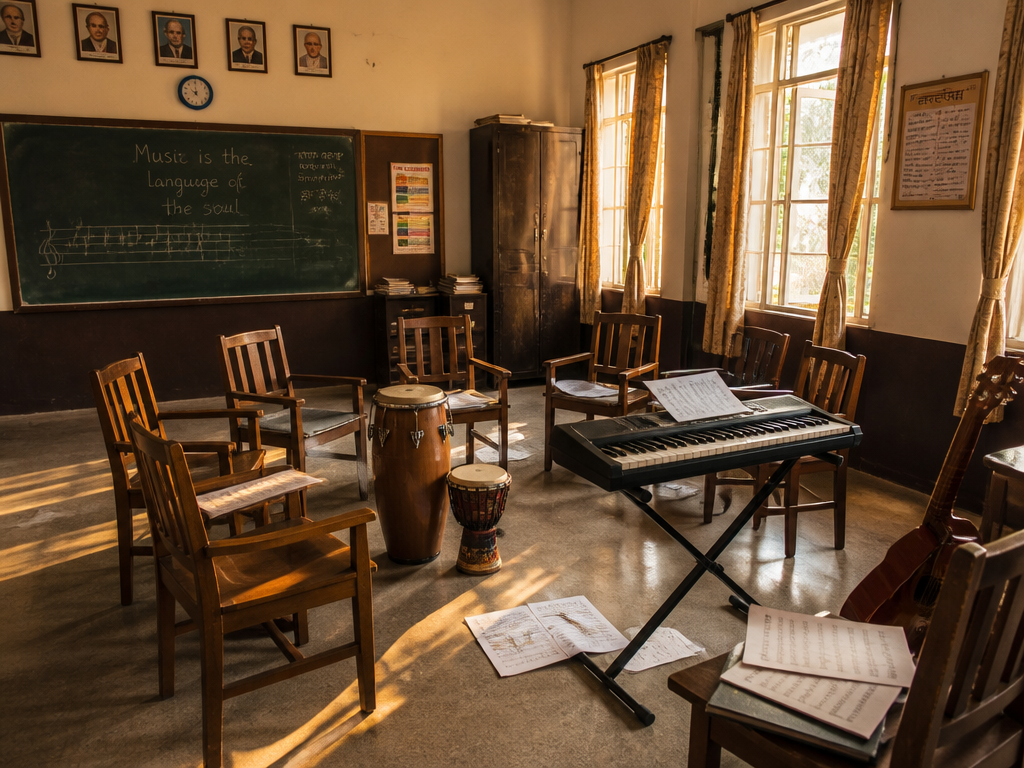
Picture a music teacher — she runs the vocal program at a school in Pune, forty kids across three grade levels — standing at the back of a hotel ballroom in Bengaluru. She took a day off and paid for the ticket herself because the program said "music conference." On stage, a panel is discussing streaming royalties and the economics of independent releases. Useful, maybe, for the artists in the front rows. But she teaches. She wanted to know how the person two states over handles a mixed-ability class, or what to do when a ten-year-old can hear pitch but freezes when asked to sing alone. Nobody on the schedule is talking about that. She leaves at lunch.
That scene repeats more often than the sector admits, and it points at something worth examining: music education conferences in India have historically been built around performance and the music business, not around the working teacher. The events exist. The educator, specifically, tends to be an afterthought in the room — welcome to attend, rarely the person the day was designed for. This piece is about how that came to be, why the field believes it's already been solved, and where a corrective is starting to appear.
How the conference room filled up — and who filled it
Go back a couple of decades and India barely had a public-facing music-conference circuit in the contemporary sense. There were the deep, venerable traditions — classical sammelans, sabha seasons in Chennai, the guru-shishya lineage passing knowledge in ways that never needed a lanyard. Those weren't conferences in the professional-development meaning of the word. They were performance and patronage, and they were extraordinary at what they did.
What grew over the last fifteen-odd years was different: a Western-influenced, industry-shaped layer of summits, festivals-with-panels, and "music week" style gatherings. They rode the same wave that lifted independent music, home studios, and the streaming economy. The center of gravity was clear from the start. These rooms were assembled for artists, producers, and the business around them — how to release, how to get heard, how to make a living from sound.
And that made sense, because that's where the visible energy and the sponsorship money were. A panel on playlist strategy fills seats. A workshop on differentiated instruction for a Grade 6 keyboard class does not sell a headline slot.
So the educator wandered in through a side door. Teachers attended these events — they're curious, they're underserved, and a music gathering is a music gathering. Organizers noticed teachers in the crowd and started adding, here and there, a session that gestured at pedagogy. A talk on "music in schools." A demonstration by an academy. It read, from the stage, like inclusion.
That gesture is where the belief starts.
The belief, and the thin place underneath it
Here's the belief that settled into the sector: educators are already being served by the conferences we have. You'll hear versions of it whenever the subject comes up. There are more music events in India than ever. Several of them touch on schools, curriculum, or teaching at some point in the program. Therefore — the reasoning goes — a teacher looking for professional development has places to go.
Follow that back to its source and it gets thin fast.
The source is proximity, not design. The teacher was in the room, and a few sessions mentioned teaching, so the conclusion was drawn that the room served teachers. But a session about education is not a space built for educators. One is content a general audience consumes — often framed for parents, administrators, or the industry-curious. The other is a room where the assumed reader is the practitioner, where the questions start at a level a working teacher has already outgrown the basics of, and where the person next to you also spends their week in front of a class.
The confusion is understandable because both involve the word "education." But they solve different problems. A "music in schools" panel at an industry summit is usually advocacy — a case made to outsiders that music matters in a curriculum. A room built for educators skips the advocacy entirely. It assumes you're already convinced and moves to the hard part: how do you actually do the job better.

When you look for the second kind of room in India's conference history, you find remarkably little. The belief that educators are served rests on a handful of guest sessions and the fact that nobody stopped teachers at the door. That's a thin foundation for a confident conclusion. The field decided the need was met because the need was never named clearly enough to notice it wasn't.
What "for educators" actually changes
The difference isn't cosmetic, and it isn't about being more serious or more academic. It's about who the day assumes you are.
At a student showcase, the teacher is backstage — support crew for someone else's growth. At an industry summit, the teacher is an eavesdropper on a conversation about a career they may not be pursuing. In a room designed for educators, the teacher is the protagonist. The distinction sounds small until you're the one who's spent your career preparing other people to be on stage and has never once been the reason a room was booked.
That reframing changes the content in concrete ways. An educator-first program looks less like a lineup of performances and more like:
- Classroom-level pedagogy — how to teach a specific skill to a specific age group, not why music education matters in the abstract.
- Peer exchange between practitioners — the person beside you also runs a program and has already hit the wall you're standing at.
- Practical tools you can use on Monday — assessment approaches, curriculum structures, ways to handle mixed ability, not inspiration you'll forget by Tuesday.
- Professional networks that persist — contacts who understand the job, not business cards from people selling you distribution.
None of that is exotic. It's the standard shape of professional development in nearly every other teaching field. Music education in India simply hadn't had a dedicated version of it in the conference format, and the sector had talked itself into believing it didn't need one.
The corrective, arriving quietly
The clearest current example of the second kind of room is Soundboard, a symposium organized by the Indian music educators' community Out of the Box, founded by Nush Lewis. It's framed explicitly around the working teacher — a day built for educators rather than for students to perform in or for the industry to network at.
Lewis has put the founding idea plainly: the sector has always been good at making spaces where students perform and develop, and comparatively thoughtless about making spaces where the people teaching them get to learn and grow themselves. That's the gap in a sentence. It's not a criticism of the performance-and-industry events — those do their job. It's a recognition that their job was never the teacher's professional development, and that treating them as if it were is how the whole field ended up under-serving its own workforce for years.
What lends the effort credibility is that it isn't only an event. Out of the Box has done sector research — a Music Education Survey mapping the actual conditions Indian music educators work in — which means the programming can point at documented needs rather than guesses about what a teacher wants. An event built off survey data behaves differently from one built off whatever fills seats. It's more likely to schedule the unglamorous, genuinely useful session over the crowd-pleaser.
The speaker roster leans on people who run teaching institutions rather than only on performers — figures associated with organizations like SaPa and Kiara Academy, places whose entire premise is educating. That matters for the same reason the survey matters. When the people on stage are practitioners of teaching, the questions from the floor can start at a practitioner's level. You skip "why does this matter" and get to "here's what breaks in my classroom, what do you do."
The format, as with most of these, is compact — a day-long gathering rather than a week. That's a strength and a limit at once, which is worth being honest about.
Is a one-day symposium enough? A straight answer

A single-day symposium won't retrain you or replace sustained professional development — but it does the one thing a working teacher in India has struggled most to find: it puts you in a room where every other person also teaches music, and where the whole program assumes that's who you are. That's the actual value proposition, and it's a real one. The isolation of the music teacher — often the only music specialist in a school, sometimes the only one they know for miles — is the problem these gatherings address most directly. A day is short. But a day among peers who understand the specific texture of your job is not a small thing when the alternative has been zero days.
Keep your expectations calibrated. A symposium is a starting point and a network-builder, not a certification and not a substitute for ongoing mentorship or formal training. The tools you pick up need you to actually apply them. The contacts you make need you to follow up — the "stronger professional networks" line that every event promises is only as real as the WhatsApp group that survives the following month. Judge these events by what happens six weeks later, not by how good the closing session felt.
How to tell if a music event is actually built for you
Before you spend a day off and a ticket price, run the program through a quick test. This is the checklist I'd hand the teacher from Pune.
| Signal | Built for educators | Built for students / industry |
|---|---|---|
| Who's on stage | Teachers, program heads, pedagogy specialists | Performers, label people, marketers |
| Session titles | "How to teach X to age Y," "assessing without discouraging" | "The future of releases," "artist showcase" |
| The unspoken audience | Practitioners who already teach | Parents, administrators, aspiring artists |
| What you leave with | Methods to use in class, peers who get the job | Inspiration, industry contacts, a good show |
| Advocacy vs. craft | Assumes music matters, works on how | Argues that music matters at all |
If a program spends its energy convincing you that music education is important, it's talking to outsiders. If it assumes you're already convinced and gets to work on the mechanics of teaching, it's talking to you. That single distinction sorts most events faster than the marketing copy will.
One more filter: ask whether the organizers have done any research into the field, or whether the event is purely programmed to draw a crowd. A gathering built on something like a sector survey tends to schedule for genuine need. A gathering built on ticket sales tends to schedule for spectacle. Both can be worth attending — but only one is likely to have the unglamorous session you actually needed.
Why the gap stayed invisible so long
It's worth sitting with why this took so long to correct, because the answer isn't neglect exactly. It's that the teacher is structurally the quietest person in the music ecosystem. Students have parents advocating for them and showcases built around them. Artists have an industry courting them. Institutions have marketing departments. The individual music educator — often working alone, often stretched, rarely part of a professional body with a loud voice — had nobody assembling a room in their name. The absence didn't register as a problem because the person it affected wasn't in a position to make noise about it.
That's how a belief outlives its evidence. Nobody ever decided that educators didn't deserve their own conference. The field just never noticed they didn't have one, because the people best placed to notice were too busy teaching to lobby for it — and because a few well-meaning "education" sessions on other people's programs made the shelf look less empty than it was.
The corrective, when it comes, doesn't need to be loud. It needs to be specific: a room where the assumed reader is the teacher, programming that starts where practitioners actually are, and enough follow-through that the network outlives the lanyard. That's a modest bar. The surprising part is how long it went unmet.
So if you're the one who's been leaving these events at lunch, the search is starting to have an answer. Not a finished one — a day-long symposium is a beginning, not a system. But a beginning aimed, for once, at you.
The myth was that India's music education conferences already served the people who teach. The more accurate version is that they served nearly everyone in the room except the teacher — and only now is anyone building the room the other way around.
Not sure which tool to use?
Compare the top AI music and sound tools side by side — honest reviews, real pricing, no sponsorships.