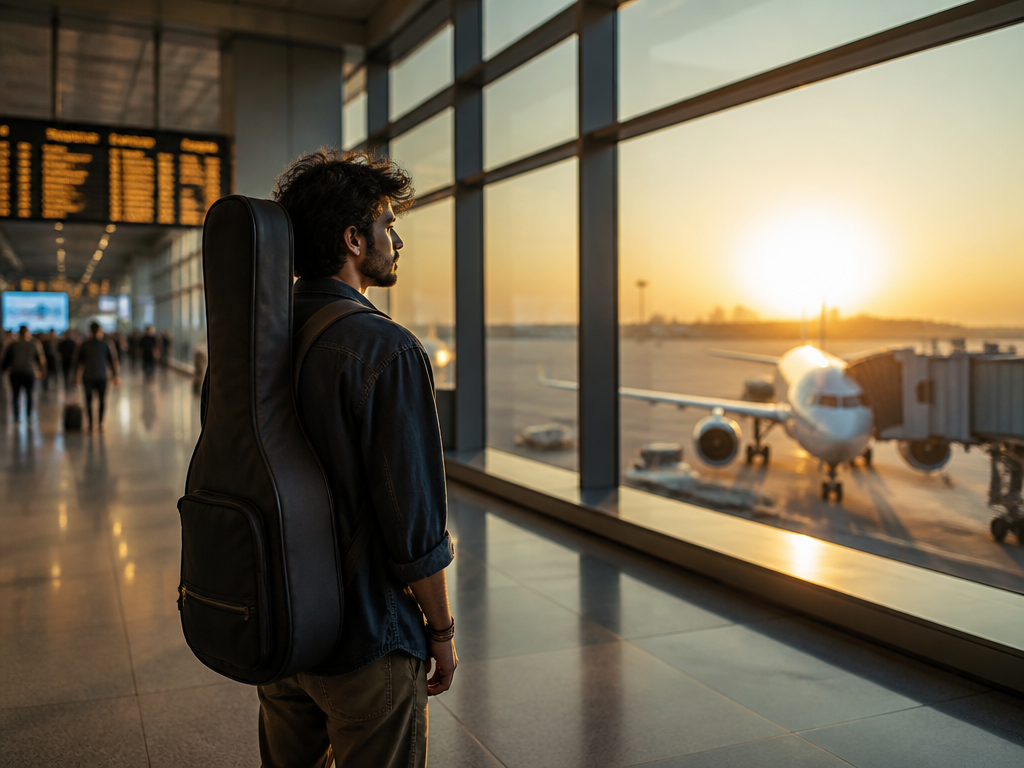
The number that kills most international bookings for an independent Indian artist is not the performance fee. It is the flight. A slot at a mid-size festival in Bangkok, Lisbon, or Jakarta might pay you a modest fee or none at all, and still cost you a return airfare, three nights in a city you don't know, freight or excess baggage for a pedalboard, and a week off whatever pays your rent. That math is why a lot of good acts from Mumbai and Bengaluru have watched music festivals abroad from an Instagram feed.
Here is the thing worth knowing before you write that off: a growing number of those festival slots come with the travel attached. Not the fee — the airfare and the bed. That changes the arithmetic entirely, and most independent musicians in India have never been told the programs exist.
The myth: "Play abroad only after you can afford to"
The advice sounds sensible, which is why smart people repeat it. Build a following at home. Sell out the local rooms. Bank the money. Then, once you can absorb a couple of lakhs in travel with a straight face, take the international show.
The problem is that the logic runs backwards. Festival bookers, distributors, and the export offices that fund cultural exchange are not looking for the artist who already made it. They are looking for the act with a credible catalogue and a story that travels — someone whose selection they can justify and whose costs they can subsidize. The subsidy is the on-ramp, not the reward for having already arrived. Wait until you can self-fund and you have skipped the exact moment these programs are designed for.
The other half of the myth is that "exposure" abroad is worthless — a euphemism for playing free to strangers. Sometimes it is. But a well-chosen festival slot puts you in front of programmers from other territories, sync agents scouting for placements, and press that your home coverage doesn't reach. Whether that is worth a week of your life depends on which festival, not on the abstract idea of "going international."
The evidence: subsidized slots are real, and Indian acts are already taking them
Distribution platforms have run curated festival programs for years, and several have started explicitly opening them to Indian artists after leaving the region off the list for a long stretch. The structure is consistent enough to describe plainly: a platform partners with a regional festival, runs a submission window, selects one or a handful of acts, and covers a defined chunk of travel and accommodation.
The grants are usually modest and named as such — a fixed sum meant to offset airfare and a few nights, not a tour budget. That honesty is a feature. A program that promises to make you rich is selling something; a program that says "here is a set amount toward your flight and hotel, the rest is on you" is telling you how it actually works.
Precedent matters here more than promises. Indian and South Asian acts have played regional festivals in Southeast Asia and Europe on exactly these terms in recent years — genuinely independent artists, not major-label rosters, selected through open submission. When you are deciding whether a program is real, the useful question is not "how much do they pay" but "who went last year, and can I find them online." If past selections are named and traceable, the program has a track record. If nobody's listed, treat it as unproven.
The mechanism: what these programs actually cover, and the catch
Read the terms the way you'd read a sync contract — slowly, and for what's missing.
What's typically covered: a capped travel grant (airfare plus a set number of hotel nights), a confirmed performance slot, festival credentials, and sometimes local ground transport. Occasionally a small performance fee. The cap is the number that matters; everything above it comes out of your pocket.
What's usually not covered: visa fees and the appointment scramble, travel insurance, excess baggage or instrument freight, per diems for food, any second musician you bring, and the income you lose by being away. For a solo act traveling light, the grant can cover most of the real cost. For a four-piece with a drummer's hardware, the uncovered gap can quietly equal the grant itself.
The eligibility catch: many distributor-run programs require an active distribution plan with that specific platform. That is the business model — the festival slot is a benefit of being a paying releasing artist, not an open public contest. It's a fair trade if you were going to distribute anyway, and an expensive one if you sign up to a plan you don't otherwise need chasing a slot you might not win. Do the boring version of the math before you subscribe for the prize.
The other common requirement is a real, released catalogue — music that's live on streaming platforms, with metadata that resolves and a profile that looks like a working artist rather than a demo folder. Submissions with three unreleased tracks and no footage lose to submissions with a proper catalogue and one clean live video every time.
Before you submit: what to have ready
Programmers decide fast and on thin evidence. Give them the strong version.
- A released catalogue on streaming, with correct metadata, credits, and cover art. If your distributor lets you set a release date, have new material timed to land before the submission window closes.
- One good live video. Not four rough ones. A single 2–3 minute clip, shot in decent light with usable audio, that proves you can hold a stage. Phone footage is fine if the sound is clean.
- A one-paragraph bio that leads with what travels. Where you're from, what you sound like in a sentence a foreign programmer will get, and any prior stage or press. Skip the adjectives.
- 48kHz WAV masters and stems ready to send. Festivals and any sync interest that follows will ask; having them on hand signals you're a professional, not a hobbyist.
- A realistic cost sheet for yourself. List the grant cap against your actual costs — visa, insurance, freight, food, lost income. If the gap is survivable, apply. If it isn't, apply for the solo version of your set or wait for a closer festival.
Keep the assets in one folder so a submission takes an afternoon, not a weekend. Most artists miss deadlines because gathering the materials feels like a project. It shouldn't be.
The honest takeaway
A subsidized slot does not make an international festival free, and anyone who tells you it does is rounding up. Visas, food, freight, and the week you don't earn are still yours. What the grant removes is the single largest barrier — the airfare that turned a "yes" into a "can't afford it" — and it removes it for exactly the independent, mid-catalogue artists who'd otherwise never get on the plane.
So the number that kills most international bookings for an Indian artist is the flight. But it turns out the flight is the one cost these programs were built to cover. What's left after that is a week, a visa queue, and a decision — which is a very different problem from the one you thought you had.
Not sure which tool to use?
Compare the top AI music and sound tools side by side — honest reviews, real pricing, no sponsorships.