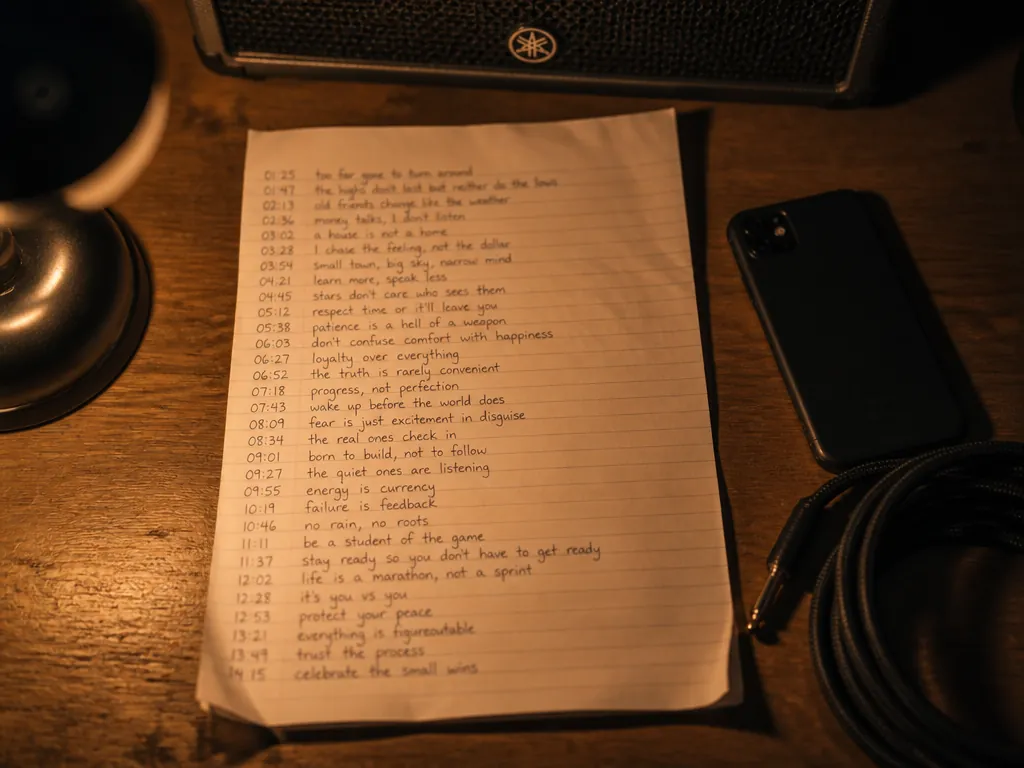
Thirty-one.
That is how many discrete decisions I wrote down while rebuilding a 74-second loop for a game build last month — a music production behind-the-scenes log kept in a plain text file, one line per move, timestamped, no editorializing. A hundred minutes of work. Thirty-one lines.
Here is the same session as I would tell it in an interview: the AI bed came back too polite, so I detuned the bass, cut a hole in the pad every fourth bar, and swapped the hats for something I recorded off a snare rim. Then it sat right.
Thirty-one moves. Three sentences. That gap — twenty-eight decisions wide — is the most interesting thing about every studio story you have ever read, and nobody reports it, because the number is boring and the three sentences are not.
What the thirty-one actually counted
The method was deliberately dumb, because a clever method would have let me cheat.
A "decision" counted if it changed what came out of the monitors and I kept it through at least one full playback. Transport moves, saves, renames, window-shuffling, and scrolling did not count. Anything I undid inside ten seconds did not count. I wrote the line before I took the next action, which is the part that hurts — logging is a metronome you cannot rush.
The session: a 74-second loop at 92 BPM in F minor for a rain-soaked market level. Source material was a four-stem render at 48 kHz WAV — drums, bass, pad, texture — plus two tracks I played in myself. A hundred minutes on the clock, phone face-down.
The thirty-one broke down like this:
- 12 gain, pan, or EQ moves
- 6 arrangement edits (mutes, nudges, one truncation)
- 5 pitch and tuning moves
- 4 plugin instantiations
- 3 outright replacements of a sound
- 1 tempo change I later kept by half
That is the whole census. It is an honest count of a defined thing, and it measures exactly one quantity: how many times I acted on the audio and did not immediately take it back.
Why do producer interviews only mention three or four decisions?
Because the interview format rewards decisions that are tellable — the ones with a clean before and after that a listener can hear on demand, in a room, without the multitrack. "I detuned the bass fourteen cents" survives retelling. "I brought the pad down 1.5 dB and put it back up 0.8 dB forty minutes later" does not survive anything. It is not that producers are hiding the other twenty-eight moves. It is that those moves have no narrative handle. They are audible only as an absence — you would notice if they hadn't happened, and you cannot notice them happening.
So the story compresses to the three decisions that carry a shape. Which is fine. It becomes a problem the moment you read the compressed version as a recipe.
What the number does not measure
Four things, and each of them is bigger than the count.
Reversals. My rule threw out anything I undid quickly, which means the log has no record of the six or seven times I tried a thing, heard it, and backed out. Those attempts are where the session actually happened. A count of kept moves is a count of survivors, and survivors are a lousy sample.
The decisions not to act. Around minute sixty I sat with my hand on the mouse over a reverb send for what felt like a long time and did nothing. That is not in the log. It is not in any log. Every record you admire contains dozens of restraints that leave no trace, and restraint is most of what separates two engineers with identical plugin folders.
Everything that made twenty-eight of those moves automatic. High-passing the pad at 180 Hz was one line in a text file and roughly ten years of hearing pads fight bass. The log flattens a reflex and a discovery into the same row. When you read a behind-the-scenes account and think I would never have thought of that, you are usually looking at somebody's reflex, not their insight.
Rank. Thirty-one is a count, not a weight. Three of those moves changed the character of the cue; the other twenty-eight kept it from falling over. A number cannot tell you which is which, and neither can a transcript.
The three that survived
The bass render came back clean in a way that made it sound like furniture. I printed a copy detuned fourteen cents flat, ran the original and the copy together with about 11 ms of delay on the detuned one, and the note stopped being a pitch and started being a thing with edges. Fourteen cents is nothing. It is under the threshold where anyone says "that's out of tune" and over the threshold where the ear stops trusting the sound is one object.
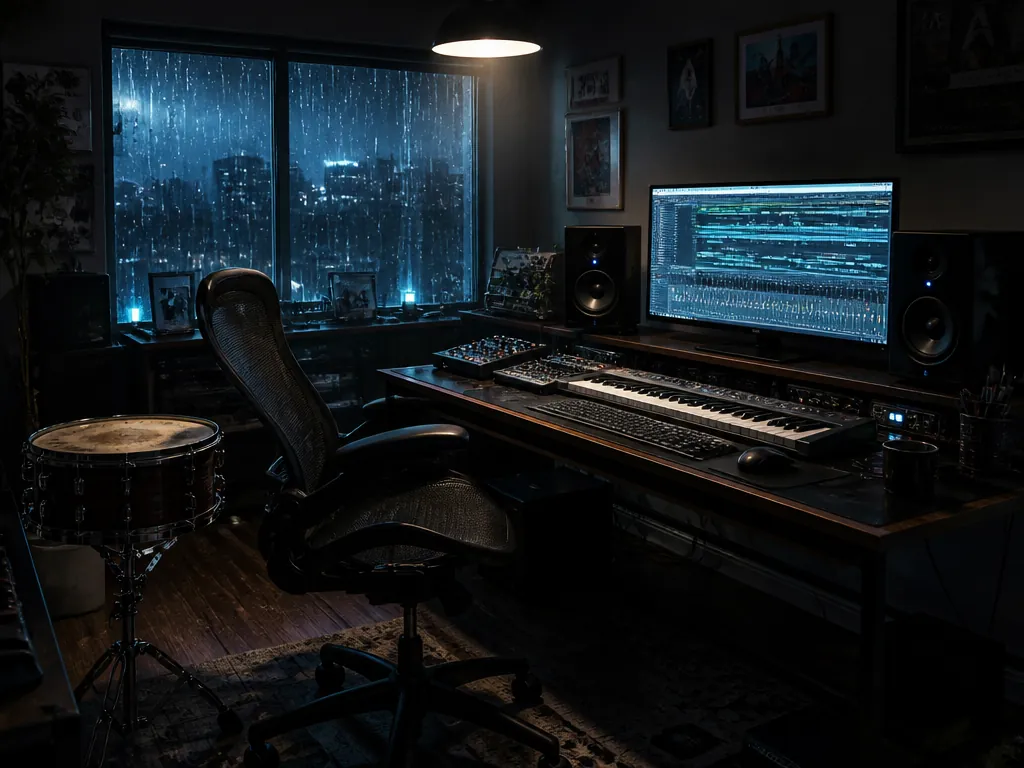
The pad was continuous, which is what these renders tend to give you — a beautiful unbroken sheet with no room in it. I muted it across beats one and two of every fourth bar. Two beats of silence in eight seconds. On its own it sounds like a mistake. Under drums and rain foley it reads as breathing, and the loop stopped announcing its own seam at the wrap point.
The hats went because the render smeared them. The transients arrived soft-shouldered and slightly late, the way a lot of generated percussion still does at the top end — the model gets the pattern and loses the attack. I recorded twenty seconds of a brush on a snare rim, chopped four hits, and programmed the same pattern. Same rhythm, and suddenly a grid.
None of those three is a technique you should adopt. They are what that cue needed at 92 BPM under rain. The point of writing them down was never to bank them.
Run the log on one session this week
This takes no software and adds maybe six minutes to a working session. Do it once.
- Open a text file next to your DAW and put the session name and start time at the top. You should see an empty file and feel mildly ridiculous. That feeling passes around line four.
- Write your rule down before you start. Mine: changed the audio, survived one full playback. Yours can differ — it needs to be a rule you can apply without thinking, because thinking about the rule is time not spent on the track.
- Log the move before you make the next one. One line: timestamp, what changed, whether you kept it. Not why. "Why" is a story and you will write it later, badly.
- Work a real session for 90 minutes. Not a special one. The log distorts less if the work is ordinary. You should end with somewhere between fifteen and sixty lines; if you have four, your rule is too strict, and if you have two hundred, you are logging mouse movement.
- Close the file and do not read it that day. You should see nothing, because you closed it. Same-day reading turns the log into a performance review.
- The next morning, mark the lines that changed the character of the piece. Circle them, star them, whatever. For most sessions this will be two to five lines out of thirty.
- Write the three-sentence interview version from the starred lines only. You should be able to do it in under two minutes. If you cannot, the session didn't have three decisions in it, which is worth knowing too.
A usable log line looks like this:
| Time | What changed | Kept |
|---|---|---|
| 0:14 | pad HPF → 180 Hz | y |
| 0:22 | bass copy detuned −14 c, +11 ms | y |
| 0:41 | tape sat. on drum bus, drive 3 | y |
| 1:03 | pad mute, beats 1–2 of every 4th bar | y |
One practical dependency: this only works if you can take your material apart. Bounced-to-stereo output gives you nothing to log. It is a large part of why we pay attention at City of Punk to which tools hand back real stems at 48 kHz rather than a finished-sounding mixdown — a file you cannot open is a file you cannot make decisions inside of.
Reading studio stories with a log in your pocket
Once you have your own thirty-one, producer interviews change register. You stop mining them for moves to copy and start reading them for constraints — the deadline, the room, the singer who could only do two takes, the label that wanted a chorus by 0:45. The named decisions were downstream of those constraints, and constraints are the transferable part. A detuned bass is a fact about somebody else's Tuesday. "The render sounded like furniture and I needed it to sound like a thing with edges" is a problem you will have again.
The compression is not dishonest. Three sentences is what fits in a person's memory, and the craft was real whether or not it survived the retelling.
This week: log one session, star the two lines that mattered, and notice how much of the work was holding the shape steady rather than finding the shape — a record's story isn't its history, it's the shortest path through that history that another person can hear.
Not sure which tool to use?
Compare the top AI music and sound tools side by side — honest reviews, real pricing, no sponsorships.