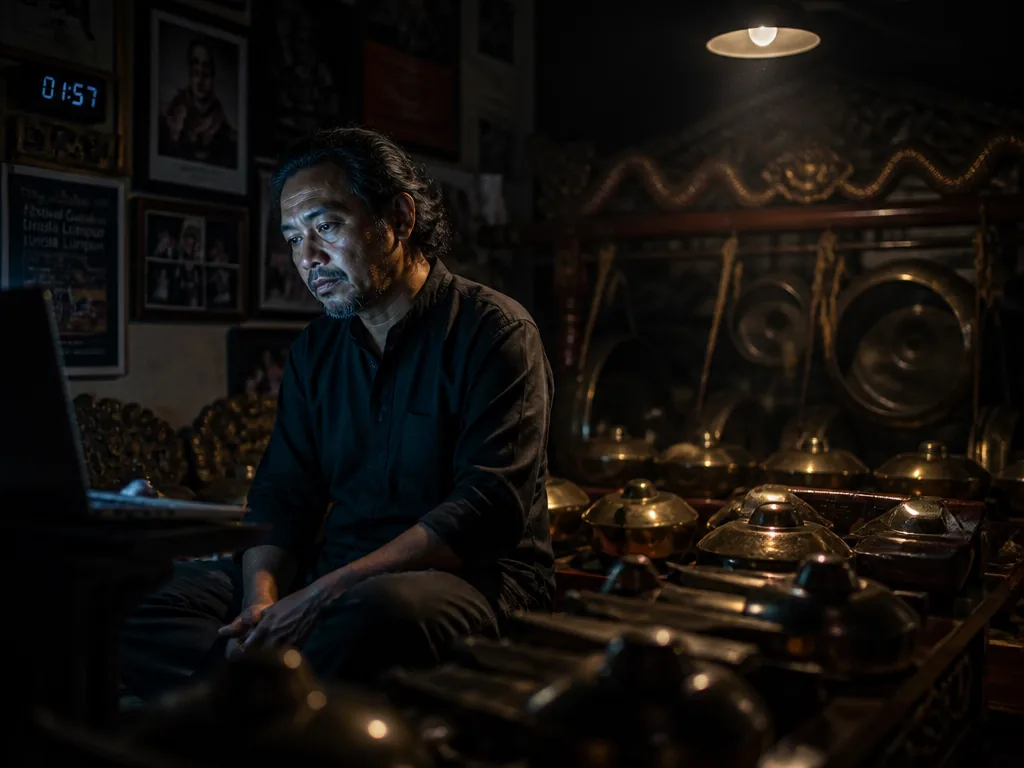
A gamelan teacher in Kuala Lumpur said the sentence to me like it was a seatbelt: "AI is just a tool. Use it, keep your soul." He'd read it in a dozen op-eds. He repeated it the way you repeat something you want to be true. Then he asked me the real question — the one the op-eds skip — at close to two in the morning, staring at a scoring deadline: "Okay. But which part of what I do is the tool part, and which part is the soul part? Because nobody tells me where the line is."
That line is the whole argument. The common advice about AI music generation — treat it as an instrument, not a replacement — is roughly right and quietly incomplete. It holds beautifully for some of your work and snaps clean in half for the rest, and if you're a composer or educator in Singapore or Malaysia trying to protect an idiom that took centuries to tune, the snap is where you live.
Disclosure before we go further: City of Punk builds a generation tool of its own. So read this knowing I have a dog in the fight, and then watch me tell you exactly where these tools fail. That's the only way a review like this is worth your time.
Where the "just a tool" advice is right
For scaffolding, the advice is not only right, it's underused.
If you're scoring a student film due Friday and you need a temp bed — something at 90 BPM, warm Rhodes, a soft neo-soul pocket to cut picture against — a generation tool gets you there in an afternoon instead of a weekend. Nobody in the audience will ever hear it; it exists so the editor can find the rhythm of the cut. That's a legitimate job, and hand-composing it is a poor use of a scarce week.
The same goes for arrangement drafts. Hum a melody into your phone, feed it in, and get back three harmonizations to argue with. Two will be wrong. One will contain a chord you wouldn't have reached for, and that chord earns its keep. For a time-poor educator building exercises, that's real leverage: generate a 16-bar loop, export 48kHz WAV stems, and hand students the parts to remix, re-voice, and critique. The machine did the grunt work. The learning is still human.
In this mode — sketch, temp, scaffold, reference — the tool framing is honest and the utility is concrete. Take it.
Where the advice snaps
Now prompt one of these models with the word "gamelan."
What comes back is tuned-percussion cosplay: metallic mallet sounds arranged into Western equal temperament, quantized to a grid, cheerful and dead. The model has heard patterns labeled "gamelan" and reproduces the surface. What it cannot reproduce is pelog and slendro — tuning systems that don't map onto a piano and were never meant to. It flattens the microtonal spacing that makes the idiom itself. It irons out the rhythmic elasticity, the accelerando that a live ensemble breathes together without a click.
This is the crack in the advice. AI-generated music is extraordinary at replicating patterns and generating variations on them. But a living tradition is not a pattern. It's a pattern plus a memory of why the pattern bends where it bends. A pentatonic scale is a pattern. The specific weight a ronggeng singer puts behind a phrase because of what the phrase has meant for a hundred years — that is not in the training data, and if it is, it's in there uncredited, scraped from someone's field recording without a line of consent.
That last point matters more in this region than the sound quality does. When you generate in the style of a tradition, ask whose recordings taught the machine that style, and whether those tradition-bearers saw a cent or a credit. "Use it as a tool" says nothing about that. It should.
How I'd decide which tool earns a seat
When I test a generation tool for regional work, I score it on the things that actually change your Friday, not on the demo reel:
- Output quality for the specific idiom. Not "does it sound like music" — does it respect the tuning and rhythm of the tradition you care about? Most fail here, badly.
- Licensing clarity. Read the commercial-use terms in full, not the pricing-page headline. Terms vary by tool and change often, so confirm at signup: what you can sell, whether attribution is required, whether outputs are exclusive to you.
- Stems and export. Multitrack stems and 48kHz WAV are the minimum for real post work. A single stereo bounce is a toy.
- Price over twelve months. The monthly number times twelve, plus what happens to your catalog if you cancel. Some tools revoke usage rights when you stop paying. Check before you build a business on it.
- Who it's wrong for. Every honest review names this.
Teaching through the machine, not around it
Here's the pedagogical turn, because you're not only a maker, you're passing this down.
Use the failures as curriculum. Play students the equal-tempered "gamelan" render next to a real ensemble and let them tell you what's missing. They'll hear it before they can name it — the deadness of the grid, the wrong intervals. That's ear training with a free villain. The tool teaches by being wrong in instructive ways.
And protect the source. If your students generate in a traditional style, make provenance part of the assignment: name the living practice they're borrowing from, and study the real thing first. The machine is allowed to be a mirror. It is not allowed to be the original.
Who it's for, who should skip it
For: composers who need fast temp scores and draft arrangements, and educators building remixable exercises. In those lanes, it's a genuine time multiplier.
Skip it if you're treating generation as a substitute for idiomatic mastery in a living tradition. It will hand you a convincing forgery, and convincing forgeries are how idioms quietly die.
The honest version of the rule
So the advice isn't "AI is just a tool, keep your soul." That's a seatbelt with no buckle. The honest version is this: know which part of your work is a pattern and which part is a memory. Give the pattern to the machine. Keep the memory yourself.
Which brings me back to the teacher and his two-in-the-morning question. He was wrong that there's one line between tool and soul. There are hundreds, redrawn per project — and learning to see them in your own work, that discernment, is the craft now. The machine can hold the pattern. Where the line falls is still, entirely, your call.
Not sure which tool to use?
Compare the top AI music and sound tools side by side — honest reviews, real pricing, no sponsorships.