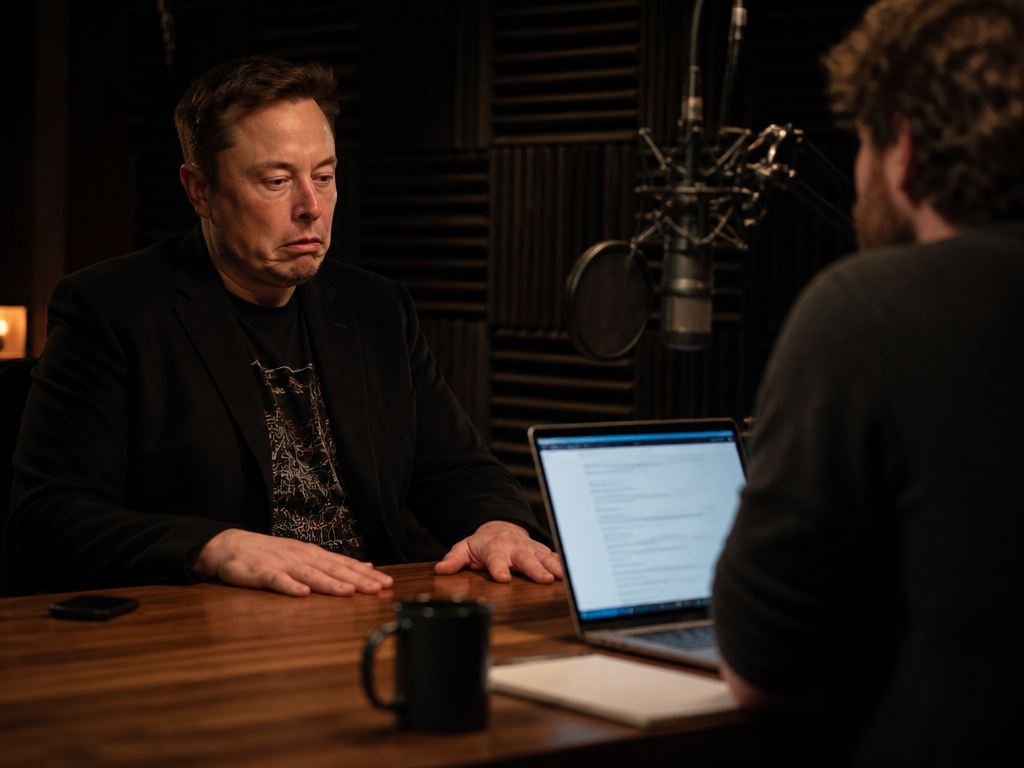
A famous actor sits across from a podcast host, laptop open, and says the quiet part into the microphone: this stuff scares him. Then, in the same breath, he types a few words, hits a button, and plays back a song that did not exist ninety seconds ago. He is unsettled and he is doing it anyway. That gap — between the flinch and the click — is the most honest thing anyone has said about AI music generation in months, and it traveled faster than any of the music ever could.
I have watched a lot of these clips now. Working sound designer, ten years scoring indie games and short films, four synthesizers I cannot fix on a shelf behind me. When a recognizable face demonstrates a text-to-song tool on a popular show, my inbox fills up the next morning. Not with questions about how it works. With a single conviction, stated as fact: everyone in the business is already doing this.
That conviction is worth pulling apart, because it has a source, and the source is thinner than the belief.
How one microphone moment becomes industry gospel
Here is the pattern. A celebrity — usually not a working session musician, usually someone adjacent enough to sound credible — mentions on a podcast that the pros have moved on. "The guys in town are all using it now." It lands because it carries two kinds of authority at once: fame and insider geography. Naming a music city does the work. You picture the studios, the session players, the whole ecosystem quietly switching over while you weren't looking.
The clip gets cut. It runs as a headline. It gets quoted in a newsletter, then in a Discord, then in a pitch deck, then back onto another podcast where a different host repeats it as established context. By the fourth hop, nobody remembers it started as one person's offhand impression. It has become a census.
It was never a census. It was a feeling, spoken aloud, by someone with a microphone and no obligation to count.
Are professional musicians actually using AI music generation?
Some are, for specific tasks — and most are not replacing their craft with it. The honest version is narrower and more interesting than the headline. Producers reach for generative tools to rough out a scratch idea, to fill a temp slot before the real composer is hired, to mock up a reference so a client can hear "something like this" without booking a room. That is real adoption. It is also not the same as a guitarist hanging up the instrument.
The disruption is happening at the bottom of the budget, not the top of the credits. The work that gets handed to a generator first is the work nobody wanted to pay studio rates for in the first place: the thirty-second bed under a corporate explainer, the placeholder loop in a game build that ships and never gets revisited, the third variation a client demanded "just to compare." Those jobs were always undercooked and underpaid. They are the first to go.
What is not going — not this year — is the part where a human with taste decides which of forty mushy renders is the one, then bends it into something that fits the scene. The tools generate. They do not curate. That gap is where the working pro still lives, and most of them know it.
The number that makes the story real
Strip away the celebrity and you are left with the only detail that matters: cost. A polished song bed used to mean a room, an engineer, players, and a day. The cost of one credible draft has collapsed toward the cost of an afternoon and an export. That is not a rumor. Anyone with a browser can verify it in an evening.
But notice what the cost collapse actually replaces. It replaces the draft, not the decision. It replaces the demo you would have paid a junior to bang out, not the final master a label will fight over. When you hear "a studio day became a free tool," the true sentence underneath is narrower: a studio day's worth of guessing became free. The guessing was never the expensive part anyone was proud of.
What the podcast version gets right, and where it stretches
The conversational take is directionally true and specifically loose. Here is the split, as I see it from inside the work.
| The podcast claim | What's actually true |
|---|---|
| "Everyone's using it" | Some are, for scratch tracks and temp music; full replacement is rare |
| "It's basically free now" | The draft is cheap; mixing, mastering, and taste still cost time |
| "You type words and get a song" | You type words and get forty tries; one might be usable |
| "Vocals sound real" | Instrumentals hold up; convincing lead vocals remain the hard part |
| "It's already changed the industry" | It's changed the bottom of the budget, not the top of the craft |
None of those corrections kill the story. They right-size it. The technology is real, the adoption is real, and the headline is still doing more emotional work than factual work.
Why "frightening" is the correct word, not the dumb one
It would be easy to dunk on the celebrity flinch — to say, you're scared and you're using it, pick a lane. I won't, because the flinch is the most accurate response on the table.
What unsettles people is not that the music is good. Plenty of it is mushy, generic, harmonically polite in a way that gives it away inside eight bars. What unsettles people is the ease. The distance between wanting a thing and having a thing has almost vanished, and we are not built to trust things that arrive without friction. A song you sweated over for a week feels earned. A song that arrives before your coffee cools feels like it must have cost someone, somewhere, something — and you are right, it did. It cost the junior who used to get the scratch-track gig.
The fear is not about robots taking the art. It is about the quiet reallocation of who gets paid for the unglamorous middle of the pipeline. That is a real economic question, and "frightening" is a reasonable thing to call it. The mistake is letting the fear stand in for understanding, the same way the headline stands in for the census.
At City of Punk we build neural tools for exactly the jobs I described — the loops, the beds, the temp music that needs to be original and clear to use commercially. So I have skin in this. Which is why I would rather you hold an accurate picture than an exciting one: the tools are a new instrument, not a verdict on the old ones. They reward taste and punish laziness, like every instrument before them.
The next time a clip tells you the whole industry has already switched, remember where that sentence was born — a microphone, a feeling, a click. The technology is genuine. The certainty around it is borrowed.
Believe the tool. Audit the rumor.
Not sure which tool to use?
Compare the top AI music and sound tools side by side — honest reviews, real pricing, no sponsorships.