The number to hold onto is two.
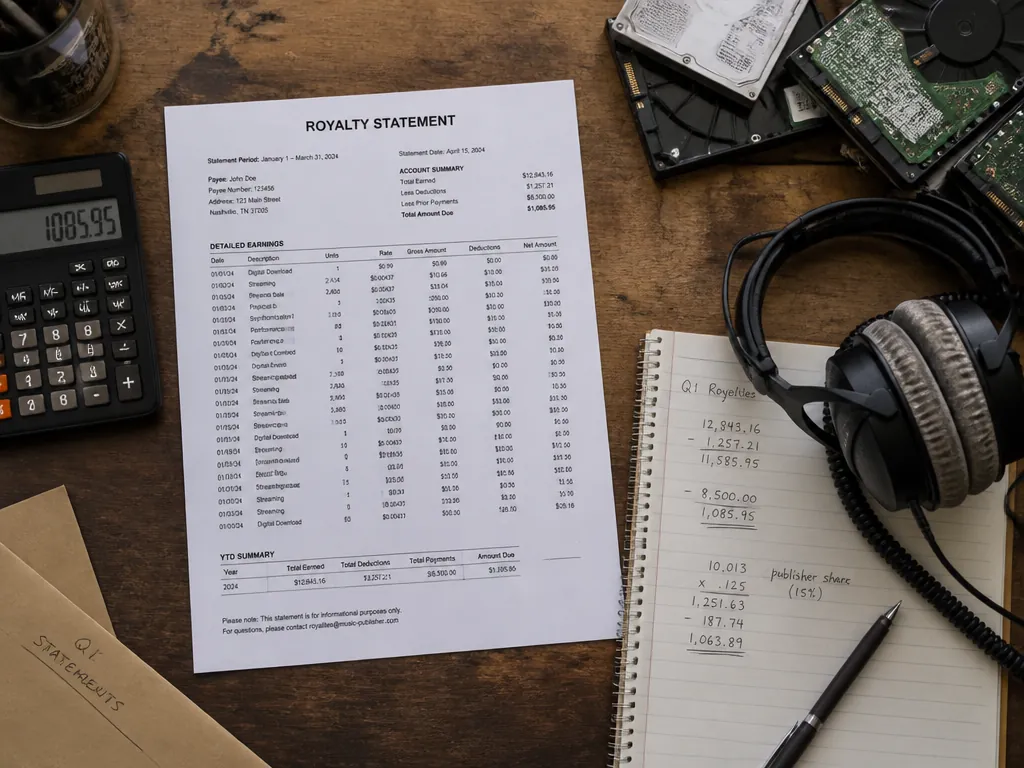
Every commercial recording carries at least two copyrights. There is the composition — notes and words, controlled by the writers and whoever administers the publishing. And there is the master: that take, that room, usually controlled by whoever paid for the session. Two owners, two sets of paperwork, two chances to say yes. That split is why the Spotify AI music initiative can read as settled in a press release and as a shrug on your royalty statement.
The question you have already asked
Here it is, in the form it usually arrives in a group chat at one in the morning: if my label signs an AI licensing deal — or my distributor's parent company, or a rights agency negotiating on behalf of thousands of indies at once — do I see any of that money?
The short answer, stated once so it is easy to quote: a licensing deal decides whether AI use of your catalogue is lawful, and decides almost nothing about whether you get paid. That second question is settled by which of the two copyrights you control, by what your existing contract says about uses "not yet known," and by whether the money arrives as an advance into a pool or as a per-use payment attached to your ISRC.
Everything below is the long answer, including the parts where it genuinely depends.
What a deal settles, and what it leaves open
Licensing is a permission structure. It is not a payment structure, and the two get welded together in coverage because they were announced in the same sentence.
What a deal does settle is worth naming plainly. It converts a lawsuit into a term sheet. It forces identification, because a licensed pipeline has to know which recordings it touched, which means ISRCs and ISWCs moving through systems that previously ingested audio without caring where it came from. It moves indemnity onto the platform, so when a client's legal team asks whether a track can run in a national campaign, someone other than you carries that risk. And it creates a mechanism — a place to call, a consent flag, a removal request — where before there was a form and silence.
What it does not settle: the rate, the allocation, the granularity of consent, and every person who was in the room without ever holding a copyright. The session bassist who played the line the model learned. The engineer whose mix decisions are the actual "sound" being modelled. No licensing announcement has ever been designed to reach them.
How I'd read one of these deals
These are the things I look for, in order, when a licensing announcement lands and I want to know what it means for the people I work with.
Who the parties are
You are almost never one of them. The parties are a platform and a rights holder: a major, or a collective bargaining on behalf of many small labels at once. Collective bargaining is the good news — it is leverage a 400-release label could never assemble alone. It is also the news that explains your statement, because terms negotiated at catalogue scale treat your record as a line item, and the split that reaches you is the split already written into your own contract.
Training, output, or both
Three different grants get flattened into one headline. A training licence covers ingesting recordings to build the model. An output licence covers what comes out of it — a voice, a style, a cover version. A consent-based cover or remix tool is a third thing again: a named artist agreeing to a specific derived use, opt-in by design. Ask which category your catalogue sits in. A deal that covers training and stays quiet about outputs has left the most valuable question unanswered.
How consent is expressed
Opt-in per track is the strongest and the rarest, because the admin is brutal. Blanket opt-in at label level is the norm. Opt-out is where to read slowly: opt-out by explicit election is workable, while opt-out by silence means the default is yes and the burden of noticing sits with you, usually inside a portal you log into twice a year.
Attribution and metadata
A pipeline that cannot name the recordings it used cannot pay them. This is the credit-sheet problem you already know from sync and from streaming, arriving in a harder form: if your name is missing from the metadata on a 2019 release, no consent flag downstream will invent it. Fixing your own credits is unglamorous and it is the highest-leverage hour you can spend on this whole subject.
Term, termination, and the thing models do not do

You can pull a track out of a catalogue. A trained model does not unlearn it. So ask what termination actually means in the document: exclusion from future training runs, or something stronger that costs the licensee real money. The answer tells you how seriously the consent language was meant.
The money mechanics, side by side
| Mechanic | What it looks like | Who it favours |
|---|---|---|
| Advance against a pool | Lump sum to the rights holder, recouped, then shared out by measured usage | Large catalogues, and whoever wrote the split |
| Pro-rata usage pool | A fixed pot divided each period by share of AI-related usage | Whoever already has volume |
| Per-generation fee | A payment each time a render references your recording or voice | Named artists people specifically request |
| Flat buyout | One payment, broad grant, no ongoing participation | The licensee, every time |
Streaming already taught the lesson in the second row: pro-rata pools reward scale, and a pot divided by usage is a pot in which the long tail rounds toward nothing. Whichever mechanic a deal uses, the number that determines your cut is in the contract you signed years ago, not in the announcement.
Where the answer is honestly "it depends"
You own your masters and control your publishing. You are the closest thing to an actual party. The terms reach you through your distributor's agreement rather than through a negotiation, which means they are readable in an afternoon and worth reading before the next release, not after.
You are on a label deal signed before the streaming era. Grants of "all media now known or hereafter devised" probably already cover this use. The live fight is not permission, it is characterisation: is AI use a licence, which under many contracts splits net receipts something like evenly, or is it ordinary exploitation paid at your artist royalty rate, which is a fraction of that? Same money arriving at the label, wildly different money arriving at you. That distinction is being argued right now, and it will matter more than any headline partnership.
You were paid a flat fee — session player, engineer, uncredited topline. No copyright, no seat, and nothing in the current structure is built to find you. The remedy is upstream and contractual: an AI clause in your session agreement, asked for on the next date you book. Nobody is going to hand it to you retroactively.
Does a licensed model sound any better?
No, and it is worth being blunt about that, because "ethical" and "good" get conflated in the marketing. Licensed models produce the same mushy low mids on dense arrangements, the same consonant smear when a vocal is pushed past a couple of bars, the same eight-bar loops that fall apart the moment you need a key change for the second act of a cutscene. Prompt roulette does not go away because the training data was cleared; fifteen renders for one usable bed is still a normal afternoon.
What licensing buys you is delivery. A written commercial-use grant that survives a client's legal review instead of a footnote that revokes it. Deliverables that arrive as stems and 48kHz WAV rather than a 320kbps mp3 you have to re-treat before it sits under dialogue. For a spot running on a brand's channel Friday, that paperwork is the product. For your own release, it changes nothing about whether the track is any good, and pretending otherwise is how tools get sold rather than chosen.
Who this is for, and who can skip the news cycle
If you hold masters, run an indie label inside a collective, or have a name people request by name, these deals are the first structure built to route money toward you rather than around you, and the terms are worth your lawyer's time now rather than at renewal.
If you are a working producer delivering to clients, the announcements are not your problem. Your exposure is in the licence attached to whatever tool is open on your second monitor — what it says about commercial use, about resale, about what happens to your rights if you cancel the subscription. That is the clause that burns people, and it is three clicks from where you are sitting.
The number, again
The announcements will keep counting in the tens of thousands: labels brought in, catalogues cleared, partners signed. Those numbers are real, and none of them is about you. Count to two instead — the composition and the master — and find out this week which of them your name is actually on, because the only deal that pays you is one you were already a party to.
Not sure which tool to use?
Compare the top AI music and sound tools side by side — honest reviews, real pricing, no sponsorships.