The counter read north of eleven million before the doors opened.
Not tickets. Interest — a button press that costs nothing, logged from an account that may or may not be awake on the night. That figure got attached to one of the largest Roblox concerts on record as of writing, and it travelled the way soft numbers travel: into headlines, into decks, into a slide labelled audience in somebody's quarterly review. It is a real signal about something. It is not a signal about how many people heard the second verse.
I care about the second verse because that is my job. I have spent a decade putting loops under other people's pictures, and the thing I have learned about a mix is that it only exists where somebody hears it. So when a virtual show gets written up as a record, my first question is not how many. It is: through what, on what, and while doing what else.
Ask that question and the interest counter starts to come apart in an interesting way. Because a lot of the people who clicked that button were not clicking for the artist. They were clicking because the developer hosting the show had attached a temporary in-game multiplier to attendance — show up, get faster, get richer, get further up the leaderboard. The music was the price of the buff, not the product.
That is not a scandal. It is a design decision, and a fairly elegant one. But it means the number at the top of the article is measuring the incentive, not the act. And once you notice that, you notice that the phrase covering all of this — the virtual concert — is doing far too much work. There are at least three different products wearing that word, and they fail in completely different ways.
Three shapes of show
The Set Piece
A bespoke destination. The artist gets a purpose-built world, usually commissioned from a studio that does nothing else, and the show is a linear spectacle: scripted camera moves, scale shifts, a stage that becomes a planet. Attendance is measured in concurrents across instanced sessions, the run is short, and the whole thing is designed to be clipped. The Set Piece is the model people picture when they hear that a major artist played inside a game, and it is the model that produced the platform attendance claims everyone now compares against.
It is also the most expensive thing in this article by a wide margin, and the thing most likely to be paid for by someone whose name is not on the record.
The Bribe
A show grafted onto a game that was already running. The developer already has a daily active audience doing something repetitive and numeric — racing, grinding, tapping, hatching — and the concert is a temporary event inside that loop, sweetened with a reward: a multiplier, a limited cosmetic, an exclusive pet, a currency drop. Attendance is enormous, because the game's existing population walks through the door on its way to the reward.
The artist rents a crowd that was already assembled. The developer rents relevance and a spike in reactivations. Both parties get a press release. Nobody involved is confused about the mechanism, which is why I find it hard to be sniffy about it.
The Address
A persistent space the artist keeps. Not an event — a place. A room, an island, a studio, a venue that stays open after the campaign ends, with the catalogue playing in it, merch on a wall, a jukebox, sometimes a small playable loop so there is a reason to be there for longer than a screenshot. Traffic is low and boring compared to the other two. It also does not go to zero on Tuesday.
The Address is the least covered of the three because there is no launch moment to write about, which is precisely why it is underrated by everyone reading launch coverage.
How I'd score a virtual show
Six criteria. They are the ones I would use if a label handed me a budget and asked which of these three shapes to buy, and they are deliberately unromantic.
1. What the mix survives. Not what was rendered — what arrives. Sample rate, channel count, whether the music is a 2D stream sitting over the whole world or a spatialised emitter that changes as the player moves, and whether it ducks for the game's own sound effects. This is the criterion the industry press never scores and it determines whether the song was actually heard.
2. Cost, and whose cost. Build fee, platform revenue split, the marketing spend needed to make anyone show up, and which line item on which company's budget it lands on. A number that looks catastrophic on an artist's budget looks like a rounding error on a beverage brand's.
3. The attention contract. What did the player trade to be in the room? A deliberate choice to attend? A tap on a button in a feed? A route to a reward they were already chasing? The cheaper the trade, the softer the number it produces.
4. Spillover you can actually measure. Streaming lift on the performed tracks in the following week, search volume, catalogue depth (do they play track four?), pre-saves, wishlist adds. Not impressions. Reported lift varies wildly by campaign and most of what circulates publicly comes from the party that paid for the show, so treat any single figure as a claim rather than a finding.
5. Residual value. What exists thirty days later. An asset, a returning audience, a reusable build, a piece of catalogue — or a case study PDF.
6. Who it's wrong for. Every one of these is wrong for somebody, and the somebody is usually an artist whose team read a headline about a different artist.
| Criterion | The Set Piece | The Bribe | The Address |
|---|---|---|---|
| What the mix survives | Best case: bespoke spatial audio, still delivered to phone speakers | Whatever the host game's audio bus allows; competes with SFX | Full control, quiet room, tiny audience |
| Cost, and whose | Highest; usually brand- or platform-funded | Low to moderate; often revenue-shared with the developer | Low build, ongoing upkeep, no headline |
| Attention contract | Deliberate attendance, short window | Reward-seeking; music is incidental | Voluntary, repeat, self-selected |
| Measurable spillover | Strong on the performed tracks, shallow on catalogue | Huge reach, thin conversion, weak on catalogue | Small numbers, deepest catalogue engagement |
| Residual value | Clips and a case study | A spike, then the game's baseline | A permanent, reusable property |
| Wrong for | Anyone spending their own money | Anyone whose story is craft or catalogue | Anyone who needs a launch-week number |
What the mix actually survives
Here is where I earn my keep, because this is the part of the analysis that almost never gets written and it changes the ranking.
A large share of this audience is on a phone or a tablet, held about forty centimetres from the face, playing through a driver the size of a shirt button. Below roughly 200 Hz there is nothing. Your sub-bass does not exist. That gorgeous detuned analog bassline you spent an afternoon on is a rhythmic ghost — the listener perceives it from the harmonics your saturation left behind, or not at all. If the arrangement's low end carries the hook, the hook is gone.
Then there is the delivery path. Music inside a game world is either a flat 2D stream — same level everywhere, effectively a radio bolted to the camera — or a positional emitter with a rolloff curve, which means the mix changes as the player walks. Positional is more immersive and much more dangerous: walk twenty studs from the stage and the vocal drops under the crowd bed, because the rolloff was tuned by someone thinking about realism rather than about the song. I have heard shows where the chorus was inaudible from the merch stand.
Add the host game's own sound: footsteps, coins, a UI chime that fires every time the reward multiplier ticks. If the audio designer did not build a proper ducking or bussing scheme, the song is fighting a slot machine. In the Bribe model this is close to a structural problem, because the reward feedback loop has to stay audible — that is the mechanic. The music gets the leftovers.
And the delivery is almost always a prerendered, pre-mixed stream rather than live stems. That means no adaptive arrangement, no reactive layers, no ducking against gameplay state — the one genuinely native thing games can do with music, which the concert format mostly throws away. There is a version of this format where the crowd's collective input changes the arrangement in real time, and I keep waiting for someone to build it properly. Mostly what ships is a video with a polygon budget.
Moderation and rights add a last layer of friction. Uploaded audio on the platform is subject to moderation and access rules that have tightened over the years, and licensing for anything using third-party masters is negotiated per campaign. Terms vary, they are rarely published, and if you are an independent artist reading a case study about a major-label show, assume the parts you cannot see are the parts that mattered. Get the commercial and territorial terms in writing before anyone builds a stage.
Running the three past the criteria
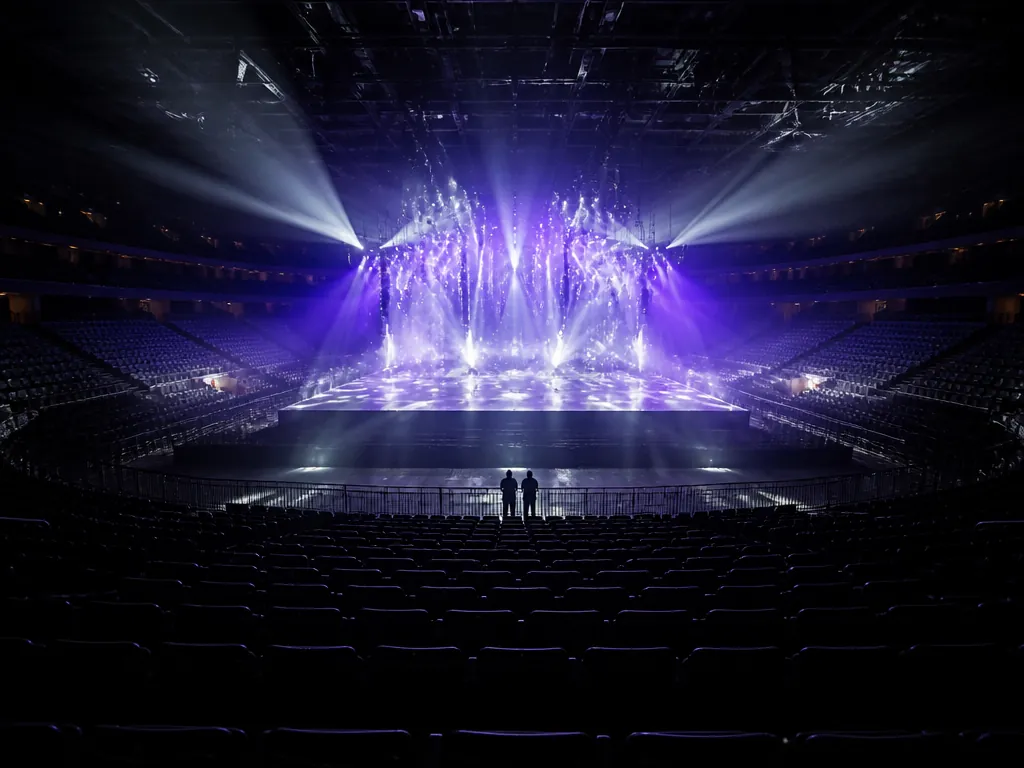
The Set Piece wins on craft and loses on arithmetic. It is the only shape where the audio can be designed rather than accommodated — you control the emitters, the reverb sends, the crowd bed, the moment the low end drops out before the last chorus. It produces the clips that outlive the event, and clips are the actual product of a virtual show. It also costs more than most artists will earn from the campaign it supports, which is why the ones you have read about were underwritten by a brand or the platform itself. Its honest negative: the attendance record it chases is a vanity metric with a short shelf life, and once the run ends you own a case study and a folder of renders. Nobody can revisit the world. You paid a spectacle price for a temporary asset.
The Bribe wins the number everyone quotes and wins it cheaply. It is genuinely smart distribution: instead of persuading strangers to come to a show, you place the show where a large, active, incentivised population already is. If your goal is a launch-week spike and a defensible reach figure, nothing else in this article competes. Its honest negative is the conversion cliff. The reward is the reason for the visit, so a meaningful share of that crowd is standing in the room facing the exit, waiting for the timer. Interest converts to attendance at some rate nobody publishes; attendance converts to a stream at a much worse one; and the catalogue effect is close to nil, because a player farming a multiplier does not go looking for track seven. You bought reach with a coupon attached. Count it as reach, and do not let anyone in the room call it fandom.
The Address loses both headline numbers and quietly wins the sixth criterion. The people who show up to a persistent artist space chose it with nothing offered in return, which makes them the only self-selected audience of the three. They stay longer. They hear more than the singles. The build is reusable, it can host the next campaign, and the traffic compounds slowly rather than spiking and dying. Its honest negative is that it is boring to fund and easy to abandon — an empty room is worse than no room, upkeep costs money forever, and if the numbers are the thing your quarter is judged on, this shape will never save you. It is a catalogue play in an industry that pays for launch weeks.
So the ranking depends entirely on which number you are being paid to move, and I would rather say that plainly than pretend one shape is best. If you need reach this month and someone else is funding it, take the Bribe and report it honestly. If you have a brand partner carrying the build and a song with a real visual identity, the Set Piece is the only one that respects the music as music. If you are playing a longer game and can tolerate three months of unimpressive dashboards, the Address is the only one of the three that still exists next year.
Who this is for, who should skip it
Label marketing teams with a launch-week target: the Bribe, without apology. Negotiate for the audio bus — insist the music sits above the reward SFX, and ask for the rolloff curve before you sign. Build a measurement plan that separates interest, attendance, median dwell and post-event streams before the event, because after the event you will be handed whichever of those four looks best.
Independent and mid-tier artists spending their own money: skip the Set Piece entirely. The version of it you can afford looks like the version you cannot, and the gap is visible in about four seconds. An Address you actually maintain, with a decent spatial mix and a reason to return, will do more for you over eighteen months.
Brands and platform partners: the Set Piece is yours, and it is the one place in this analysis where a large budget genuinely buys something the others cannot fake.
Analysts and journalists covering this beat: the useful question is never how many were interested. It is what was on offer, who paid for it, and what percentage of the room was facing the stage. Ask for median session length inside the event. Whoever refuses to give it has told you the answer.
Anyone selling this as the shape of live music: skip it. These are marketing instruments with a soundtrack, and they work better when everyone involved says so out loud.
The number, again
Eleven million people did not want to see a concert. Eleven million accounts clicked a free button attached to a temporary speed boost, and a fraction of them turned up, and a fraction of that fraction stood still long enough to hear a full song through a phone speaker with the coin chime firing over the vocal. That is still a lot of people. It is also a completely different sentence from the one that ran in the headlines, and the gap between those two sentences is where the entire economics of this format lives.
The counter is not measuring the artist. It is measuring the size of the bribe, and the industry should price it accordingly.
Not sure which tool to use?
Compare the top AI music and sound tools side by side — honest reviews, real pricing, no sponsorships.