A render takes under a minute. You type a line about a stomping four-on-the-floor chorus with a German vocal, wait, and a stereo master lands in your downloads folder. Whatever happens inside that minute is now the subject of litigation on two continents, and the Suno AI copyright lawsuit brought by GEMA in Munich is the first of those proceedings to produce a decision a rights holder can hold up rather than forecast. Its significance has little to do with the sums involved. It has to do with the question a German court was willing to answer: whether training a generative music model on protected repertoire is an act that requires permission.
That question is being put three different ways in three different rooms, and the answers are not converging. A publisher, a master owner, and a general counsel at an AI music company are each looking at a different set of rules with a different price tag attached. What follows compares those three routes against the criteria that actually decide outcomes — not the criteria that generate headlines.
What Munich was asked
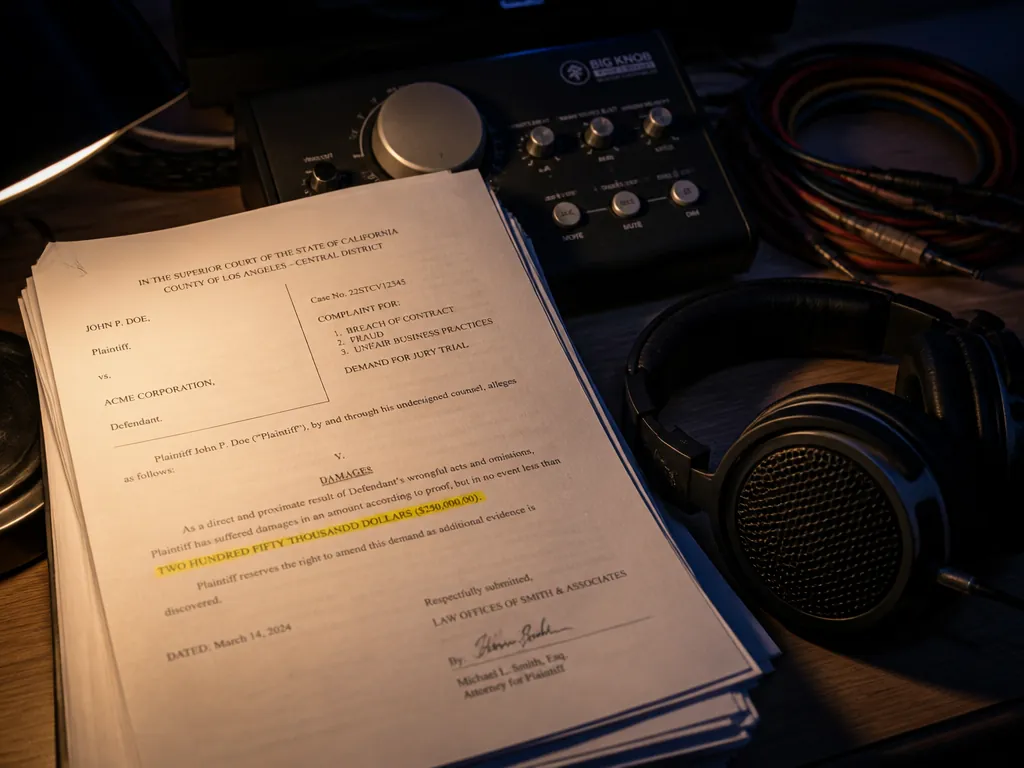
GEMA administers performing and mechanical rights in Germany on behalf of composers, lyricists and music publishers. It brought its claim in the Munich Regional Court, the same venue where it had earlier pressed a case against OpenAI concerning song lyrics. The claim was not argued as a general objection to machine learning. As reported, it leaned on the output side: prompts that returned tracks any German listener over thirty would recognise, with melodic contours and lyric fragments belonging to catalogue standards GEMA's members wrote and still control.
Suno's public position, held consistently since the American suits landed, is that training on widely available recordings is analytical and transformative, that the model does not warehouse or serve copies, and that a ruling under German law settles nothing about American law. The company has signalled it will appeal. Both framings can hold simultaneously in a narrow sense — GEMA can prevail in Munich on the record it built, and the US question can remain genuinely open, because the two systems are not asking the same thing.
The rest of this piece is about why they are not asking the same thing, and what that means if you are the one deciding where to spend an enforcement budget or a compliance budget over the next eighteen months.
Criterion one: which copyright is on the table
Music carries at least two independent rights, and the parties suing over them are usually different companies with different lawyers.
GEMA speaks for the musical work — the composition and the lyric. It does not control masters. The American cases brought by the major recording companies against Suno and Udio in 2024 assert rights in sound recordings, a separate property with a separate owner and, in the US, a separate statutory history. Publishers sit on the composition side; in the EU there is also a producer's neighbouring right that behaves differently again.
The practical consequence is unglamorous and expensive. An AI music company can license every master from every major label and remain exposed on the publishing side. It can do a deal with a collecting society and remain exposed to master owners. Clearing one right is not partial progress toward clearing the other; it is a separate transaction with a separate counterparty who has watched you pay someone else and priced accordingly.
The honest limit on GEMA's win: it does not reach masters, and it does not bind a Berlin label that wants its own claim. A composition-side victory is a template, not an umbrella.
Criterion two: does liability attach at training or at output
This is the fault line, and the two jurisdictions sit on opposite sides of it.
German copyright law grants a reproduction right, and copying protected works into a training corpus is a reproduction unless an exception applies. Section 44b of the German Copyright Act implements the EU's text-and-data-mining exception from Article 4 of the 2019 DSM Directive, which is the doorway a model developer has to walk through. The argument is therefore about the corpus itself, at the moment it was assembled.
US law has no equivalent statutory doorway. Copying into a training set is likewise a prima facie reproduction, but the defence is fair use — four factors weighed case by case, with the first (purpose and character) and the fourth (effect on the market for the work, including the market for licensing it) doing most of the work. There is no register to consult and no box a rights holder can tick in advance. You find out what the answer is when a judge tells you.
Output-side claims run alongside both. If a model returns something substantially similar to a protected work, that is an ordinary infringement question, older than any of this, and it does not depend on resolving the training issue at all. This is why output evidence is so attractive to a claimant: you can play it in the room. A 3:12 stereo file where the chorus tracks a known melody bar for bar is comprehensible to a judge in about eight seconds. Proving what sat in a training corpus, by contrast, requires knowing the contents of the training corpus, which is the one document a claimant does not have.
The defensible criticism of the output-first approach is that it proves less than the headline suggests. Demonstrating memorisation in specific outputs establishes that specific outputs infringe. Getting from there to a finding about the entire training process is a longer walk, and defendants will keep pointing that out on appeal.
Criterion three: is there an exception, and how does a rights holder switch it off
Under Article 4(3) of the DSM Directive, the commercial text-and-data-mining exception does not apply where the rights holder has expressly reserved use, and for content made publicly available online that reservation must be made "in an appropriate manner, such as machine-readable means". Germany's implementation carries the same reservation mechanism.
That single sentence is the most operationally important clause in European AI copyright, and it is unresolved in ways that matter. Whether a robots.txt directive is sufficient, whether terms-of-service prose qualifies as machine-readable, whether a reservation filed in 2025 has any bearing on a model trained in 2023 — these are live questions, and a referral to the Court of Justice on the point would do more to settle EU-wide exposure than any single national judgment.
What a rights holder can take from it, though, is a lever that does not exist in the US at all: an affirmative act, performable now, cheaply, that changes the legal position of anyone scraping afterwards. There is no American equivalent. You cannot opt out of fair use.
The cost of that lever is that it is prospective and it is fiddly. A catalogue distributed across a dozen platforms, some of which control their own robots files, cannot be reserved by one press release. The reservation has to be made where the content actually sits, and it has to be dated, because the date is what you will be arguing about later.
Criterion four: what a win actually delivers
German practice grants injunctive relief as an ordinary consequence of infringement rather than an extraordinary one, alongside information claims that compel a defendant to disclose the scope of use, and damages that may be assessed by licence analogy — what a willing licensee would reasonably have paid. That last method is quietly significant for AI training, because it converts "you should have taken a licence" into a number derived from the licence you did not take.
An injunction from a German court governs conduct in Germany. In practice, for a service reachable from a browser, that means geoblocking, feature removal, or a deal. It is territorially bounded and commercially awkward to comply with halfway.
Running underneath is the EU AI Act, whose obligations for general-purpose AI models began phasing in during 2025 and include publishing a sufficiently detailed summary of training content and maintaining a policy to comply with EU copyright law, including Article 4(3) reservations. Those duties attach to models placed on the EU market irrespective of where the training happened, which is the extraterritorial hook rights holders have been waiting for. The caveat worth stating plainly: whether a music-specific generative model falls within the general-purpose category is arguable, and a company with a good argument that it does not will make that argument.
The US route delivers a different weapon. Statutory damages under 17 U.S.C. §504(c) run up to $30,000 per registered work, rising to $150,000 where infringement is found willful. Multiply by a catalogue and the arithmetic stops being about music and starts being about solvency. That arithmetic is why American cases in this space have a strong tendency to end in negotiation rather than judgment — which means the US route reliably produces money and unreliably produces precedent.
| Criterion | Germany / EU | United States | Negotiated licence |
|---|---|---|---|
| Right typically asserted | Composition and lyric (collecting society); producer's right separately | Sound recording (labels); publishing claims filed separately | Whatever the counterparty controls, bundled |
| Where liability attaches | Training reproduction, unless TDM exception applies; outputs separately | Fair use decided factor-by-factor; outputs separately | Not applicable — permission granted |
| Rights holder's advance lever | Machine-readable reservation under Art. 4(3) | None | Refusal to deal |
| Primary remedy | Injunction, information claim, damages by licence analogy | Statutory damages at scale | Fee, revenue share, or attribution scheme |
| Territorial reach | National injunction; AI Act duties follow the EU market | Nationwide, defendant-dependent | Contractual, as drafted |
| Evidence problem | No broad discovery; build from outputs | Broad discovery reaches the corpus | Disclosure is negotiated, not compelled |
| Realistic time to resolution | Appeal layers, possible CJEU referral | Multi-year, frequently settled | Months |
Criterion five: what it costs to find out
American discovery is the most powerful evidence-gathering machine in commercial litigation, and in AI cases it is aimed at exactly one thing: the training manifest. If a claimant survives to that stage, they learn what was ingested. That prospect shapes settlement behaviour long before any judge weighs a fair-use factor.
German procedure gives a claimant no comparable pre-trial reach. You build your case from what you can generate yourself, which is why an output-led strategy is not merely tactically clever there — it is close to the only strategy available on an affordable budget. Information claims exist, but they follow a finding rather than fund one.
So the forum determines the shape of the claim before anyone drafts a pleading. In the US, you sue on the corpus and use discovery to prove it. In Germany, you sue on the renders and let the corpus follow. A rights holder who imports the American strategy into a German court will spend money proving something the procedure will not help them prove.
Criterion six: price over twenty-four months
This is where the comparison stops being academic. An appeal to the Higher Regional Court, a possible onward step to the Federal Court of Justice, and a plausible reference to the Court of Justice on the interpretation of Article 4 is a multi-year commitment for both sides. In the US, the label litigation has already consumed more than a year on procedural ground alone.
Against that, the licence. GEMA published a licensing model for generative AI in 2024 built around participation rather than prohibition, and through 2025 several major rights holders moved from purely adversarial posture toward deals with AI music companies — a pattern reported across the industry press rather than one this publication has audited. The direction of travel is not subtle. Parties who can afford to litigate indefinitely are choosing not to.
The road that keeps getting taken
A licence resolves the question the courts are slowly grinding toward, resolves it in months rather than years, and resolves it with terms the parties chose. It is the cheapest instrument on the table for both sides, and it is winning.
The honest problem with it is distributional. Deals get struck by parties with the balance sheet to litigate as an alternative. An independent label with 400 masters, a session bassist, an unrecouped songwriter — none of them are in the room where participation is defined, and all of them will be told afterwards what their share is. A licence negotiated under injunction pressure also prices differently from one negotiated in an open market, and every rate agreed now becomes the comparable used against everyone who signs later. Collecting societies are the obvious counterweight, which is precisely why the composition-side case in Munich carries more structural weight than its damages figure suggests.
So the verdict, such as it is: the EU is where the leverage sits, the US is where the money sits, and the licence table is where nearly all of this ends. A rights holder with limited budget establishes facts more cheaply in Germany and monetises them more thoroughly in America. An AI company facing both has a compliance file — training-content summary, copyright policy, reservation-honouring pipeline — that is materially cheaper than an appeal, and it should have been bought a year before anyone thought it was needed.
Who this bears on
Publishers and collecting societies. You have a lever the Americans do not. File machine-readable reservations wherever your catalogue is exposed, record the date, and keep the record, because the date is the disputed fact in every case that follows.
Master owners. A composition-side judgment does not cover you. Your claim is separate, your counterparty may already be negotiating with someone else, and your leverage decays as the licensing comparables set.
AI company executives. The near-term exposure is not a damages award, it is market access. Compliance documentation and an honoured opt-out pipeline are the low-cost purchase; a company betting the file is unnecessary is betting on classification arguments it does not control.
Studios and publishers buying AI-assisted music. Read the indemnity. Most terms of service allocate output risk to you, and "commercial use permitted" is a statement about the vendor's licence to you, not a warranty about the training data behind it.
Anyone waiting for one global answer. You can stop reading. Two systems are asking different questions, and they are going to keep producing different answers for years.
When I hand off a game score now, the stems ship with a plain text file beside them: one line per cue, naming the tool that made it, the version of that tool's terms that was live the day I rendered, the render date, and whether the cue is AI-assisted, AI-generated, or played. It has never once been asked for. It takes about eleven minutes per project, and it is the only part of my delivery I expect to matter in five years.
Not sure which tool to use?
Compare the top AI music and sound tools side by side — honest reviews, real pricing, no sponsorships.