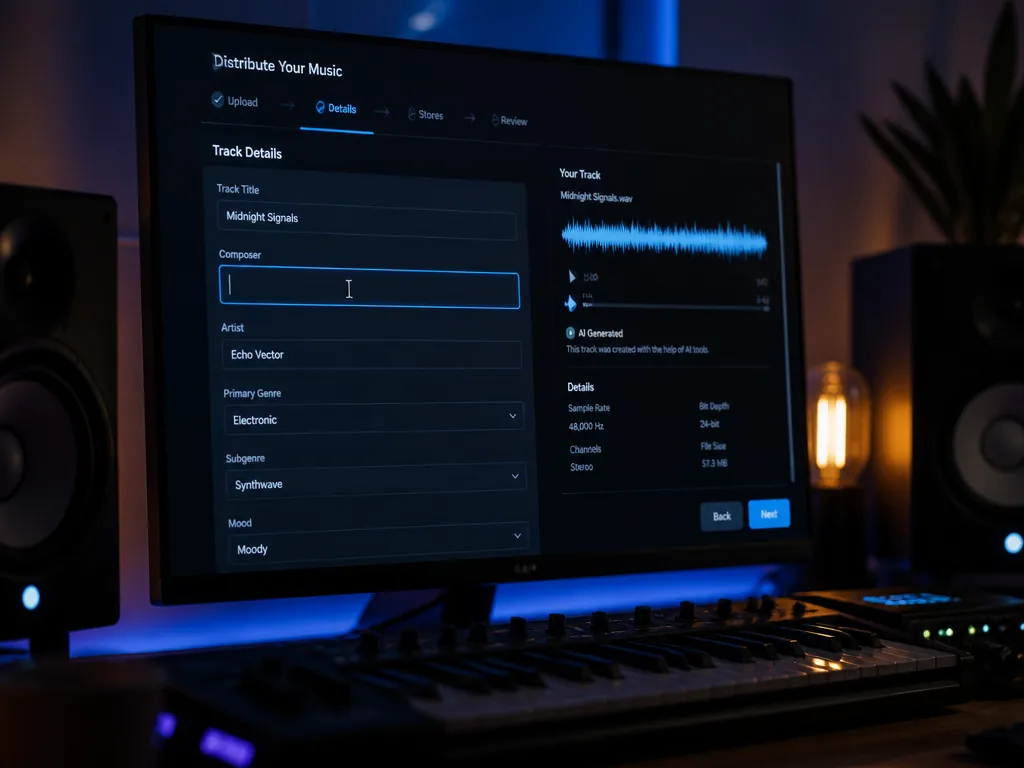
There is a field in every distributor's upload form marked Composer. Sometimes it is required, sometimes it is not, and for a fully AI-generated instrumental it is the field where an honest person freezes. You typed a prompt. A model rendered a 48kHz WAV. You comped three takes, EQ'd the low mids, and printed stems. Whose name goes in the box?
That question sounds like paperwork. It is actually the seam where AI music policy, royalty routing, and your legal standing all meet, and the answer changes depending on which layer of the pipeline you are looking at. Let me walk the layers, because they do not agree with each other, and pretending they do is how people end up with tracks in limbo six weeks before a release.
So whose name is the composer on an AI-assisted track?
Short version: on a track you prompted, edited, and finished, you are the artist, and you are almost always the credited composer at the distributor level — because distributors are asking who is responsible for the release, not who is legally the author. Those are different questions. The distributor wants a party to pay and a party to blame if there is a dispute. That is you.
The legal-authorship question is separate and messier. In the US, the Copyright Office has been consistent that purely machine-generated output without meaningful human authorship is not registrable, while material where a human made substantial creative choices can be. Where your track sits on that line depends on how much of the final thing is your arrangement, editing, and selection versus raw render. That distinction does not block you from distributing or from collecting streaming royalties. It matters most if you ever need to enforce a copyright — to stop someone from using your track without permission. Registration and streaming payouts run on different rails.
So you can be the credited artist, be routed royalties, and still hold a copyright claim that is thinner than you assumed. Hold that thought, because it is the thread running through every layer below.
The layers, and what each one actually cares about
Think of a released track as passing through five checkpoints. Each one has its own rule about AI, and they were written by different people at different times who were not coordinating.
| Layer | What it asks about your AI track | Where the risk sits |
|---|---|---|
| Metadata / credits | Who is the artist, composer, producer | Getting this wrong strands royalties or flags fraud |
| Distributor | Do you have rights to distribute this | Account termination if you can't attest |
| Streaming platform | Is it fraud, spam, or undisclosed AI | Delisting, disclosure labels, playlist exclusion |
| PRO / publisher | Is there a registrable work behind it | Performance royalties you may or may not collect |
| Content ID / rights DB | Does this collide with someone else's claim | False matches, or your track claimed by others |
The credit at the top and the copyright question at the bottom are related but not identical, and the three middle layers mostly do not care about copyright at all. They care about attestation and behavior.
What the distributors are checking
Your distributor's terms almost certainly include a line where you warrant that you have the rights to distribute the material. Read it. For AI-assisted work the operative question is whether the terms of the tool you used grant you commercial rights to the output. This is where the license on your generation tool becomes load-bearing.
If you generated with a service that grants full commercial ownership of your renders, you can attest cleanly. If you used a tool whose free tier reserves rights, or grants only a non-exclusive license, your attestation is on shakier ground and you may be violating both the distributor's terms and the tool's. Foundries built for commercial output — City of Punk among them — exist partly to close this gap, so the WAV you export is clearly yours to sell. Whatever tool you use, the practical move is the same: keep the license terms for the version you generated under, on the date you generated. Terms change. Your proof should not.
What the platforms are doing about disclosure
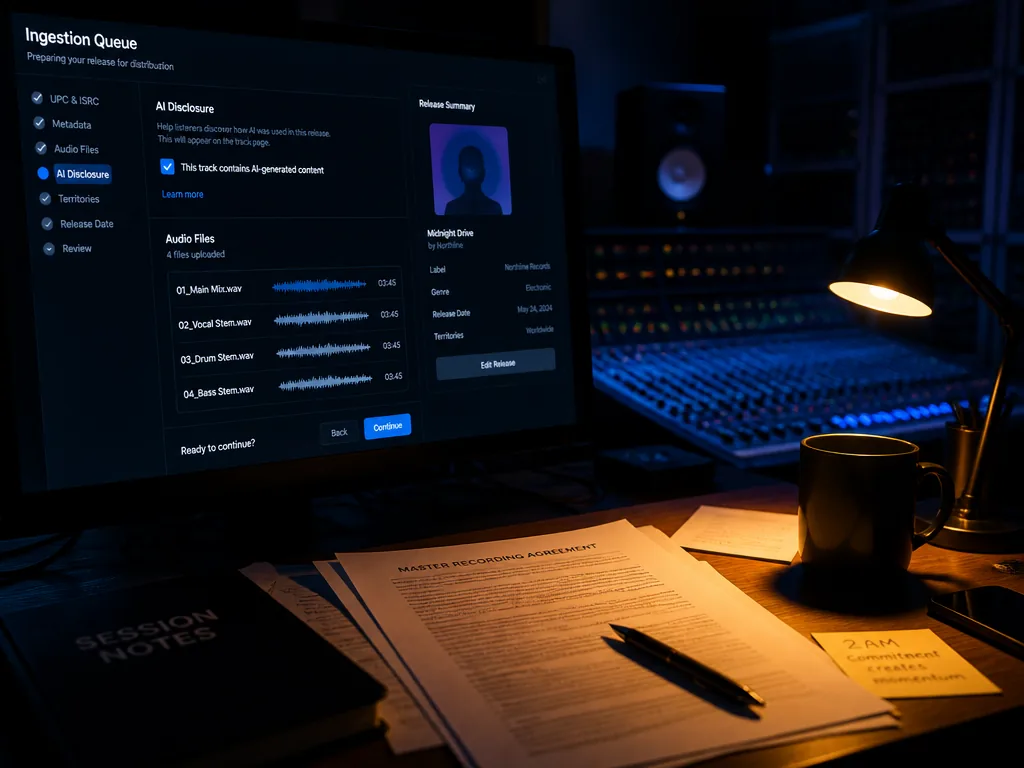
This is the fastest-moving layer, and the one where "it depends" is most honest. As of writing, the platforms have not converged. Some are running AI-detection and mass-removing what they classify as spam. Some are moving toward disclosure labels — a tag indicating a track is AI-generated or AI-assisted, sometimes surfaced to listeners, sometimes only used internally for ranking. Some are quiet.
What is consistent across the stated policies is the target: deception, impersonation, and spam-farming, not AI as a technique. Nobody with a published policy is saying "you may not use AI." They are saying "you may not flood us with thousands of near-identical tracks to game per-stream payouts, and you may not clone a named artist's voice to pass your track off as theirs." If your work is original, finished, and released under your own name, the disclosure regimes are administrative, not existential — you check a box, or you don't and hope the detector agrees.
The exposure to watch: some platforms weight or exclude flagged tracks from algorithmic playlisting. That does not remove your track. It can quietly cap its reach. If a chunk of your income model depends on editorial or algorithmic placement, a disclosure flag is a business variable, not a formality.
Where the royalties actually split
Streaming pays two royalty streams that people conflate: the recording (paid to whoever owns the master — you, via the distributor) and the composition (paid to the songwriter and publisher, via a performing-rights organization and mechanical-rights administration).
The recording side is straightforward: you're the rights holder of the master, the distributor collects, you get paid, AI or not.
The composition side is where the authorship question comes back. PROs register works and their writers. If the underlying composition has questionable human authorship, whether a given PRO will accept the registration — and whether foreign societies will honor it — is not uniform, and it is not settled. Some writers register AI-assisted works by claiming their arrangement and topline contribution. Whether that survives scrutiny across every territory is exactly the kind of thing no one can promise you today. If you skip PRO registration entirely, you are likely leaving the composition-side performance royalties on the table. If you register aggressively, you are betting on recognition that varies by society.
What this piece did not answer
Three things, honestly.
I cannot tell you whether your specific track clears the copyright-authorship bar, because that turns on facts about your process and on guidance that is still being litigated and revised. I cannot tell you how any one PRO in your territory will treat an AI-assisted registration, because their positions are not standardized and several have not published one. And I cannot tell you which platform disclosure rule will exist by the time you release, because that layer is moving monthly.
Where to look next: your distributor's current terms of service, your generation tool's commercial-rights language for the version you used, and your local PRO's published position on AI works — in that order, before you upload, not after a dispute.
Fill in the composer field with your own name and know exactly which of those claims you can defend.
Not sure which tool to use?
Compare the top AI music and sound tools side by side — honest reviews, real pricing, no sponsorships.