The last time I cast a voice actor for a game, the booth work took three hours and the paperwork took longer. We wanted a market-barker NPC — gravel in the low mids, a laugh that could sit under a crowd bed at 48 kHz without fighting the ambience for the same 2 kHz of real estate. He gave me forty usable lines and a fifth take on the laugh that beat the four I'd asked for. Then his agent sent the contract back with one clause struck through: the one that would have let us train a model on the recordings.
Right instinct. Weaker shield than most people assume. Here is the claim I'm going to spend the rest of this piece earning: AI voice cloning is not, for the most part, a copyright problem. Treating it as one is why so much of the outrage bounces off the industry it's aimed at, and why the people with the strongest moral case keep losing on procedure.
What copyright actually covers
Copyright attaches to fixed works — the recording, the script, the mix. When a studio runs a session, it walks away with a master of those forty lines, and that master is protected the way any recording is. Copy it, upload it, cut it into a trailer without permission, and you are in familiar, well-lit legal territory.
A voice is not that. Timbre isn't a work. Neither is the way you clip the ends of consonants, or the half-beat you leave before a punchline, or the particular rasp that gets you cast as the mercenary and never the prince. Those are traits of a person. Copyright has almost nothing to say about traits of a person — which is a feature, because nobody wants a world where a vocal fry is licensable property, and a hole once a model can learn that trait from thirty seconds of clean audio.
Whether the training process itself makes infringing copies is genuinely unsettled and varies by jurisdiction; that fight is live in courts on several continents as of writing. But look at where a win there leaves the actor. The output — a new performance, in their voice, saying words they never agreed to say — reproduces no protected master. It's an original fixation of a synthetic performance. The thing that was taken was never the copyrighted thing.
Can someone legally clone your voice?
It depends on where you live, what you signed, and what the clone gets used for — and in most places the law that helps you is not copyright but the right of publicity (US) or personality rights (much of Europe and Asia). Those regimes protect identity: name, likeness, and, increasingly, voice. They are the reason a soundalike can be actionable even when nothing was copied.
That is not new law scrambling after new tech. It is old law that saw this coming. When Bette Midler sued Ford in the late 1980s over an ad built around a singer imitating her, and when Tom Waits sued Frito-Lay over a similar trick shortly after, both won on appropriation of identity rather than copyright. The doctrine already understood that a voice can carry a person. What it did not anticipate was the cost curve — one lawsuit per ad campaign is survivable; one per upload is not.
The map is patchy, and the gaps are the story
Right-of-publicity law in the US is state by state. Tennessee updated its statute in 2024 to name voice explicitly, which is what happens when your state's largest export is people who are recognizable by sound. California passed measures the same year aimed squarely at digital replicas in performer contracts, including consent requirements and provisions covering deceased performers. Federal proposals covering voice and likeness have been circulating for years; check whether one has actually landed by the time you read this, because that changes the picture more than any state bill.
Europe's AI rules lean on transparency — disclose that synthetic content is synthetic — which addresses deception but not consent. Japan is the instructive case, and the reason Japanese voice actors have been unusually vocal. Japan recognizes a publicity right, but through court decisions rather than a dedicated statute, and its copyright law contains a broad exception for machine analysis of works. So in the country producing an enormous share of the world's character voice work, the copyright lever is deliberately loose and the identity lever is judge-made. An actor whose voice shows up in an anime dub they never recorded is not short of moral standing. They are short of a statute with their situation's name on it.
Right now, the contract is doing the work the law isn't
This is why the last few years of labor fights in games and animation were, underneath the headlines, arguments about clause language. Consent per use rather than blanket consent. Compensation when a replica is used, not only when it is made. The right to say no to a specific line. Union agreements in interactive media moved on exactly these points, and they moved because withholding performances was the only leverage available while the statutes caught up.
Most work is not covered by any of that. Indie games, corporate narration, e-learning, audiobook pickups, podcast reads — the contract is whatever the buyer's template says, and templates are written by whoever is paying.
Clauses to read twice
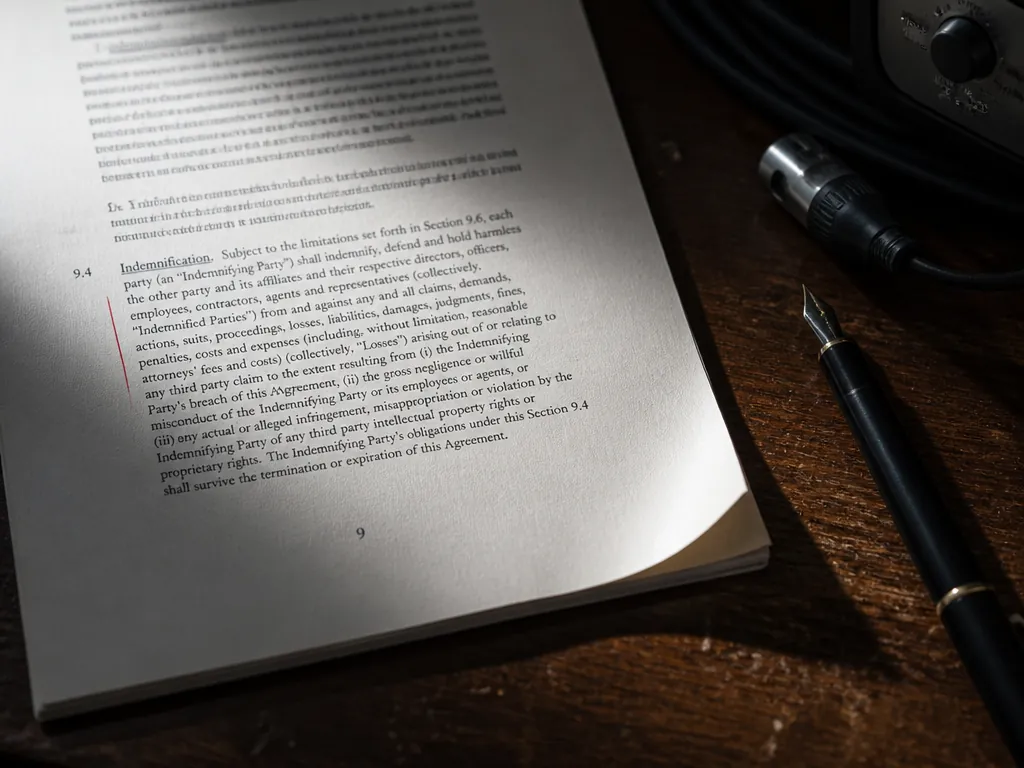
- "In all media now known or hereafter devised" — drafted decades ago for formats nobody had invented. Ask whether synthesis is inside or outside it, in writing.
- Training vs. use. Permission to train a model and permission to deploy its output are two grants. Separate them.
- Term and revocation. Perpetual and irrevocable means exactly that. A replica right that survives the project, the studio, and you is a different deal from a three-year license.
- Transfer. If the buyer sells the catalog, does the replica right go with it, and to whom.
- Compensation trigger. Per-use, per-title, or one buyout at session rate.
- Deletion. Who deletes the model, on what timeline, and how you'd ever know.
- Estate. Who decides after you, and for how long.
That is a reading list, not legal advice. Bring it to someone who does this for a living, and get answers on paper.
The harm no contract reaches
None of this touches the clip of a beloved character reading something vile, made in an afternoon by a stranger with a scraped model. The maker signed nothing. The actor's remedy is usually a platform's policy, not a court — and platform policy is a customer-service queue, not a right.
The practitioners I know are less exercised about lost bookings than about that queue. Being made to say things is a specific kind of injury, and it lands the same whether the target is a lead in a franchise or someone who narrates training videos. The volume differs. The nature of it doesn't. Making a stranger's voice say something they'd never say is not a neutral act, and no amount of "it's only a meme" makes it one.
From the other side of the glass
I still hire people. When I use a licensed voice model — and there are marketplaces where actors opt in, set boundaries, and get paid on use — the test I apply is dull and effective: did a named human agree to this specific deployment, and can they withdraw. Vendors' terms shift; read the current ones rather than the ones you read last year.
The technical honesty: clones are good at consistency and bad at intention. Level, sibilance, and room match are handled. What comes back thin is micro-timing — the breath before the bad news, the choice to underplay a line the script over-writes. For barks and menu prompts you may not care. For a character anyone is meant to love, you will hear it, and so will they.
So: not a copyright problem. That was never a loophole to celebrate — it's an address. Copyright protects what you made; this is about who you are, and the law that finally holds the line will have to be about people rather than property.
Not sure which tool to use?
Compare the top AI music and sound tools side by side — honest reviews, real pricing, no sponsorships.