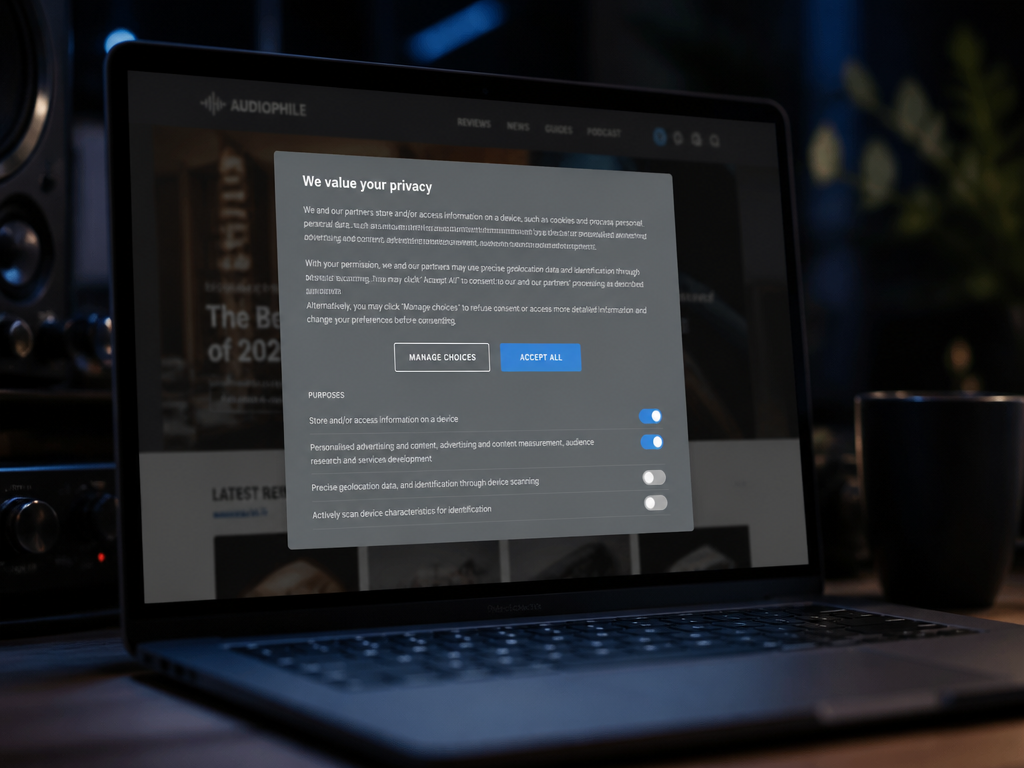
You followed a link to an industry report — something about international music markets in 2026 — and the report did not load. A privacy policy banner loaded instead. Grey overlay, a paragraph of measured legal prose, two buttons, and a third link that unfolds into a list of toggles. No audio. No headline. Nothing you came for. The thing standing between you and the content is a consent mechanism, and it runs before a single byte of editorial reaches your screen.
That wall is worth understanding, because you hit a version of it every time you open a new audio tool, sign up for a sample library, or embed a track from a platform you have never read the terms of. The privacy policy is not decoration. It is the visible edge of a process that decides what gets recorded about you while you work — and as a producer building commercial projects on these tools, the data trail is one of two legal surfaces you are standing on. The other is licensing, and people conflate the two constantly. They are not the same wall. Let us walk the mechanism in order: what happens first, what happens next, and what happens while you are actually working.
What you are actually looking at when the banner loads first
A privacy policy banner appears before the content because, under the EU's General Data Protection Regulation (GDPR) and its UK equivalent, certain kinds of data processing require a lawful basis established before the processing happens. For some categories that basis is your consent, and consent has to be obtained up front, freely, and unambiguously. So the consent gate renders first, the editorial renders second. The order is not an accident — it mirrors the legal sequence the operator is obligated to follow.
This is the part most people skim. The short version: a site that serves visitors in the EU or UK has to tell you what it collects, why, and on what legal grounding, and for the optional stuff it has to ask first rather than ask forgiveness. The banner is the asking. The longer document behind the "more information" link is the telling.
For you, the practical takeaway is that the banner is a signal about how the operator treats data generally. A vague, single-button "Accept" with no genuine reject option is a different posture than a layered panel that lets you decline analytics and still read the page. You can read the operator's seriousness from the architecture of its consent flow before you read a word of its prose.
First: the request arrives, and the gate decides what to ask
Here is the causal chain, in order.
When your browser requests the page, the server has to make a decision before it can lawfully drop anything onto your machine or start logging anything tied to you personally. It sorts its intended processing into buckets. Some of that processing it can do without asking — keeping you logged in, remembering items in a cart, load-balancing across servers, basic security. The operator relies on a lawful basis other than consent for those, usually that they are necessary to deliver the thing you requested. The gate does not ask permission for these because, legally, it does not have to.
Everything else — the processing that exists to serve the operator's interests rather than to deliver the page — has to clear a higher bar. Analytics that profile your behaviour across sessions. Advertising trackers. Pixels that report back to a social platform. Fingerprinting scripts that try to identify your device even without a cookie. For most of these, in most readings of the regulation, the operator needs your affirmative consent first. That is why those buttons exist and why they default — when the operator is doing it correctly — to off rather than on.
So the first thing that happens is a sort: necessary on one side, consent-required on the other. The banner you see is the consent-required side asking to proceed.
Next: the categories unfold, and each one means something different to you
Open the layered panel and you typically find three or four labelled groups. The names vary by operator, but the structure is durable across the regulated web. Understanding what each does matters more to you than to a casual reader, because you are often the one building a product on top of one of these platforms, and a tracker that follows your end users follows them into the game, the video, or the podcast you ship.

- Strictly necessary. No toggle, or a toggle locked on. This is the processing the site argues it cannot function without. You cannot decline it and still use the service, which is precisely why it is allowed to skip the consent step.
- Functional or preference. Remembers your language, your volume setting, whether you dismissed a tooltip. Usually optional, usually low-stakes.
- Analytics or performance. Measures how people move through the site. The operator's interest, not yours. This is the bucket where session recording, heatmaps, and cross-session profiling live.
- Marketing or targeting. The trackers that feed advertising and that share identifiers with third parties. The highest-stakes bucket, and the one most likely to follow your users beyond the page if you embed the operator's content.
The reason this enumeration matters to a working producer: when you embed a third-party player, pull in a font from a CDN, or drop in a "free" sample-library widget, you may be importing that operator's marketing trackers into your own project. Their consent obligations can become yours. A podcast page that loads an audio player which fingerprints listeners is now processing listener data, and the question of who is responsible — you, the platform, or both — is not one the banner answers for you.
During: what gets logged while you actually work
Consent governs the optional stuff. But a large amount of data processing happens on the necessary side, lawfully, without ever asking you, and as a producer this is the part that touches your sessions directly. Walk through a normal workflow on any cloud audio tool and watch the trail.
You open the tool and log in. Account data — email, hashed password, session token — is processed to authenticate you. You preview a loop. The request hits a content delivery network, which logs your IP, the timestamp, the asset, and your user agent, often for security and abuse-prevention reasons that sit on a lawful basis other than consent. You audition twenty variations of a render. The platform may log every generation, every prompt, every download, partly to operate the service and partly — depending on the operator — to improve its models. You download a stem pack as 48kHz WAV. That download is recorded against your account, which is how usage limits and license tracking get enforced.
Then there are the sub-processors: the third parties the operator hands your data to in order to run. The payment processor that handles your subscription. The email service that sends your receipt. The cloud host that stores the files. The analytics provider, if you consented. A competent privacy policy lists these by category and tells you where they sit geographically, because cross-border transfer of personal data carries its own requirements.
None of this is sinister by default. It is the ordinary machinery of running a service. But it is the machinery you are agreeing to operate inside the moment you click through, and if you are building something you intend to sell, you want to know what is being logged about your process and, more importantly, whether anything you input — a vocal stem you recorded, a melody you uploaded as a reference — is being retained or used to train a model. The privacy policy is where that answer lives, in the data-retention and the purposes-of-processing sections, which almost nobody reads and which almost always reward reading.
The two walls people conflate: data and rights
Here is the distinction that trips up producers more than any GDPR clause. There are two separate legal surfaces in front of you, and they are easy to confuse because both arrive as a wall of small print.
The first is the privacy surface — the consent banner, the data-processing terms. It governs information about you: your identity, your behaviour, your inputs. GDPR lives here.
The second is the licensing surface — the terms of use, the license grant. It governs what you are allowed to do with the output: the track you generated, the sample you downloaded. Copyright and contract law live here.
Consenting to data processing tells you nothing about whether you can use the audio commercially. Accepting a license grant tells you nothing about what the operator logs while you work. A tool can have an exemplary privacy policy and a license that forbids commercial use, or a permissive license and a privacy posture that hoovers up everything you touch. You have to read both, separately, for different reasons. The banner that loads first is the data wall; the license you have to find in the terms is the rights wall.
A pre-build checklist for any audio tool's privacy policy
Before you commit a paying project to a platform you have not vetted, read its privacy policy for these specific things. This takes about ten minutes and saves the kind of problem that surfaces after you have shipped.
- What it logs about your inputs. Does it retain the prompts, reference uploads, or recordings you feed it? For how long?
- Whether your inputs train its models. Look for "improve our services," "model training," or an opt-out. If you are uploading proprietary or client material, this matters.
- The sub-processor list. Who else touches your data — payment, hosting, analytics, email — and where are they located.
- Cross-border transfer. If you or your client operate under EU/UK rules, check whether data leaves the region and on what mechanism.
- Retention periods. How long account data, logs, and generated files persist after you delete a project or close your account.
- Your rights and how to exercise them. Access, deletion, portability. A policy that names a real contact for these is a better sign than one that points at a form into the void.
- The consent default. Did the banner pre-tick the optional boxes? That alone tells you how the operator reads its obligations.
And the comparison that earns a table — what each consent category actually means for a commercial project you are about to build:
| Consent category | What the operator does | What it means for your project |
|---|---|---|
| Strictly necessary | Auth, security, delivery | Unavoidable; check retention, not consent |
| Functional | Remembers preferences | Low stakes; rarely affects deliverables |
| Analytics | Profiles usage behaviour | If you embed their player, this can follow your end users |
| Marketing | Shares identifiers with third parties | Highest stakes; can import tracking obligations onto you |
Where the foundry sits in this
City of Punk publishes The Signal and also runs a neural sound foundry, so it is fair to ask where a tool like ours falls on these two walls. The honest framing: a sound source you build commercial work on should be clear about both surfaces — what it does with the audio you make (the license) and what it does with the data you generate while making it (the privacy policy). Those are the two questions worth asking of any generator you put in your pipeline, ours included, and they are answerable from the documents, not from the marketing.
The reason commercial-safety is the recurring theme on this publication is that producers get burned at the seam between these two walls. A library is "royalty-free" but its privacy terms let it claim a license to your uploaded reference material. A generator's output is yours, but its data policy logs and retains your prompts indefinitely. Read for the seam. The clean answer is a tool where the output is unambiguously yours to ship and the data terms do not quietly take more than they need to run.
If your immediate problem is a build that needs adaptive loops by Friday and you have no time to clear samples, the privacy policy is the second thing to read — after you have confirmed the license actually permits the commercial use you intend. Get the rights wall right first, then the data wall. Both, before you commit.
What this did not answer, and where to look next
This walked the mechanism — request, sort, consent, processing — and the producer-facing reading of it. It did not tell you which lawful basis a specific operator should be relying on for a specific kind of processing, because that turns on facts and jurisdiction this piece cannot see. It did not cover how enforcement actually plays out, which varies by regulator and by country and changes faster than any article can track. It did not give you legal advice, and nothing here is a substitute for it — when a real client contract or a cross-border deployment is on the line, that is a lawyer's question, not a banner's.
It also did not resolve the licensing wall, the one that decides whether you can sell the track at all. That is the larger of the two for most producers, and it has its own causal chain — Content ID, license tiers, stem rights, the difference between royalty-free and rights-managed. Read the data policy to know what is recorded about you. Read the license to know what you are allowed to ship. The banner that loads first only ever answered the first question; the answer you actually came for is one wall further in.
Not sure which tool to use?
Compare the top AI music and sound tools side by side — honest reviews, real pricing, no sponsorships.